


By Archie Boan
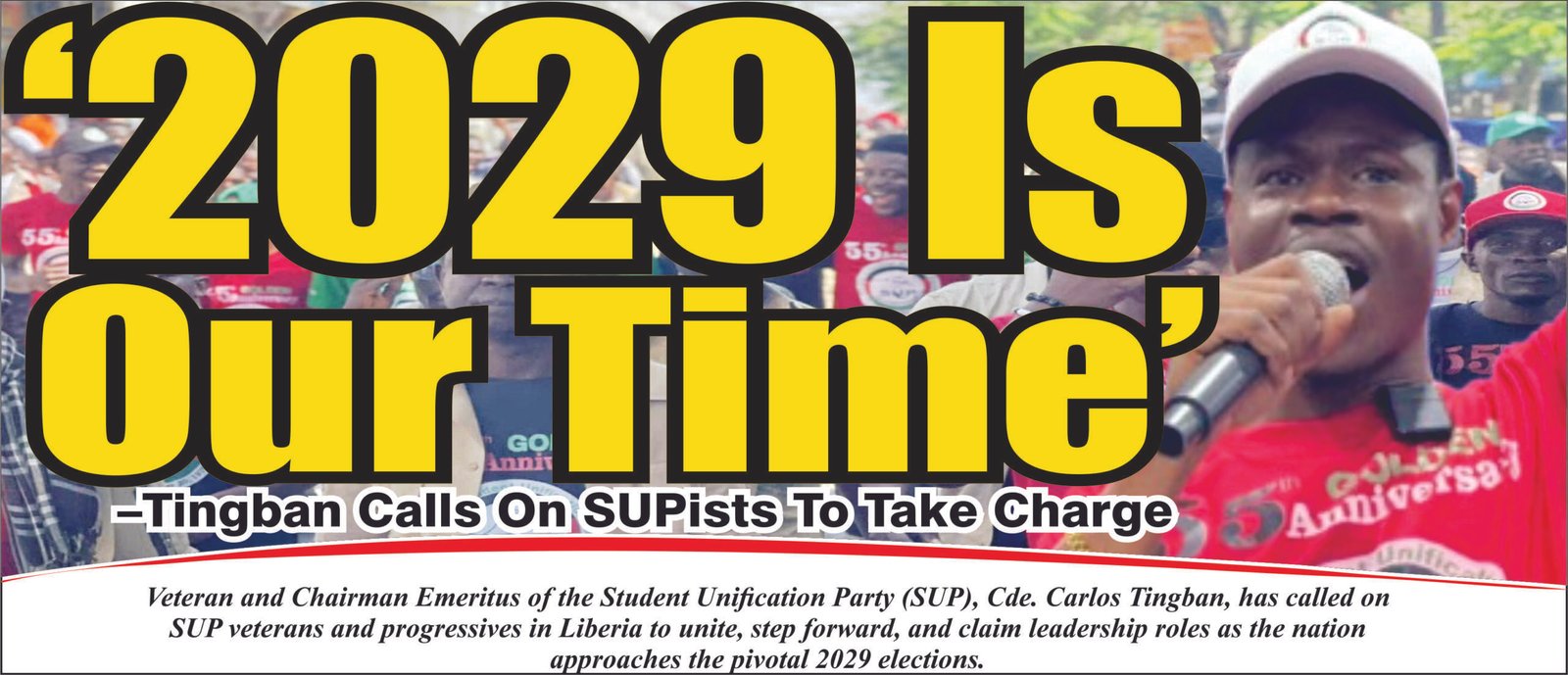
Monrovia, Liberia – Veteran political leader and Chairman Emeritus of the Student Unification Party (SUP), Carlos Tingban, has called on Liberia’s progressive youth and SUP veterans to step forward and claim leadership roles as the nation approaches the pivotal 2029 elections. His message was delivered on Friday during the 55th Anniversary celebrations of the iconic campus-based movement, widely recognized for shaping Liberia’s political landscape (SUP).
Speaking to a gathering of current militants, alumni, advocacy groups, and national stakeholders, Tingban described the occasion as an opportunity to reflect on the Movement’s legacy while preparing for a transformative future.
“2029 is not just another election cycle. It is a future demanding our participation and leadership,” Tingban asserted. “Progressive youth and SUP veterans can no longer occupy the margins of society. It is time to lead with ideology, discipline, and the unmatched experience that has guided us through decades of struggle.”
He called on SUP members to pursue electable offices, influence public policy, and assert leadership in academia, civil society, industry, and government. According to Tingban, the Party’s long-term vision must extend beyond politics alone, aiming to shape Liberia’s institutions with the same discipline that has sustained the Movement for over half a century.
In his remarks, Tingban commended President Joseph Boakai for what he described as “significant achievements” during his tenure, crediting part of the administration’s progress to the involvement of SUP veterans in key positions. “The 2029 elections present an opportunity for the SUP to expand its influence in national governance,” he said, emphasizing the need to strategically occupy legislative and executive spaces.
Tingban also stressed that revolutionary movements thrive only on discipline and organizational cohesion. Drawing from the principle of democratic centralism—a guiding philosophy of the SUP—he urged members to embrace unity over individualism.
“Party discipline must be reinstated and popularized. Freedom comes with responsibility, and revolutionary work succeeds when we act together,” Tingban said. “Integrity must remain at the core of our ethos. Power should never poison purpose.”
A significant portion of the ceremony was dedicated to honoring the sacrifices of SUP veterans who faced harassment, intimidation, and exile for their activism. Tingban paid special tribute to activist Martin K. N. Kollie, describing him as a “pillar of the Movement” whose commitment endured despite years of political persecution.
He also recognized Christopher Walter Sisulu, recalling the brutal attack that left him beaten and humiliated, allegedly by forces linked to the ruling CDC. Tingban lamented that Sisulu, like Kollie, now lives in exile.
“These comrades are not just names in history books; they are pillars of the Movement—embodiments of courage, ideological purity, and patriotic service,” Tingban said. He urged the Party to reconnect with veterans living abroad and ensure that their contributions are honored and remembered.
Reflecting on SUP’s 55-year history, Tingban described the Movement as “not old, only rich with experience,” emphasizing its resilience, evolution, and unwavering commitment to its founding ideals. He challenged the next generation of SUP leaders to build on this legacy.
“Let us honor our past with action, take charge of the present with courage, and shape the future with the thunderous voice of the people we serve,” he concluded to resounding applause.
The anniversary celebration highlighted the enduring impact of student activism in Liberia and reinforced the SUP’s ambition to remain a key driver of political and social transformation in the country.