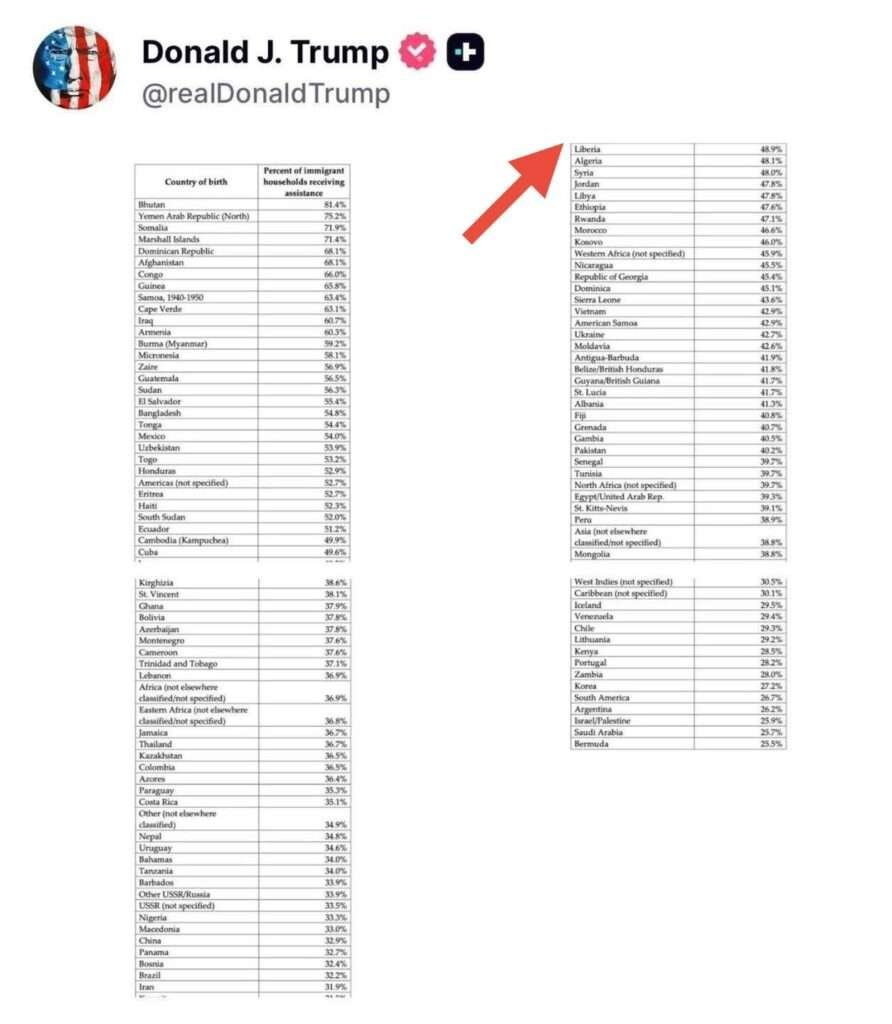



President Trump has published a list of citizens from countries receiving welfare in the USA.
The list shows that 48.9% of all Liberian immigrant households in the USA are receiving welfare. Bhutan 81.4%; Yemen 75.2%; Somalia 71.9%.
A statistical chart circulated by President Donald J. Trump on social media this week has drawn particular attention to Liberia, ranking it among the countries with the highest percentage of immigrant households in the United States receiving public assistance.
According to the figures, nearly half of Liberian immigrant households—48.9 percent—are reported to receive some form of welfare.
The chart ranks countries of birth by the share of immigrant households participating in public assistance programs.
While several countries show higher rates, including Bhutan, Yemen, and Somalia, Liberia’s placement near the top has fueled discussion about the economic circumstances of Liberian immigrants in the United States.
The figures, attributed to U.S. government survey data, appear to combine participation in a range of programs, including Medicaid, food assistance, housing subsidies, and other welfare-related benefits.
Supporters of the president argue that the data raises concerns about the long-term fiscal impact of immigration and the need for policies that emphasize economic self-sufficiency.
However, economists and immigration researchers caution that the Liberia figure requires careful interpretation. The data refers to households, not individuals.
If any member of a household receives assistance, the entire household is counted as participating. In many Liberian immigrant families, U.S.-born children are eligible for benefits even when adult immigrants face restrictions.
Liberia’s immigration history also plays a significant role. Many Liberians arrived in the United States as refugees or under-protected status after years of civil war and political instability in their home country.
Refugees are often eligible for temporary assistance upon arrival, which can elevate welfare participation rates in the short term.
Critics further note that the chart circulated online contains apparent inconsistencies, including spelling errors and unclear classifications, raising questions about how the data was presented and whether important distinctions were omitted.
Research by the U.S. Census Bureau and independent institutions have consistently shown that welfare use among immigrant groups, including Liberians, tends to decline over time as employment increases and households stabilize.
Long-term studies also indicate that immigrants generally contribute more in taxes than they receive in public benefits over their lifetimes.
As immigration remains a contentious issue in American politics, Liberia’s placement on the list illustrates the broader debate over how welfare statistics are used—whether as evidence of systemic strain or as a snapshot of temporary challenges faced by communities rebuilding their lives in the United States.