
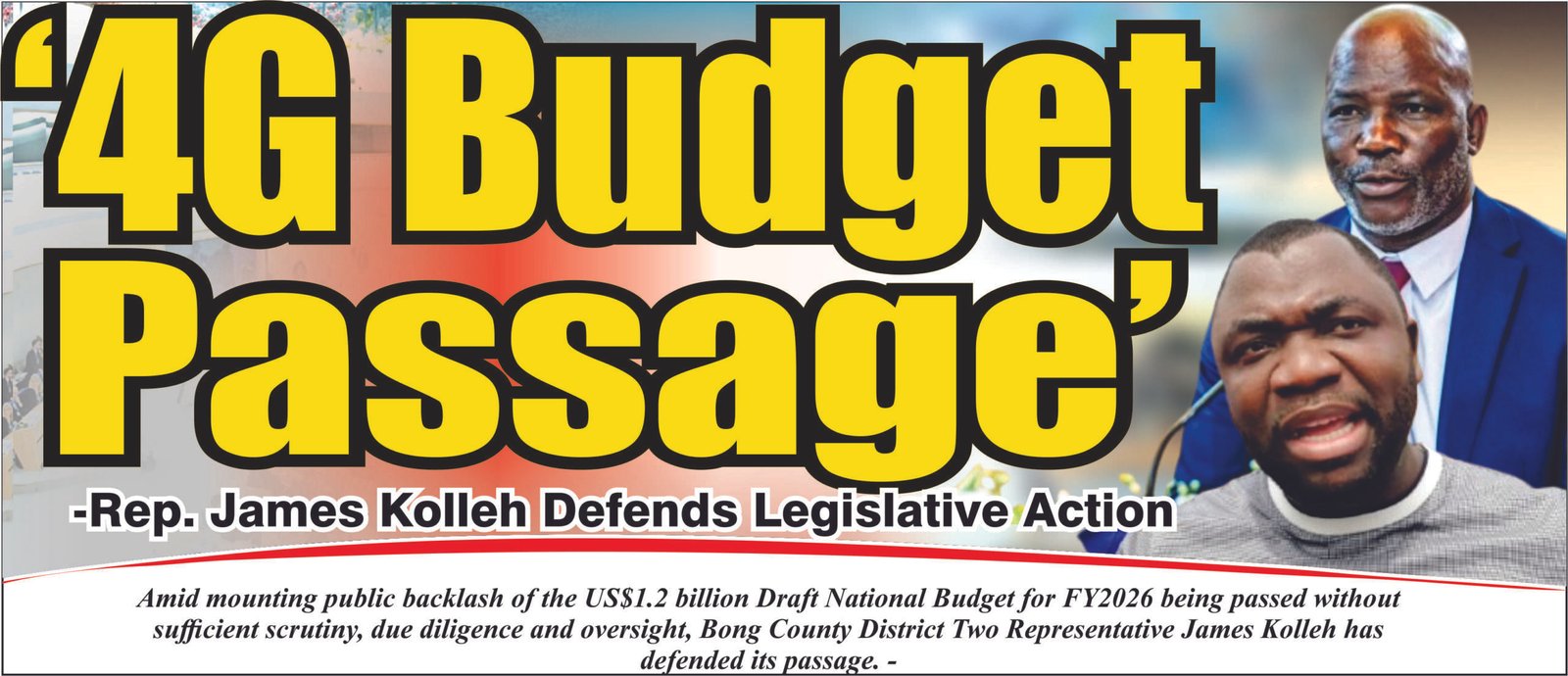
Amid mounting public backlash of the US$1.2 billion Draft National Budget for FY2026 being passed without sufficient scrutiny, due diligence and oversight, Bong County District Two Representative James Kolleh has defended its passage.
Representative Kolleh’s comments came in response to concerns raised by Gbarpolu County Senator Amara Konneh, who criticized the House of Representatives for approving the budget too quickly and without what he described as a thorough review.
According to Kolleh, the national budget is not prepared “in a vacuum,” but through extensive consultations between the Executive Branch and relevant legislative committees, particularly the House Committee on Ways, Means and Finance.
“The budget is an annual instrument, and it is prepared by the Executive in consultation with the Ways, Means and Finance Committee,” Kolleh said. “Every county in Liberia is represented on the budget committee, and those representatives are responsible for informing their respective legislative caucuses about what is contained in the budget.”
He explained that county representatives on the committee routinely brief their colleagues on allocations, challenges, and funding gaps affecting their constituencies. This process, he noted, often results in lawmakers submitting requests on the House floor for adjustments to institutional budget lines.
Addressing criticism regarding the time spent reviewing the budget, Kolleh said lawmakers are constrained by constitutional and operational deadlines.
“People say it took 50 days to review 736 pages,” he said. “But if the Legislature delays the budget for weeks or months how do you expect the government to operate? Will the government collapse?”
Kolleh further pointed to constitutional provisions that prevent one chamber of the Legislature from sitting in the absence of the other for more than five days, arguing that this limitation required the House to act when it did.
“If the Senate cannot pass the budget, the Legislature will be recalled, and recall comes with conditions,” he said. “Is the Executive prepared to meet those conditions?”
The Bong County lawmaker emphasized that the national budget, which runs from January to December, must be enacted before the start of the new fiscal year to ensure continuity of government operations. Any delay, he warned, could disrupt salary payments, procurement processes, and the implementation of development projects.
“By January 2026, the current budget should already be in execution,” Kolleh said. “If we delay, do we operate on partial salaries only? What happens to government operations and projects?”
Kolleh also noted that national budgets often share similarities from year to year, as they are built on existing government structures and programs, with adjustments made where necessary.
He maintained that the House fulfilled its constitutional mandate by scrutinizing the budget through committee deliberations, increasing allocations where justified and reducing them where funds were deemed unnecessary.
“The Senate has its own constitutional responsibility,” Kolleh said. “We have done ours. I cannot say what the Senate will do, because I do not have the authority to speak for them.”
The proposed 2026 National Budget has since been forwarded to the Liberian Senate for consideration as part of the bicameral legislative process.