
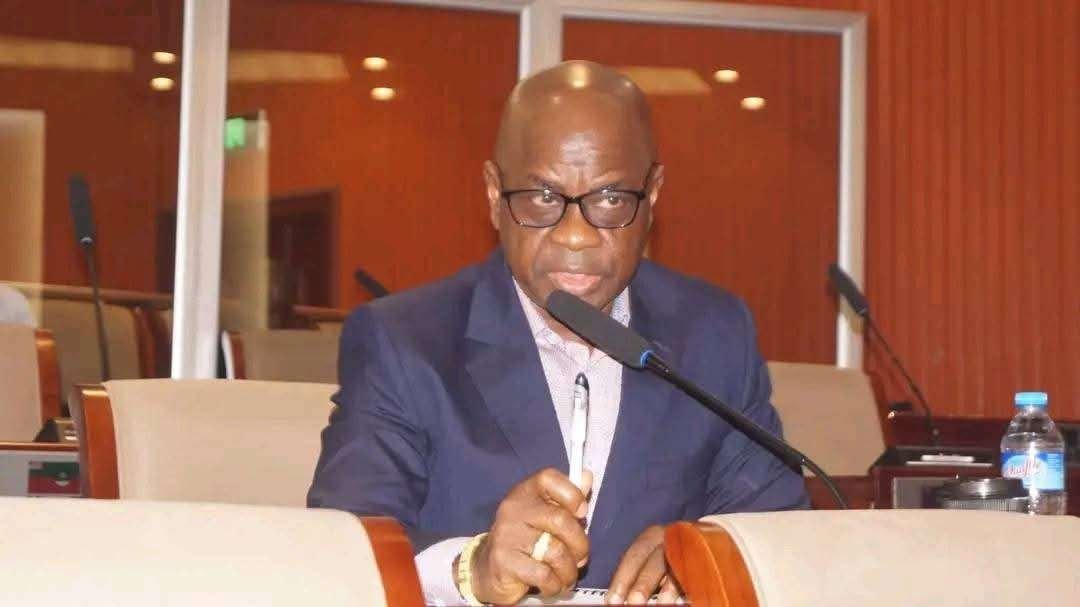
The Office of Senator James Emmanuel Nuquay, Senior Senator of Margibi County, has issued a forceful response to what it describes as a “series of shameless lies” made by businessman and politician Musa Hassan Bility during a recent appearance on Action TV.
In a statement released on December 1, 2025, Senator Nuquay’s office accused Bility of launching “an angry barrage of fabrications” and challenged him to provide documentary evidence for each of his allegations or publicly retract them.
“Truth produces evidence; lies produce excuses,” the Senator’s office declared.
“Musa Bility is a pathological liar who thinks so little of the Liberian people that he believes he can spew fabrications and have them accepted as truth.”
The statement outlined a point-by-point rebuttal to eight claims Bility reportedly made during the broadcast.
Nuquay Rebuts Bility’s Claims
Claim 1: Bility has been “taking care of” Nuquay for 5–10 years
Senator Nuquay dismissed the assertion as baseless, asking why—among many petroleum dealers—only Bility would have taken on such a role.
“This is not friendship betrayed. This is theft disrupted,” the Senator’s office said, alleging that Bility grew hostile after legislative oversight exposed irregularities in the petroleum sector.
Claim 2: Bility bought the Senator a vehicle
Nuquay said no such purchase ever occurred and challenged Bility to produce vehicle registration, customs records, or a title.
“A car without documents is like a shadow without a body—it doesn’t exist.”
Claim 3: Bility has records proving financial support
Nuquay called the claim “imaginary,” demanding evidence such as bank transfers or receipts.
“If you have records, produce them.”
Claim 4: Bility managed Nuquay’s public relations during the Speaker race
Nuquay described the claim as “laughable,” noting he was elected Speaker on a white ballot—without need for PR maneuvering.
The Senator’s office further questioned Bility’s involvement in legislative leadership battles.
Claim 5: Bility contributed over US$300,000 during the 2017 campaign
Nuquay flatly denied the allegation, pointing out that Bility supported other political interests at the time.
“Campaign contributions of that magnitude appear in NEC records. He didn’t give me a dime.”
Claim 6: Bility supported him after the election
The Senator’s office rejected this as a “fabricated relationship,” adding:
“There was no support because there was no arrangement.”
Claim 7: Nuquay owns property under other people’s names
Nuquay demanded evidence such as deed records or registry filings.
“Put up or shut up.”
Claim 8: Nuquay targeted Bility because he sought a legislative audit
The Senator’s office said records show otherwise, noting that the Senate—not the House—initiated the audit.
Nuquay Explains “Real Reason” for Bility’s Anger
The statement argues that the root of the dispute lies in petroleum-sector reforms initiated through the Senate Committee on Public Corporations, chaired by Nuquay.
According to the Senator’s office, the reforms corrected long-standing irregularities—including inflated storage charges and embedded regulatory fees—and redirected US$0.11 per gallon of fuel into a County Road Development and Maintenance Fund.
The fund is expected to generate approximately US$16.5 million annually, with every county receiving more than US$1.1 million for road infrastructure.
“This reform did not create new taxes—it reclaimed public value that had been buried inside private petroleum charges,” the Senator’s office stated.
“What once funded hidden private profit now funds public roads.”
The office argued that while several importers were affected by the new reforms, only Bility responded with what it described as “public rage, defamation, and fabricated sponsorship claims.”
Senator’s Challenge to Bility
The statement concluded with a firm demand:
“If evidence exists to support any of the accusations now being flung in public, let it be produced before the law—openly and formally. If not, the noise will collapse.”
As tensions escalate between the two public figures, the controversy highlights broader scrutiny of Liberia’s petroleum sector and the political fallout of ongoing reform efforts.