

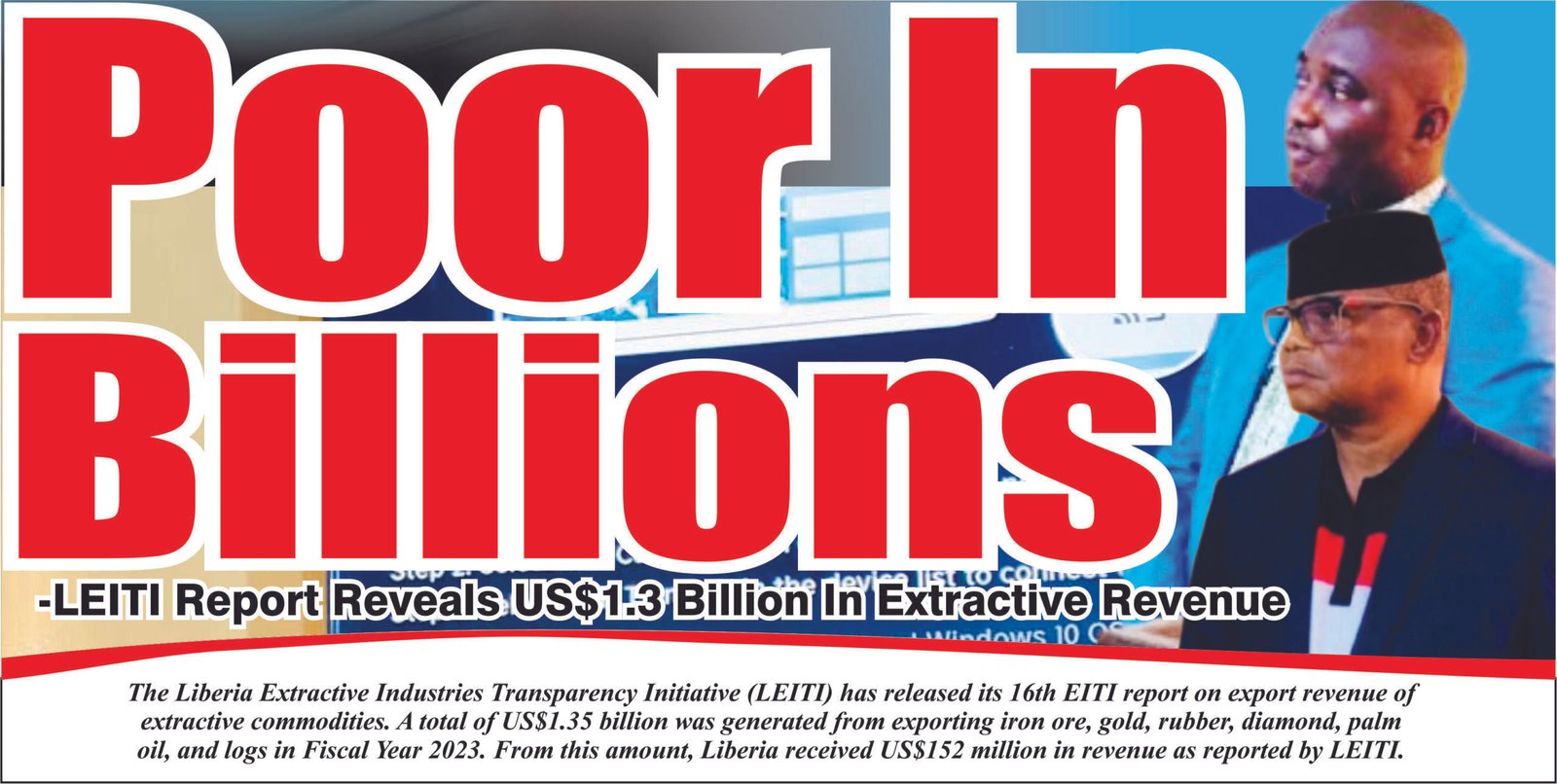
The Liberia Extractive Industries Transparency Initiative (LEITI) has released its 16th EITI report on export revenue of extractive commodities. A total of US$1.35 billion was generated from exporting iron ore, gold, rubber, diamond, palm oil, and logs in Fiscal Year 2023. From this amount, Liberia received US$152 million in revenue as reported by LEITI.
Liberia is poor by design, and that design sits inside our extractive policy regime. We are entertaining poverty instead of ending it.
The LEITI 16th Report exposes this policy failure with striking clarity.
According to the report, “total exports from the extractive sector in FY2023 amounted to approximately US$1.352 billion, while total revenues accruing to the Government of Liberia stood at US$152.46 million.” This places the public capture rate at roughly 11 percent. Evidently, no country survives on crumbs from its own natural resources.
The export composition tells a powerful story.
Gold exports alone reached US$660.34 million. Iron ore followed at US$482.7 million. Diamonds contributed US$17.91 million, rubber US$103 million, and crude palm oil US$82.79 million, as detailed in the LEITI report.
These figures should form the backbone of national development.
Instead, government revenue from these same extractions tells a very different story. LEITI reports that mining yielded US$121.49 million, agriculture US$23.97 million, forestry US$6.45 million, while oil and gas generated only US$0.55 million.
As the report notes, “the value of extractive exports remains disproportionate to revenues retained by the State.”
This is not development.
It is extraction without nation-building.
One company alone exported US$691 million in gold, yet the state received only a fraction. Another exported more than US$271 million in iron ore, while the treasury remained thin. These outcomes are not accidental-they are structural.
Planning Against Reality
I witnessed this contradiction firsthand in senior government meetings. We debated poverty reduction while conceding fiscal power upstream. We planned social programs while extractive contracts drained the revenue base needed to fund them.
Years later, the contradiction remains-and so does poverty.
Liberia cannot meaningfully reduce poverty while surrendering the economic value of its resources at the point of extraction.
Jobs That Do Not Match the Wealth
The employment data reinforces another poverty contradiction. The LEITI report states that “the extractive sector employed a total of 19,345 persons in FY2023.” Of this number, only 2,743 were women, while 16,602 were men. Alarmingly, one gold company alone employed 1,110 foreign permanent workers.
Billions leave the country, but employment opportunities for Liberians remain scarce. This is an enclave economy-capital-intensive, foreign-dominated, and disconnected from the broader population. It is not sustainable if Liberia seeks a fair and equitable system of public governance.
Governance Failures Complete the Cycle
Governance failures seal the deal. The LEITI 16th Report flags “questionable transactions and compliance gaps” involving the Liberia Petroleum Regulatory Authority, ArcelorMittal Liberia, and the Liberia Revenue Authority. These matters were forwarded to anti-corruption institutions, yet remain unresolved.
This is how poverty is engineered:
Weak oversight
Contracts tilted away from the state
Leakage treated as routine
Transparency without enforcement becomes illusion. Disclosure without consequence feeds complacency
Lessons from Elsewhere
Other countries made different choices.
Botswana secured state equity through Debswana and captures over 50 percent of diamond value.
Chile uses state participation and royalties through Codelco to stabilize public finances.
Norway built direct ownership and converted oil rents into a sovereign wealth fund now exceeding US$1 trillion.
Liberia, by contrast, chose minimal equity, flat royalties, and grant dependence. This reflects shortsighted policymaking and a failure to protect intergenerational equity.
The Questions We Must Answer
Why should a resource-rich country depend on grants for basic services?
Who benefits from an 11 percent capture rate?
Why does the state fear contract renegotiation more than mass poverty?
Poverty persists because extractive wealth escapes through bad contracts and lost revenues. Development stalls because policymakers protect concessions, not citizens. This is not accidental-it is a model that sustains political and economic cleavages instead of ending poverty.
Liberia cannot fight poverty with transparency alone. We cannot export US$1.35 billion and rely on donors to fund clinics. We cannot preach reform while extractive contracts starve the treasury.
Until Liberia shifts from a concession culture to value retention, poverty will remain unchanged. Until the state rightly claims equity, fair taxation, and control, economic development and poverty reduction will remain slogans.
The choice is ours: Do what is right, or remain eternally poor.