
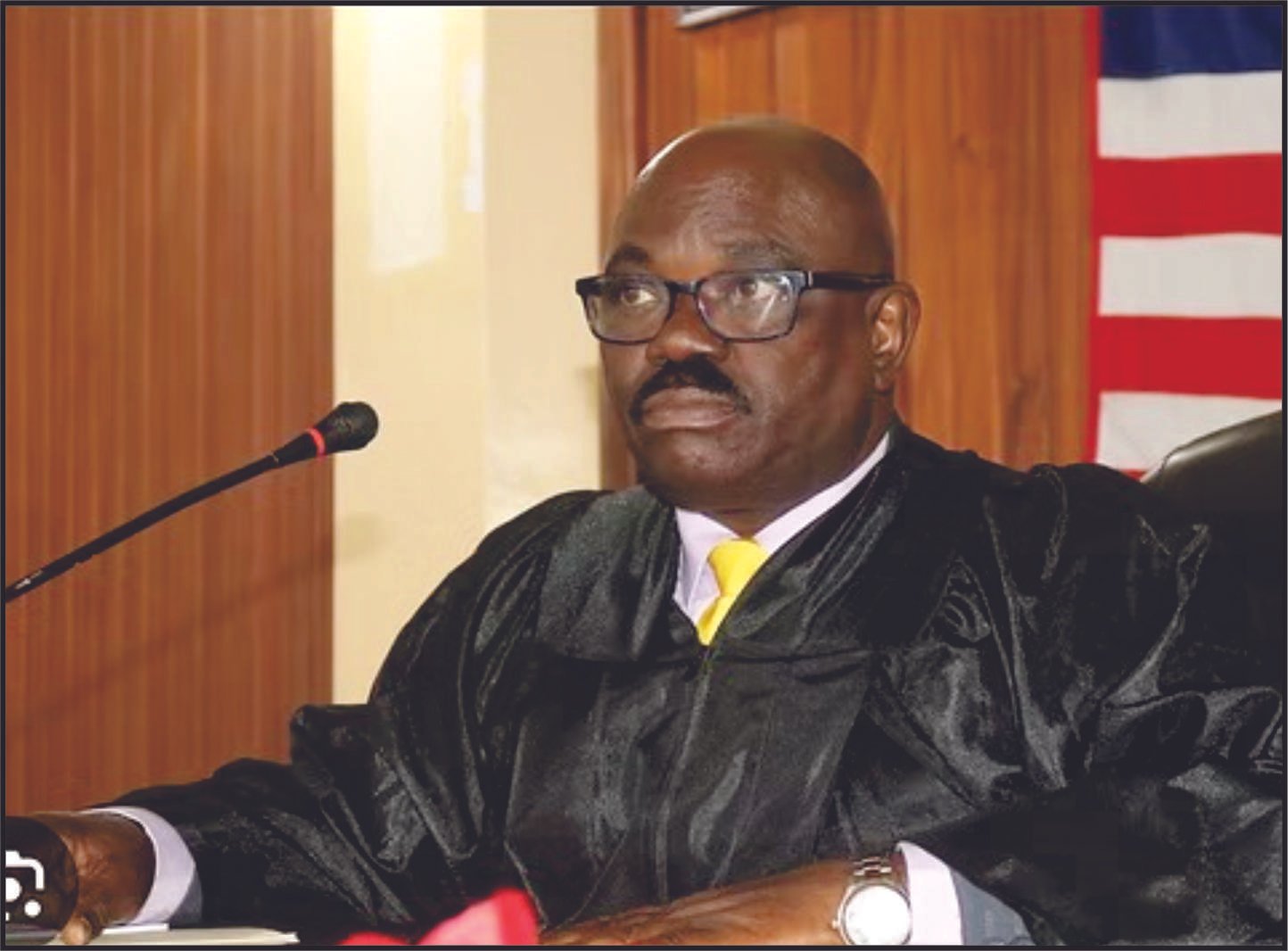
Proceedings at Criminal Court “A” at the Temple of Justice briefly paused after defense lawyers played what they claimed was an artificial intelligence–generated audio clip mimicking the voice of U.S. President Donald Trump, drawing an immediate objection from state prosecutors.
The defense team, headed by Cllr. Arthur T. Johnson, played the audio for several minutes to illustrate how AI technology can be used to fabricate or manipulate voice recordings.
The demonstration was intended to bolster the defense’s argument that audio evidence submitted by the prosecution could be unreliable.
Prosecutors objected on multiple grounds, and Judge Roosevelt Z. Willie upheld the objection, ruling that any audio material must be formally disclosed to the court before being introduced.
Defense Questions Credibility of Audio Evidence
The incident followed testimony given on Thursday, December 18, 2025, by prosecution witness Reafeal Wilson.
Wilson told the court that during the investigation, the defendants claimed the audio recordings attributed to them were created using AI tools.
According to Wilson, defendant Abu Kamara asserted that producing similar recordings would be easy, even for a child with access to artificial intelligence software.
Cllr. Johnson argued that the prosecution failed to provide proper forensic authentication of the recordings, making them unreliable in a criminal trial.
When questioned by Judge Willie about the distinction between real and AI-generated voices, Johnson explained that AI systems can replicate human speech by training on existing audio samples.
Attempted AI Demonstration Rejected
On Friday, December 19, 2025, the defense sought to reinforce its argument by playing the alleged AI-generated recording attributed to President Trump.
The audio purportedly included remarks addressing Liberia and asserting the innocence of an individual named Etheridge.
The courtroom reacted visibly to the recording, but Judge Willie ruled that the defense had erred by failing to notify the court in advance.
A legal observer noted that the attempted demonstration highlighted the dangers of relying on unverified digital evidence, cautioning that improperly authenticated audio could severely undermine a criminal case.
Court Bars Political Line of Questioning
In a separate matter, the defense questioned Wilson about the conduct of the Liberia National Police (LNP) during the recent House of Representatives leadership dispute.
Johnson asked whether police actions during the removal of the Speaker’s chair were lawful, citing a Supreme Court decision involving former Speaker J. Fonati Koffa and rival Speaker Richard Koon.
The prosecution objected, and the court sustained the objection.
The defense further alleged that the LNP took sides during the legislative crisis, accusing officers of assaulting lawmakers aligned with former Speaker Koffa.
Johnson claimed Wilson supported what the defense described as an “illegal majority bloc” and participated in actions against minority legislators.
Dispute Over Source of Recordings
When asked about the origin of the contested audio recordings, Wilson testified that they were obtained from open sources and media platforms.
The defense countered that materials sourced from social media are inadmissible in criminal proceedings without independent corroboration and forensic verification, especially given advances in AI technology.
The trial continues as the court confronts complex questions surrounding artificial intelligence, digital evidence, and evolving standards of admissibility.