


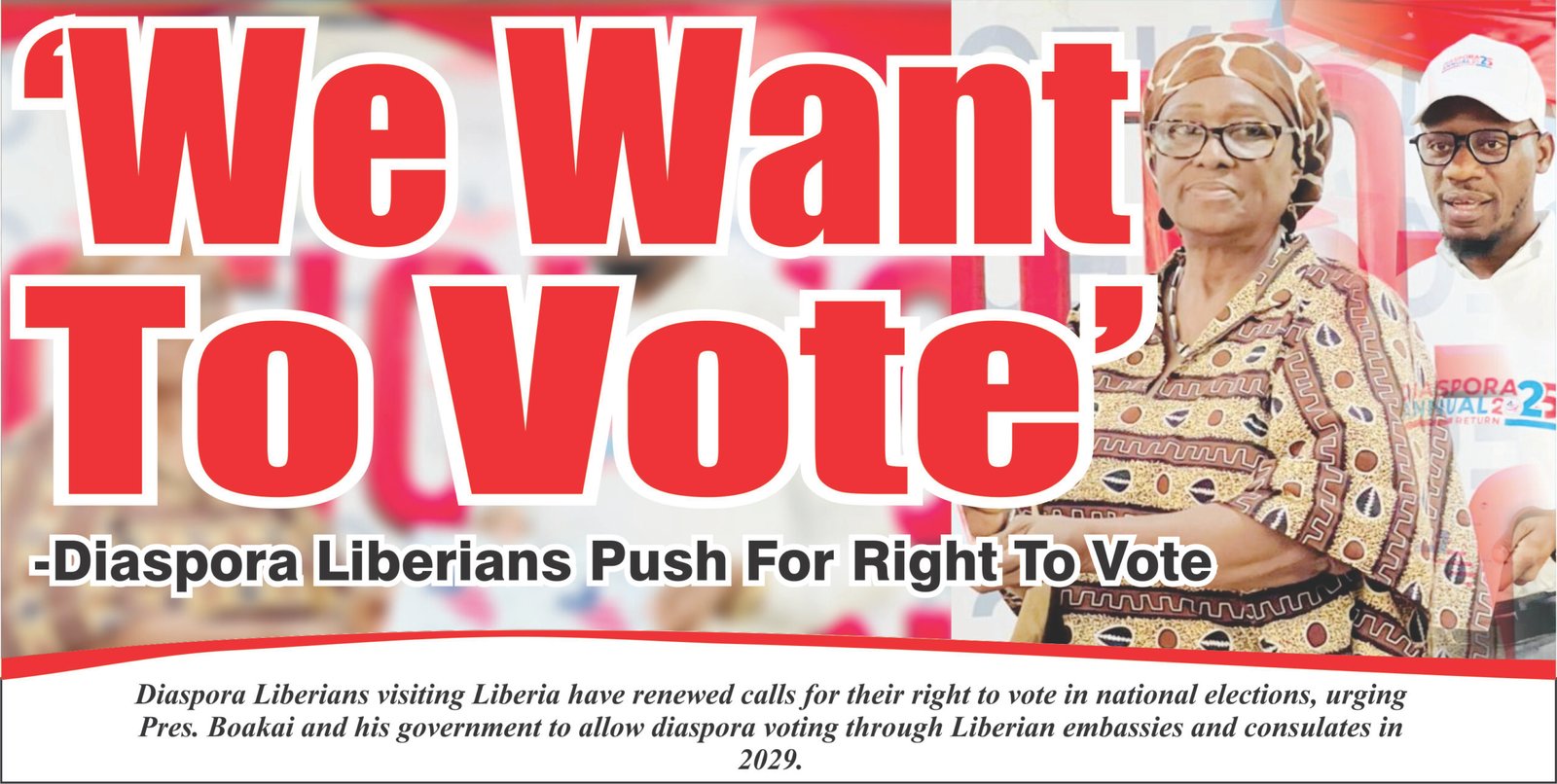
Monrovia, Liberia — Diaspora Liberians visiting Liberia have renewed calls for their right to vote in national elections, urging President Boakai and his government to allow diaspora voting through Liberian embassies and consulates, as debates intensify over constitutional provisions, election laws, and dual citizenship.
Speaking at the meeting, Minister Erasmus T. Williams, Head of Diaspora Affairs, said the demand was underscored during high-level engagements with the National Elections Commission (NEC), where diaspora representatives argued that their sustained financial and social contributions to Liberia particularly through billions of dollars in annual remittances entitle them to full political participation in the nation’s democratic process.
“Our people abroad remain Liberians,” one diaspora representative said. “Yes, some may have acquired other citizenships, but that does not erase their Liberian identity or their stake in the future of this country.”
Dual Citizenship Not a Barrier to Voting
Addressing concerns over dual citizenship, NEC’s Legal Counsel clarified that dual citizenship does not prevent Liberians from voting, stressing that it only becomes an issue when a person seeks to contest for elected public office.
Citing Article 18(c) of the Constitution and Section 3.1 of the New Elections Law, the Legal Counsel explained that every Liberian citizen aged 18 and above who is of sound mind and not convicted of an infamous crime has the right to register and vote in public elections.
“Dual citizenship is a non-issue when it comes to voting,” the Legal Counsel said. “The law only restricts dual citizens when they seek elected office, not when they exercise their franchise.”
Registration Is the Key Hurdle
NEC officials, emphasized that the central legal requirement for voting is registration. As the law currently stands, Liberia has 73 electoral constituencies, and any qualified citizen registered in one of those constituencies during the official registration period is eligible to vote.
However, NEC acknowledged that existing laws do not explicitly provide a framework for overseas registration, making legislative action essential.
“If the Legislature creates a mechanism whether through embassies or by designating additional constituencies NEC will regulate and implement it,” an NEC official stated.
Embassies as Extensions of the Republic
One proposal gaining traction is the use of Liberian embassies as extensions of national territory for voter registration, a system already practiced by several countries worldwide.
“Embassies are part of the Republic,” the NEC Legal Counsel noted. “With the proper legal backing, registration and possibly voting could take place there.”
NEC Chair Calls for Early Action
NEC Chairperson Madam Davidetta Browne Lansanah welcomed the dialogue, describing it as timely and necessary, especially with the 2029 general elections approaching.
She cautioned, however, that implementing diaspora voting would require:
Clear legislative amendments
Collaboration with the Ministry of Foreign Affairs
Accurate data on diaspora populations
Adequate funding and long-term planning
“Good elections require between 18 and 42 months of preparation,” Lansanah said. “If this is to happen, the conversation must begin now.”
Human Rights and Universal Suffrage
Several commissioners framed diaspora voting as a matter of human rights and universal suffrage, stressing that no citizen should be left behind if the law can reasonably accommodate inclusion.
While no immediate roadmap has been adopted, NEC confirmed that it is open to continued engagement and awaits clear legislative direction to move forward.
As the debate unfolds, one question continues to dominate public discourse: Should Liberians abroad enjoy the same voting rights as citizens living overseas in countries like the United States?
For many, the answer appears increasingly clear especially in a nation where today’s resident could become tomorrow’s member of the diaspora.