


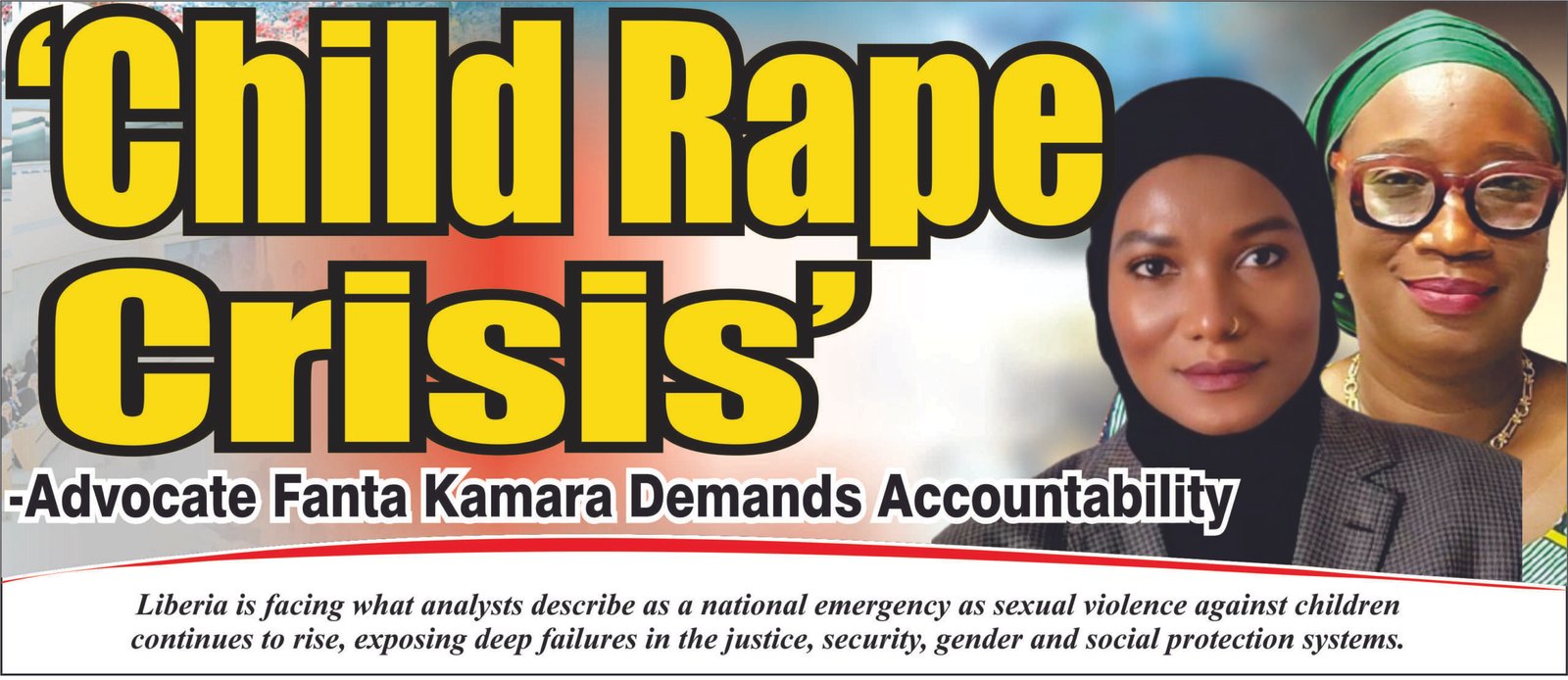
Liberia is facing what analysts describe as a national emergency as sexual violence against children continues to rise, exposing deep failures in the justice, security, gender and social protection systems.
Geopolitical analyst and governance advocate Fanta Kamara has issued a stark warning, describing the crisis as “Liberia’s most shameful and persistent human rights failure,” driven by weak enforcement, institutional protection of perpetrators, and the collapse of forensic accountability.
According to data from the Ministry of Gender, Children and Social Protection, supported by reports from the United Nations Development Programme (UNDP), the World Health Organization (WHO), and the U.S. State Department, Liberia recorded 3,381 reported cases of sexual violence in 2024, a 20 percent increase from 2023. Projections for 2025 indicate the number could exceed 3,500 cases, translating to more than nine victims per day most of them children.
International partners estimate that only about 12 percent of sexual violence cases are formally reported, meaning the true scale of abuse remains largely hidden.
Children as Primary Victims
Available data reveal that 83 percent of sexual violence victims are under the age of 20, with 39 percent fewer than 12 and one in ten under the age of five. Experts note that while Liberia’s civil war ended more than two decades ago, sexual violence has remained entrenched, cutting across communities, institutions, and social classes.
Equally troubling is the identity of perpetrators. Reports show that 85 percent of offenders are known to their victims, including relatives, teachers, community members, and, increasingly, public officials entrusted with safeguarding children.
Officials Accused, Justice Delayed
Public confidence has been shaken by a series of high-profile cases involving government personnel.
In January 2026, a senior official of the National Security Agency was arrested in connection with the alleged gang sexual assault of a 15-year-old boy in Monrovia. The victim was later found unconscious and hospitalized at JFK Medical Center.
Earlier, in August 2025, a Deputy Minister of Youth and Sports was accused of raping a 14-year-old girl. Although medical evidence was reportedly collected, the official was suspended rather than arrested. Authorities later announced that DNA results sent abroad were “inconclusive.”
Several similar cases involving law enforcement and public officials over recent years have reinforced public perceptions of two systems of justice one for the connected and another for ordinary citizens.
The Missing DNA Machines
Central to the crisis is Liberia’s inability to process forensic evidence domestically.
In 2021, government and UN-supported initiatives announced the procurement of DNA and forensic testing equipment to strengthen prosecution of sexual and gender-based violence cases. Yet in 2026, police officials continue to state that Liberia lacks functional DNA testing capacity and must rely on foreign laboratories.
“Where are the DNA machines?” Kamara asked. “Who signed for them, and why are we still exporting evidence while cases collapse at home?”
The absence of forensic capability has contributed to Liberia’s estimated 2 percent conviction rate for sexual violence cases leaving 98 percent of perpetrators unpunished.
Justice Out of Reach for Most Counties
Liberia’s specialized sexual violence court, Court ‘E’, operates in only three of the country’s fifteen counties, forcing survivors in rural areas to travel long distances at great personal cost.