


By: Archie Boan
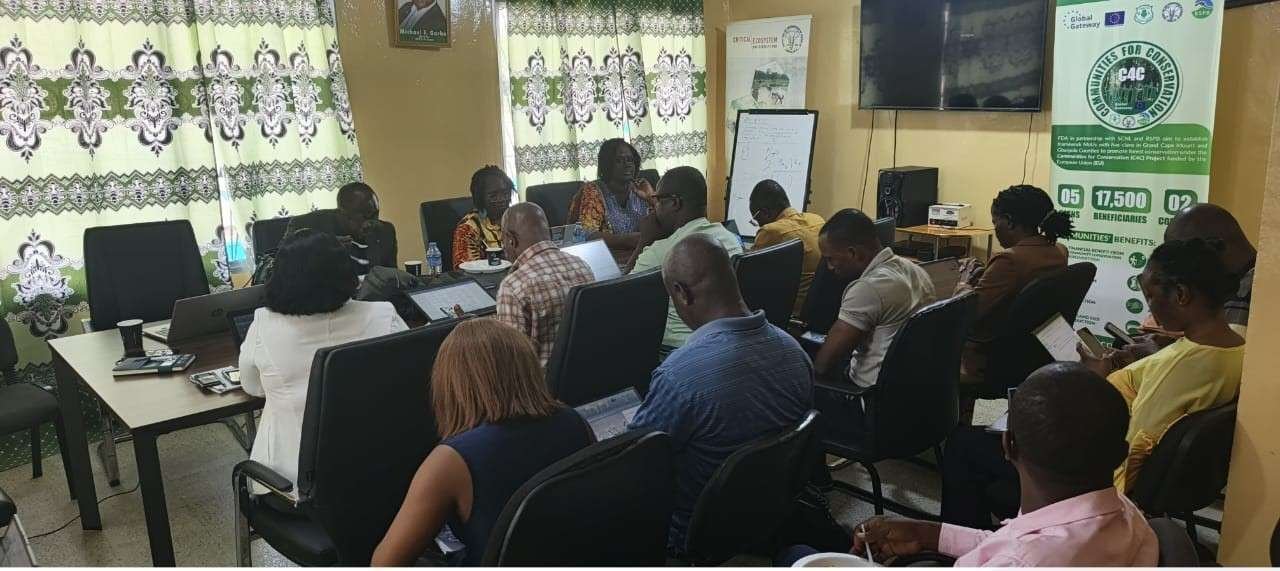
Government agencies, civil society organizations, and development partners have agreed to push Liberia’s forest sector reforms beyond declarations and into measurable action, following a daylong Forest Sector Partners Dialogue that exposed both progress and persistent governance gaps.
The high-level meeting, convened by the Society for the Conservation of Nature in Liberia (SCNL) and Sustain Earth and Equity Defenders (SEED), focused on aligning Liberia’s forest governance reforms with rapidly evolving global climate policies and carbon market frameworks, while strengthening coordination among national institutions tasked with managing the country’s most strategic natural asset.
Discussions were anchored in the outcomes of the 2025 National Forest Forum and the Monrovia Declaration on Forests a multi-stakeholder roadmap that identified chronic weaknesses in governance, law enforcement, and financing. Participants assessed how far those commitments have translated into concrete legal, policy, and institutional reforms, warning that civil society recommendations must shape decision-making rather than remain sidelined as advocacy statements.
Organizers described the dialogue as a strategic stocktaking exercise, reviewing progress since late 2025 and identifying realistic priorities for 2026, a year many participants labeled “decisive” for the sector.
At the center of the dialogue was Liberia’s emerging “Four Cs” forest economy framework: Community Forestry, Conservation, Commercial Forestry, and Carbon Finance. Stakeholders said the approach signals a shift toward managing forests as multi-value landscapes supporting livelihoods, biodiversity protection, responsible timber production, and climate finance.
Yet participants cautioned that the model will fail without addressing governance weaknesses, benefit-sharing disputes, and Liberia’s limited readiness to engage credibly in international carbon markets.
In community forestry, stakeholders cited weak governance structures, limited technical capacity, and flawed benefit-sharing systems. Calls were made for stronger compliance monitoring, simplified legal procedures, and closer coordination among the Forestry Development Authority (FDA), Liberia Land Authority (LLA), and local governments.
In conservation, low political prioritization, insufficient biodiversity data, and rising land-use pressure from mining and agriculture dominated discussions. Proposed solutions included establishing a high-level inter-ministerial conservation council, expanding digital monitoring systems, and mobilizing long-term financing through the Liberia Conservation Fund and similar mechanisms.
For commercial forestry, participants pointed to inconsistent law enforcement, outdated legal frameworks, and weak traceability and transparency systems. They urged harmonization of forestry and land laws, improved enforcement capacity, stronger revenue systems, and expanded product traceability to curb illegality.
In carbon finance, overlapping institutional mandates and the absence of a clear national carbon benefit-sharing framework were identified as major bottlenecks. Recommendations included formalizing carbon governance through legislation, creating a national carbon coordination and data platform, and strengthening national capacity for measurement, reporting, and verification (MRV).
International climate developments featured prominently, particularly Article 6 of the Paris Agreement, which governs international carbon trading and non-market cooperation. Participants stressed that Liberia must strengthen safeguards, institutions, and national positioning to engage in emerging carbon mechanisms without compromising environmental integrity or community rights.
The dialogue underscored the need for stronger interagency collaboration among the FDA, Environmental Protection Agency (EPA), Liberia Land Authority, Carbon Market Authority (CMA), and the Liberia National Tourism Authority (LNTA).
Participants noted that climate finance increasingly intersects with land-use planning, conservation-based tourism, and national development strategies.
Integrated data systems linking forest traceability, carbon MRV, biodiversity monitoring, and national land-use mapping were identified as critical tools for improving transparency and accountability.
Cross-cutting issues raised included weak institutional coordination, gender and social exclusion, unclear carbon rights, and chronic underfunding of conservation. Community representatives emphasized that communities must be treated as decision-making partners, not mere beneficiaries, especially in benefit-sharing arrangements and carbon project development.
Participants also warned of sustainability risks in commercial forestry, the fragility of conservation financing, and the danger of communities entering carbon deals in the absence of a finalized national carbon policy. The untapped potential of eco-tourism was highlighted as a complementary source of sustainable financing.
Civil society groups outlined immediate steps, including formally engaging the FDA on emerging sector concerns, seeking structured dialogue with the Carbon Market Authority on carbon policy development, and raising coordination gaps with the National Climate Change Steering Committee. Stronger engagement with the private sector was also identified as a priority.
Stakeholders agreed that 2026 will be a make-or-break year for Liberia’s forest sector. The dialogue concluded with a call for shared responsibility, tighter coordination, and sustained collaboration to ensure forests deliver long-term environmental, social, and economic benefits.
Organizers said the process marks a decisive shift from broad declarations to concrete, time-bound actions testing whether Liberia can align national forest reforms with global climate demands while safeguarding communities and the environment.