

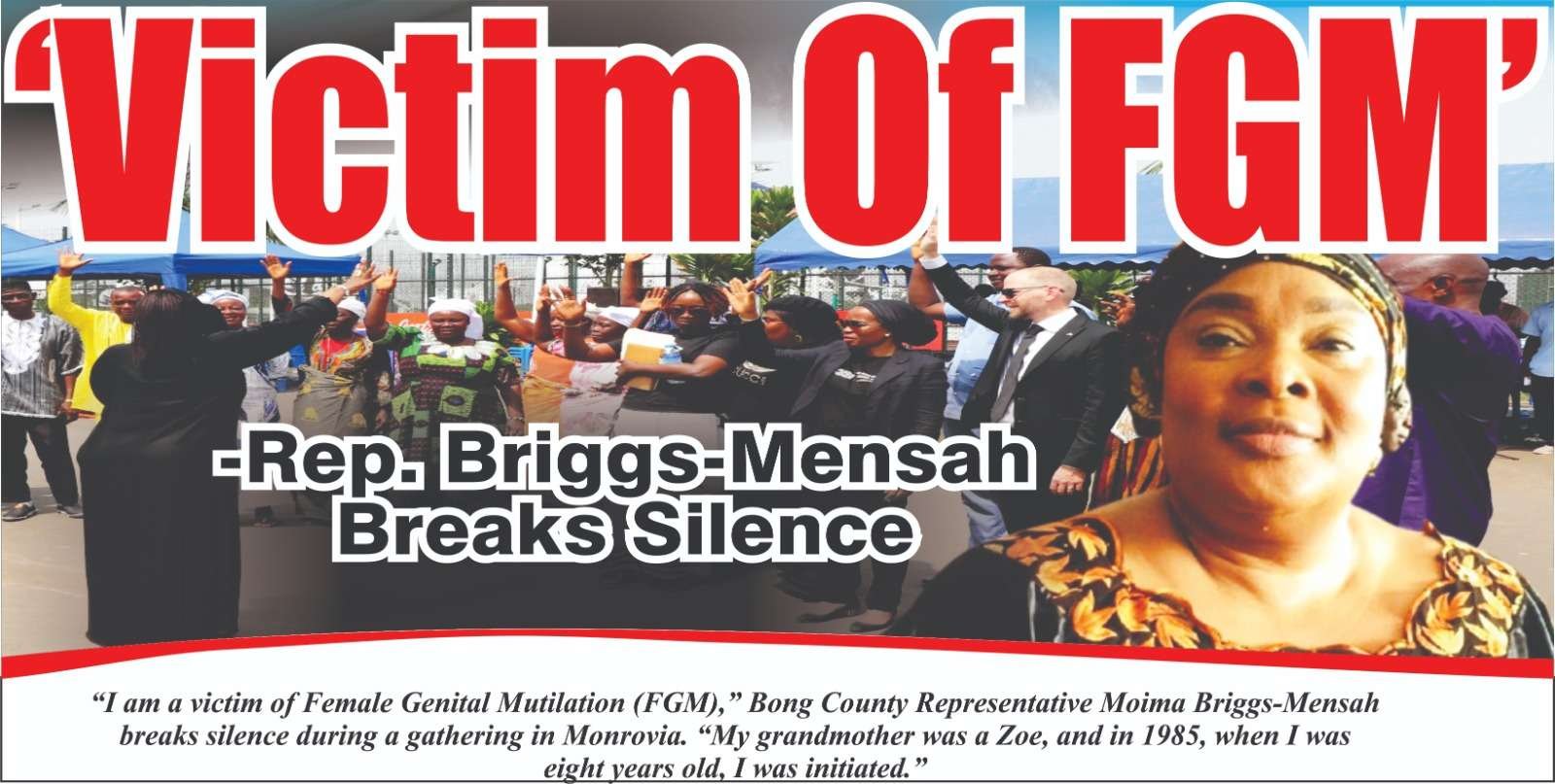
“I am a victim of Female Genital Mutilation (FGM),” Bong County Representative Moima Briggs-Mensah breaks silence during a gathering in Monrovia. “My grandmother was a Zoe, and in 1985, when I was eight years old, I was initiated.”
Bong County District #6 Representative Moima Briggs-Mensah has sharply criticized female genital mutilation (FGM), describing it as a system designed to suppress women’s sexuality and reinforce male dominance, while calling for the swift passage of the Women and Girls Protection Act.
“There will always be men because its men who want to subdue us,” Briggs-Mensah said at a recent advocacy event. “It’s their idea of keeping us and stopping our sexual desires. They make it look like they like us, but they don’t. They want to keep us somewhere,” she added.
The lawmaker, who openly identified herself as a survivor of FGM, recounted her personal experience to underscore the urgency of legal reform.
She made the remarks during the observance of the International Day of Zero Tolerance for Female Genital Mutilation (FGM), held on Friday, February 6, 2026, in Monrovia.
The Strategic lobbying Engagement organized by the Women NGO Secretariat of Liberia (WONGOSOL) in collaboration with the Ministry of Gender Children and Social protection and the ministry of local government for the passage of the women and girls’ protection act.
The national event, held under the global theme “Investing in Girls, Communities, and a Future Free from Female Genital Mutilation,” focused on strengthening legal protections for girls amid growing concerns that the absence of a comprehensive national law continues to leave many vulnerable.
Briggs-Mensah emphasized that advocacy against FGM did not begin as an attack on tradition but emerged through engagement and dialogue with traditional authorities. She noted that many traditional leaders, commonly referred to as zoes, have since expressed willingness to abandon cutting practices and pursue alternative livelihoods.
“We became brave when we saw zoes coming into town with their baskets, saying, ‘We don’t want to cut again. We want to do agriculture and training that everyone can be part of,’” she explained. “They came from Lofa, Bong, Nimba, and other counties.”
Despite previous bans on the practice, Briggs-Mensah lamented ongoing violations, citing reported cases of more than 500 girls initiated in Lofa County alone.
“If someone says the cutting was banned before, let me remind you-502 girls were still initiated in Lofa County,” she said. “When you calculate the money involved, clothes, food, and other items-you see this is no longer about culture. It is about money.”
While reaffirming her identity as a traditional woman, the lawmaker rejected claims that the proposed legislation represents a foreign imposition on Liberian culture.
“I love and appreciate tradition. I am a traditional woman and I will continue to be,” she said. “This law is not about stopping our culture. It is about stopping harmful practices, especially the forcible grabbing of children and initiating them because people want money.”
She also criticized the current licensing system for traditional bush schools, arguing that women pay significant fees but receive little protection or state support.
“Our mothers paid L$50,000 for licenses, only for men to come and take over,” she said. “We must put our feet down so these centers are included in the national budget and protected by the government.”
Briggs-Mensah pointed to President Joseph Nyuma Boakai’s public commitment to ending FGM, both at the United Nations General Assembly and domestically-as evidence of political will, adding that the proposed Women and Girls Protection Act is currently under legislative review.
“The law is now in committee,” she said. “We need all stakeholders to come together so this law can pass. We must take the message to our people and make it clear: we are not ending culture, we are ending harm.”
Participants at the event echoed the call for reform, urging the government to subsidize bush schools so girls can learn cultural values without being subjected to genital mutilation.
“To bring relief and sanity to our culture, we want the government to subsidize bush schools so every girl can return to learn about her culture,” said participant Bendu Johnson.
Another participant, Ma Hawa Dunor, stressed the importance of consent. “The FGM component must not be forced but left to the age of consent,” she said.
Civil society actors at the forum also called for unified messaging and expanded public awareness across Liberia’s counties to ensure citizens understand the provisions and benefits of the Women and Girls Protection Act.
The Act affirms that girls must not be forced to undergo genital mutilation and may only make such decisions upon reaching the legally defined age of consent-a provision advocates say is critical to safeguarding the future of women and girls in Liberia.
UN Women Deputy Representative Yenei Fakayajo warned that progress achieved through advocacy and traditional leadership declarations remains fragile without enforceable legislation, underscoring the urgent need for the passage of the proposed law.