
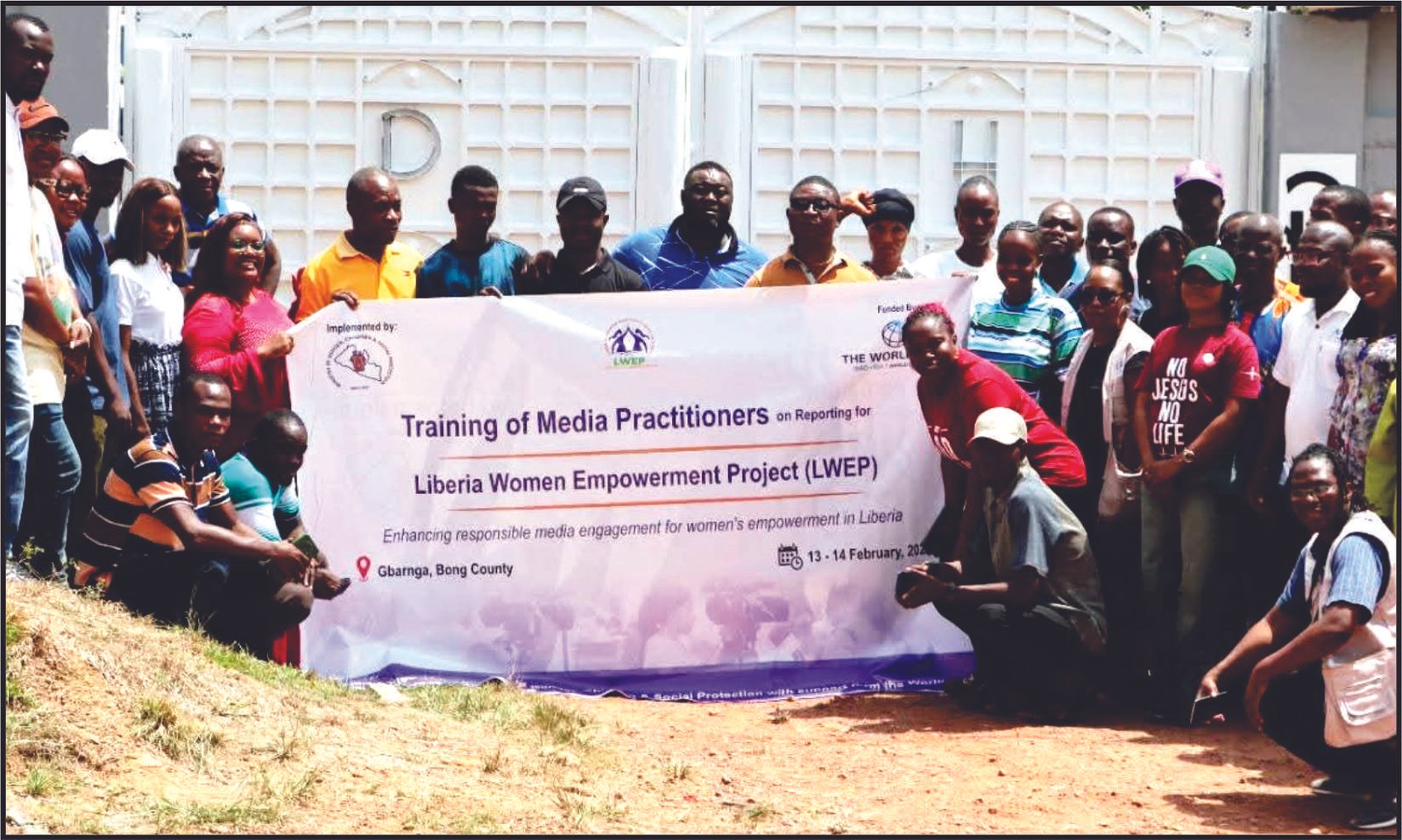
Media practitioners from across Liberia have begun a two-day training workshop aimed at strengthening responsible reporting on the Liberia Women Empowerment Project (LWEP), a $44.6 million initiative funded by the World Bank through the International Bank for Reconstruction and Development (IBRD) and the International Development Association (IDA).
The training, held in Gbarnga, Bong County is being organized by the Ministry of Gender, Children and Social Protection (MoGCSP) with support from the World Bank Group to enhance media engagement and improve public awareness about the project’s scope, funding structure and impact.
Welcoming participants, Jesse James, Women Empowerment Officer at the Ministry, underscored the critical role of journalists in ensuring that information about the project reaches communities effectively.
“There are a lot of good things the project is doing, but the information may not be filtering well to the population,” James said.
Continuing, he stated: “It is only you in the media who can help us explain that the Ministry of Gender, through this project, is empowering more than 36,000 women across hundreds of communities.”
He noted that despite the scale of the intervention, misconceptions persist about government efforts to support women and families.
“When people do not know about the work being done-even if millions are invested-it appears as though nothing is happening. We count on you to help provide accurate information to the people,” he added.
James encouraged media managers and talk show hosts to invite project officials onto their platforms to explain ongoing activities and urged journalists to review project documents to ensure informed reporting.
Providing an overview of the project, Lisa T. Diasay, Project Consultant for the LWEP, detailed the five-year initiative, which runs from 2022 to 2027 and became operational in 2023 after the Government of Liberia signed the financing agreement with the World Bank in May 2022.
The project is being implemented in six counties-including Rivercess, Bomi and Grand Cape Mount- targeting 498 communities and an estimated 267,200 beneficiaries.
Diasay explained that 70 percent (70%) of the funding is a loan to the Government of Liberia, while the remaining portion is a grant.
“A huge part of this money will be paid back by the government. Liberia met the World Bank’s benchmarks in social protection and service delivery, which made this financing possible,” she said.
Of the total budget: $8 million is allocated to social norms change interventions using the SASA! Methodology-an approach focused on preventing intimate partner violence (IPV) and addressing gender-based violence (GBV).
$23.6 million is dedicated to skills development and agricultural training. $18 million is earmarked for cash grants to 36,000 women beneficiaries.
Additional funds support institutional strengthening, GBV and adolescent sexual and reproductive health (ASRH) services, education access, and project management.
Changing Norms and Strengthening Institutions
Diasay emphasized that beyond economic support, the project seeks to transform community attitudes about women’s roles, reduce gender-based violence, and promote girls’ education.
“We want to change how communities think about women, inclusion and shared development. This is not just about money- it is about sustainability and institutional strengthening,” she said.
The Ministry of Gender is the lead implementing agency, working in collaboration with the Ministries of Agriculture, Health, Education, and Finance and Development Planning. Funds are managed through the Ministry of Finance.
Implementation on the ground involves a consortium of international and local partners, including ActionAid, Plan International, Catholic Relief Services (CRS), Medical Teams International, Defense for Children International, and other community-based organizations.
Diasay, among other things explained that local organizations play a central role to ensure community ownership and sustainability.
“When communities see organizations that have worked with them before, they are more willing to engage,” she said.
Inclusive Beneficiary Approach
While the project primarily targets women, it adopts a 70 percent women and 30 percent men beneficiary ratio to reduce household tensions and intimate partner violence.
“If we empower only the woman and exclude the men, it can create tension. Supporting both contributes to peace in the home and reduces intimate partner violence,” Diasay noted.
The initiative also supports the National GBV Hotline (116), which provides free services nationwide.
Strengthening Media Accountability
Organizers stressed that accurate reporting is essential to prevent misinformation, particularly regarding project finances and loan arrangements.
“We are depending on you to provide correct information. If journalists understand the structure and funding, they can help counter misinformation in communities,” Diasay told participants.
The training covered project components, funding mechanisms, implementation structures, and reporting ethics related to gender and development programming.
As the project approaches its final phase in 2027, the ministry of Gender, Children and Social Protection officials expressed hope that strengthened media collaboration will amplify its impact and ensure transparency.
“We want the message to reach the world. Let’s do the best we can to ensure the people understand what is being done in their communities,” James said.
The Liberia Women Empowerment Project is funded by the World Bank through IBRD and IDA and implemented by the Ministry of Gender, Children and Social Protection in partnership with multiple government ministries and civil society organizations.