


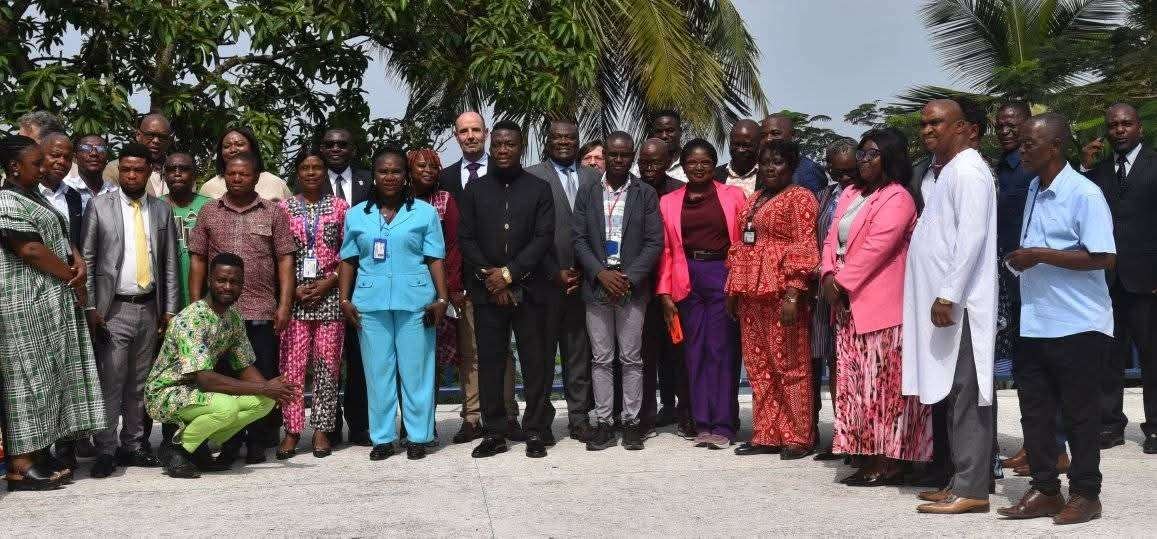
The Country Representative of the Office of the United Nations High Commissioner for Human Rights (OHCHR) in Liberia, Christian Mukosa, has emphasized that justice is central to national healing, warning that without accountability, reconciliation and sustainable development remain elusive.
Speaking on Thursday at a daylong workshop on Transitional Justice for parliamentary staff in Monrovia, Mukosa said that justice forms the backbone of the rule of law and long-term national progress.
“Justice is fundamental to reconciliation, to strengthening the rule of law, and to the development of any nation,” Mukosa said, addressing lawmakers and legal experts gathered to discuss Liberia’s transitional justice pathway.
He added that countries perceived as unwilling or unable to uphold justice often struggle to inspire confidence among international partners.
“Without credible justice,” Mukosa said, “it becomes extremely difficult for a country to attract investors and donors from around the world. Confidence in institutions is built on accountability.”
Liberia is still grappling with the legacy of its brutal civil conflicts, which lasted from 1989 to 2003 and left hundreds of thousands dead or displaced. Despite years of relative peace, calls for accountability for wartime atrocities continue to resonate among victims and civil society groups.
Mukosa stressed that transitional justice mechanisms are not about retribution but about restoring dignity to victims and rebuilding trust in state institutions.
“Justice must be served for those who have fallen victim to injustice in Liberia,” he said. “It is about acknowledging their suffering and ensuring that such violations never happen again.”
Also speaking at the workshop, Justice Minister Oswald Tweh reaffirmed the government’s commitment to confronting impunity and strengthening the justice system.
“The Ministry of Justice stands firm in the fight against injustice in Liberia,” Tweh declared. “We are committed to upholding the rule of law and ensuring that accountability is not selective.”
He noted that building a credible justice system requires political will, institutional reform, and sustained public support. Tweh emphasized that collaboration between the executive, legislature, and judiciary would be critical in advancing transitional justice efforts.
Meanwhile, the Chairperson of the Independent National Commission on Human Rights, Cllr. Dempster Brown, urged Liberians not to undermine ongoing efforts to establish a war crimes court.
Brown highlighted that President Joseph Boakai’s initiative to set up a War Crimes Court marks a significant turning point in the country’s post-war history.
“President Boakai’s efforts to establish a War Crimes Court should not be undermined,” Brown said. “This is a critical step toward ensuring that justice is served for victims of injustice.”
According to Brown, successive Liberian leaders after the civil war failed to make meaningful progress toward establishing a war crimes court, despite recommendations from the Truth and Reconciliation Commission.
“Past leaders after the war did not make significant efforts toward the establishment of a war crimes court,” he said. “This initiative is therefore both timely and commendable.”
Brown further argued that accountability for past atrocities would strengthen democratic governance and deter future violations, emphasizing that justice and stability are mutually reinforcing rather than contradictory goals.
The workshop concluded with participants reaffirming the importance of legislative engagement in advancing transitional justice. As Liberia weighs the establishment of a war crimes court, experts and officials agreed that credible justice remains essential to reconciliation, investor confidence, and the nation’s long-term development trajectory.