


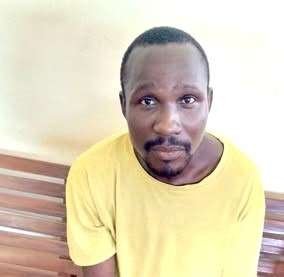
The Third Judicial Circuit Court in Sinoe County has acquitted a 40-year-old man accused of statutory rape.
Presiding Circuit Judge Wesseh Alphonsus Wesseh delivered the ruling on Tuesday, March 10, 2026, in Greenville, clearing defendant Abednego Moore of allegations that he raped a 12-year-old girl in Seebay Community.
Moore had been arrested on January 28, 2025 after being accused of having sexual intercourse with the minor in the bathroom of her parents’ home.
According to court records, Moore had been working under a short-term contract clearing brush around the yard of the girl’s father, who is a police officer.
Allegations and Medical Examination
During the police investigation, the minor reportedly told officers that Moore asked her to buy him drinking water when he arrived at her parents’ home for work.
After she returned, she alleged that he promised to give her LRD500 if she agreed to have sexual intercourse with him.
She told investigators that she followed Moore into a bathroom where he allegedly penetrated her anus. The child later repeated that claim to medical personnel at the F. J. Grant Hospital in Greenville.
However, medical examinations conducted on January 29, 2025 found no blood, bruises, or lacerations in the vagina or anus.
The report noted that the girl’s hymen was absent but recorded that the anus remained intact with no visible injuries.
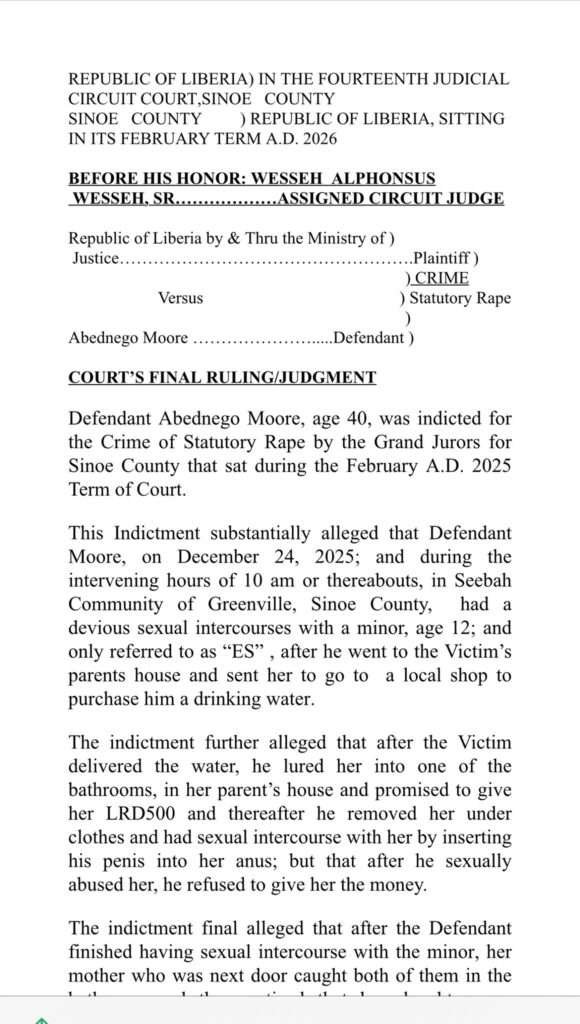
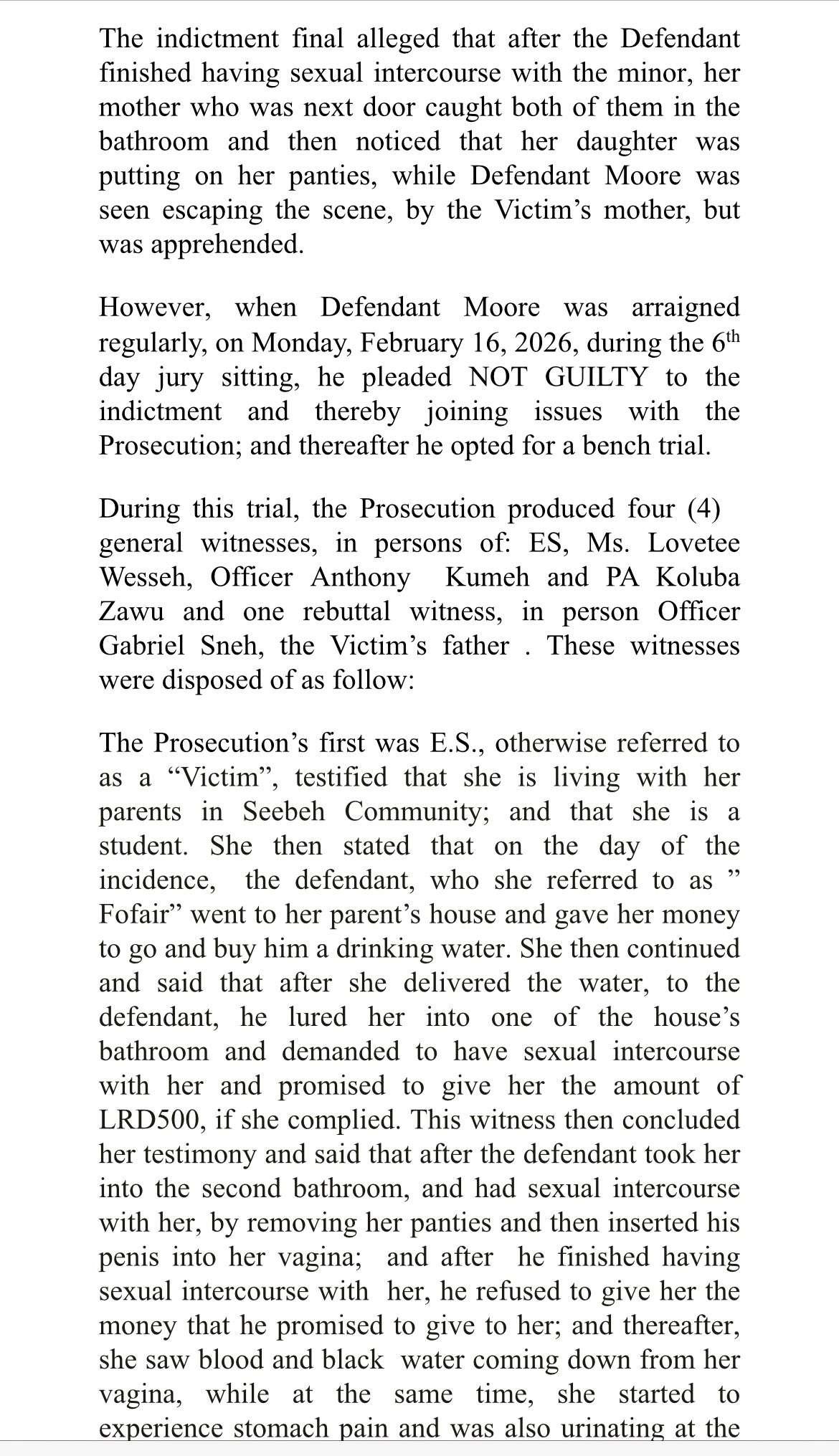
Despite those findings, the Liberia National Police charged Moore with statutory rape, alleging anal penetration.
Contradictions During Trial
When the case was called for trial on February 17, 2026, Moore pleaded not guilty and opted for a bench trial.
During her testimony in open court, the victim gave a different account from her initial statement, telling the court that Moore had sexual intercourse with her in her vagina and that she observed blood afterward.
A prosecution witness, police officer Anthony Kumeh of the Women and Children Protection Section, also testified that the intercourse occurred in the victim’s vagina. However, under cross-examination, he acknowledged that the girl had originally told police that the intercourse occurred in her anus, contradicting the police charge sheet.
Moore denied the allegation and argued that the accusation stemmed from a dispute over unpaid wages, claiming the girl’s father had refused to pay him LRD3,500 for three days of brush-clearing work.
Court: Evidence “Ambivalent”
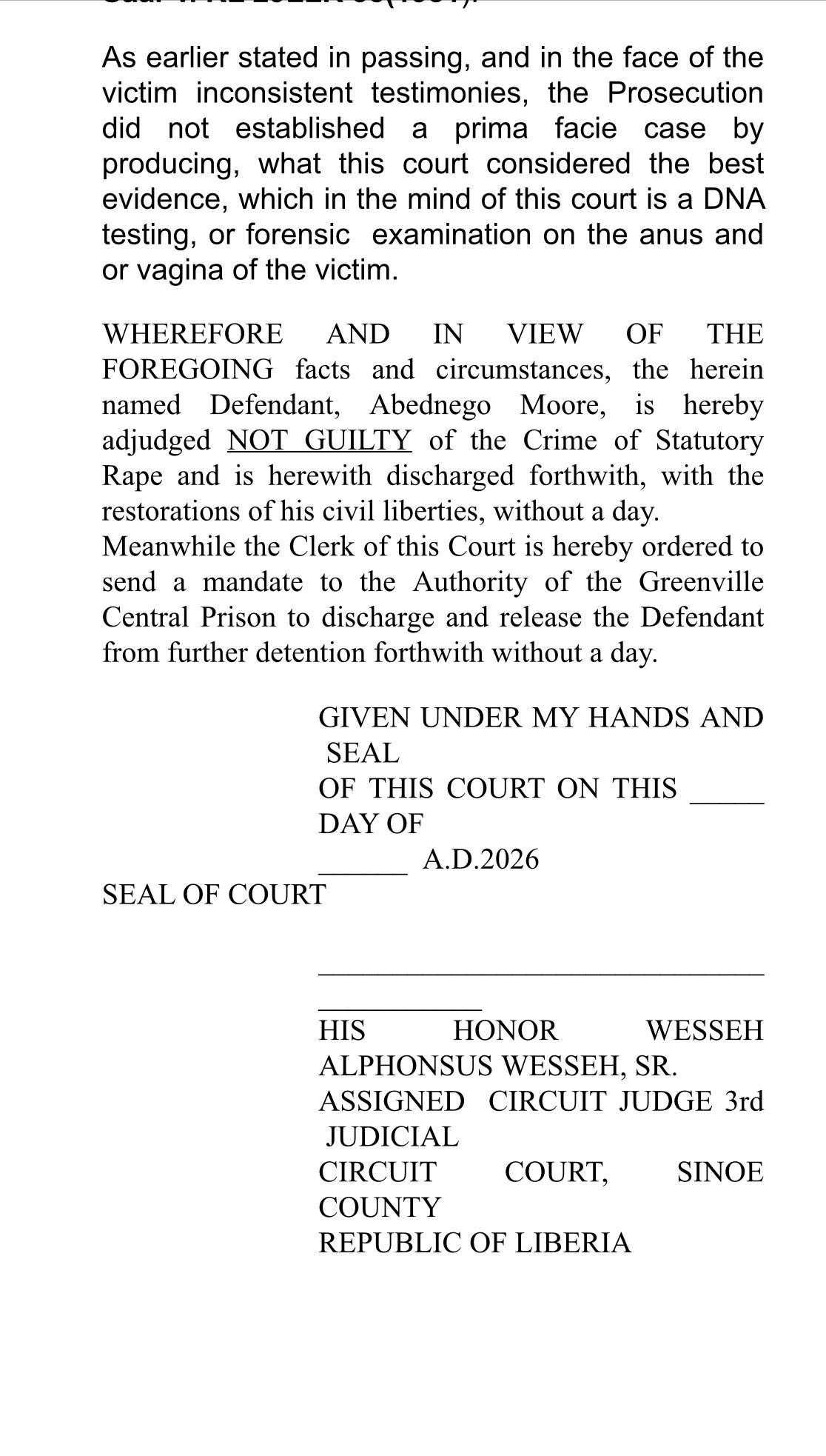
In his ruling, Judge Wesseh said the prosecution’s case was weakened by contradictory testimony and the absence of scientific evidence.
“In as much as rape do occur when a penetration occurs in a victim’s anus, vagina or any other bodily orifice, the ambivalent evidence presented by the prosecution clearly shows broken linkages,” Judge Wesseh said.
“As such this court is reluctant to convict this defendant on the charge of statutory rape without a DNA testing, or forensic examination on her hymen to scientifically ascertain as to whether her hymen was broken by the defendant’s conduct.”
Judge Wesseh stressed that criminal prosecutions must rely on the strongest available evidence.
“In order for a criminal prosecution to be sustained, the best evidence which the case is made of must be brought forth during a trial,” Wesseh said, adding that in light of what he described as “zigzag evidence,” forensic examination or DNA testing would have been critical.
Presumption of Innocence
Judge Wesseh also cited the constitutional presumption of innocence guaranteed under the Constitution of Liberia (1986) and the country’s criminal procedure law.
“The law in this jurisdiction directs that every criminal defendant is presumed to be innocent until the contrary is proved,” he said, noting that the prosecution’s evidence was inconclusive and failed to establish guilt beyond a reasonable doubt.
He added that the doubts surrounding the case were not merely reasonable but “substantial and pervasive.”