


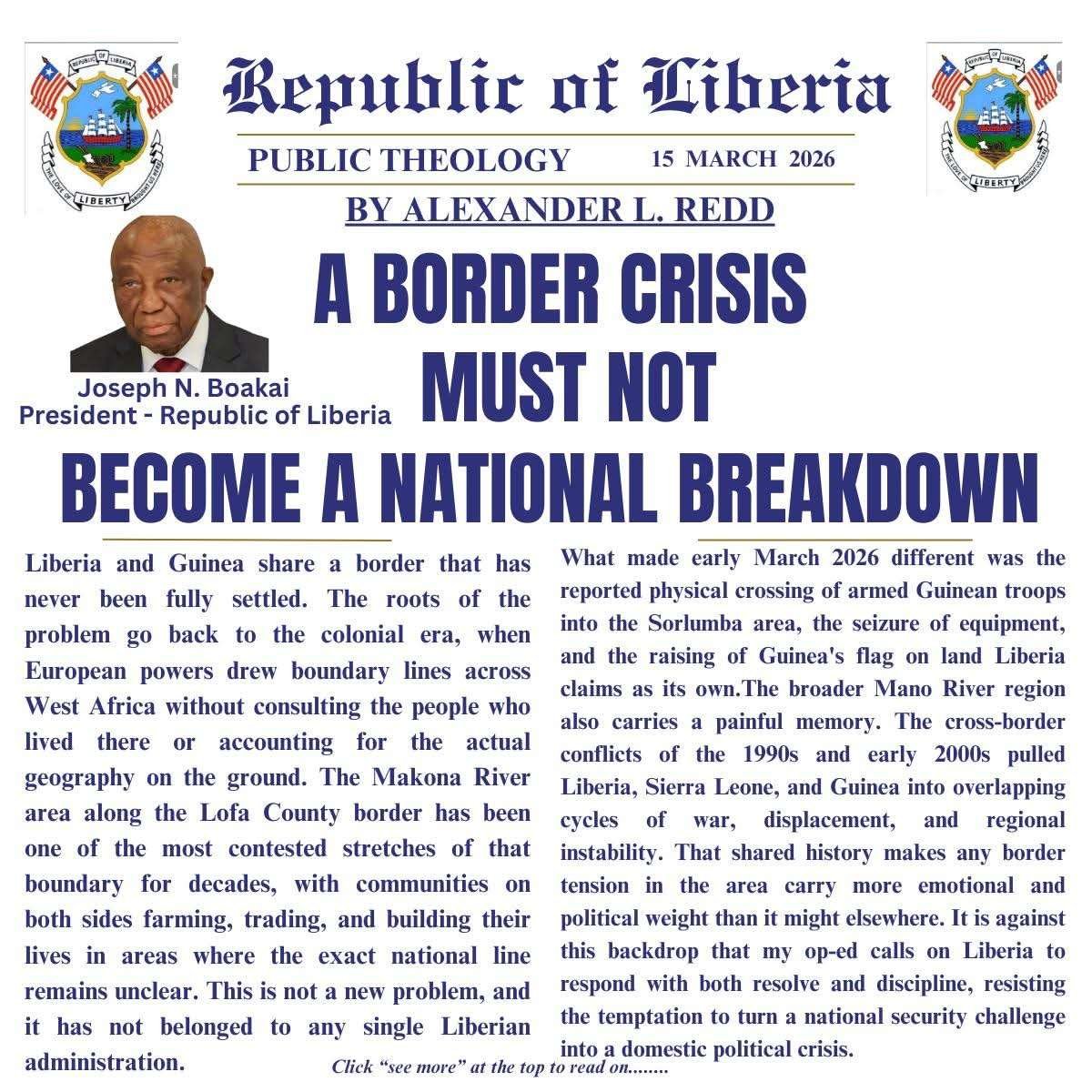
Monrovia — Alexander L. Redd, founder and pastor of Gracious Hope Bible Fellowship in Madison, Wisconsin, is calling for calm and national unity as Liberia navigates rising tensions along its border with Guinea.
In a commentary issued Sunday, March 15, 2026, Redd warned that the dispute should not trigger internal political divisions that could weaken Liberia’s national response.
His remarks come after reports that armed Guinean troops crossed into the Sorlumba area of Lofa County earlier this month, allegedly seizing equipment, raising their national flag, and leaving residents fearful and displaced.
Redd described the incident as serious but cautioned against turning the situation into a domestic political crisis.
“A nation can lose more than land in a border crisis,” Redd wrote. “It can lose its nerve, its judgment, and its common sense.”
Call for Measured Response
Redd said Liberians have the right to expect a firm and responsible response from the government but emphasized that firmness should not be confused with recklessness.
He criticized calls by Liberian lawyer Isaac Jackson for the resignation of President Joseph Boakai, arguing that such demands could undermine national unity during an active border dispute.
According to Redd, political pressure at a moment of external tension risks sending a message of instability both domestically and internationally.
“When a live border dispute is still unfolding, turning the moment into a public campaign against the sitting president does not strengthen the nation,” he wrote.
Historical Roots of the Dispute
Redd noted that the boundary question between Liberia and Guinea did not originate under the current administration. Instead, he said, it traces back to colonial-era agreements and long-standing uncertainties along the Makona frontier.
He also referenced the history of instability in the Mano River region, which includes Liberia, Guinea, and Sierra Leone — countries that endured devastating cross-border conflicts during the civil wars of the 1990s and early 2000s.
“No one who remembers that history should be eager to play with fire,” he wrote.
Diplomacy and Communication
Redd said the Liberian government appears to be addressing the matter through established diplomatic and security channels. He noted that President Boakai has engaged national security structures, briefed legislative leaders, and allowed diplomatic efforts to proceed.
However, he also encouraged the government to improve communication with the public and ensure that residents of affected border communities receive visible protection and reassurance.
According to Redd, Liberia should also develop a long-term strategy for border demarcation and rapid response to prevent future disputes.
Appeal for National Unity
Quoting a biblical passage that “a house divided against itself cannot stand,” Redd argued that internal political division could weaken Liberia’s ability to defend its sovereignty and negotiate effectively.
He urged Liberians to remain united while addressing the border issue firmly and lawfully.
“Liberia must defend its sovereignty firmly and lawfully, without apology,” he wrote. “But it must also hold its inner unity while doing so.”
Redd concluded that the current situation represents both a test of leadership and a test of national maturity for the country.
“The question is not whether Liberia should stand its ground,” he wrote. “The real question is whether we can do so without losing our head in the process.”