


By Emmanuel Karngar
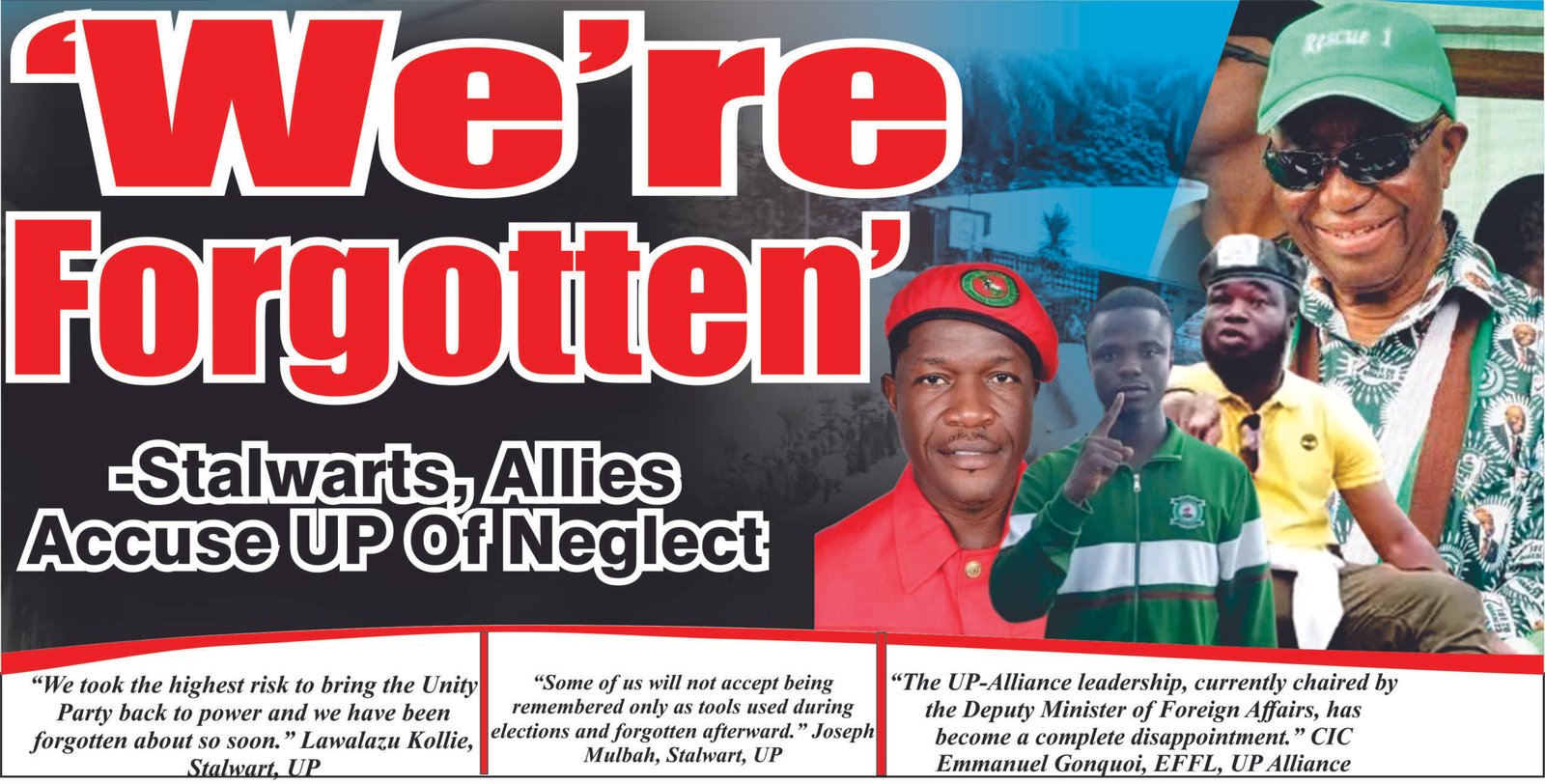
“We took the highest risk to bring the Unity Party back to power and we have been forgotten about so soon,” Lawalazu Kollie, Stalwart, UP
“Some of us will not accept being remembered only as tools used during elections and forgotten afterward,” Joseph Mulbah, Stalwart, UP
“The UP-Alliance leadership, currently chaired by the Deputy Minister of Foreign Affairs, has become a complete disappointment,” CIC Emmanuel Gonquoi, EFFL, UP Alliance
After braving dangerous journeys, remote terrain, and the hardships of campaigning, some grassroots supporters of Liberia’s ruling Unity Party (UP) say they have been sidelined by the very administration they helped bring to power.
Lawalazu Kollie, a prominent mobilizer who played a key role in the party’s campaign across Lofa, Bong, and Montserrado counties, has publicly expressed frustration over what he describes as the neglect of grassroots supporters.
In a statement shared on social media, Kollie lamented that individuals who risked their lives during the campaign have been overlooked, while others who played lesser roles have assumed influential positions in government.
“We took the highest risk to bring the Unity Party back to power and we have been forgotten about so soon,” he said.
Kollie recounted how many young partisans endured harsh conditions—travelling through remote areas and crossing rivers—to campaign for then-presidential candidate, now President Joseph Nyumah Boakai. His remarks were accompanied by a video showing campaigners navigating difficult terrain in their push for electoral victory.
He also questioned the absence of several youth activists who were highly visible during the campaign but have yet to be considered for government appointments.
Similar concerns have emerged within the UP Alliance, particularly from the Economic Freedom Fighters of Liberia (EFFL). Emmanuel Gonquoi, a leading figure within the alliance, issued a strongly worded statement criticizing what he described as poor leadership and a lack of inclusion.
Gonquoi argued that since the elections, the alliance has failed to convene formal meetings to address internal concerns, warning that its original purpose has been undermined. He said this has created imbalances and weakened unity among member groups.
Despite the grievances, Gonquoi clarified that the EFFL is not planning protests but is instead reorganizing and positioning itself politically for the future, including the 2029 elections.
Offering a broader political perspective, former Unity Party chairman Amini Modad weighed in on the growing discontent, warning of the risks that often follow political victories.
“Revolutions are initiated by idealists and reformists, fought by loyalists and optimists, but often stolen by opportunists and saboteurs,” Modad wrote.
His remarks have resonated with some supporters who see a widening disconnect between the party’s leadership and its grassroots base.
The discontent is not limited to party insiders. Joseph Mulbah, a staunch Unity Party supporter from Margibi County, also voiced his disappointment on Sunday, March 29, 2026, shortly after attending Palm Sunday service.
Mulbah reflected on the party’s political journey, recalling the commitment of supporters who remained loyal even after the Unity Party’s defeat in the 2017 elections.
He noted that many partisans sustained their dedication through years in opposition, driven by the hope that their sacrifices would eventually be recognized.
That hope, he said, was renewed during the 2023 elections, when supporters across the country mobilized extensively, contributing to the party’s eventual victory.
However, he described the current situation as “troubling,” noting that many loyalists continue to struggle for basic opportunities despite the party having been in power for nearly three years.
Mulbah emphasized that the concerns being raised are not about entitlement, but about fairness, recognition, and inclusion. He also referenced longstanding political rhetoric suggesting that rewards for loyalty should be realized in one’s lifetime, arguing that those who stood firm during difficult periods should not be overlooked in times of success.
He cautioned that history would judge not only the party’s electoral victory, but also how it treats those who made that victory possible. Mulbah concluded by reaffirming his loyalty to the Unity Party, while warning that such loyalty should not be mistaken for silence.
Following these statements, several Unity Party supporters have echoed similar concerns, calling on the party’s leadership to prioritize and recognize individuals who played key roles during its years in opposition.