


By G. Watson Richards
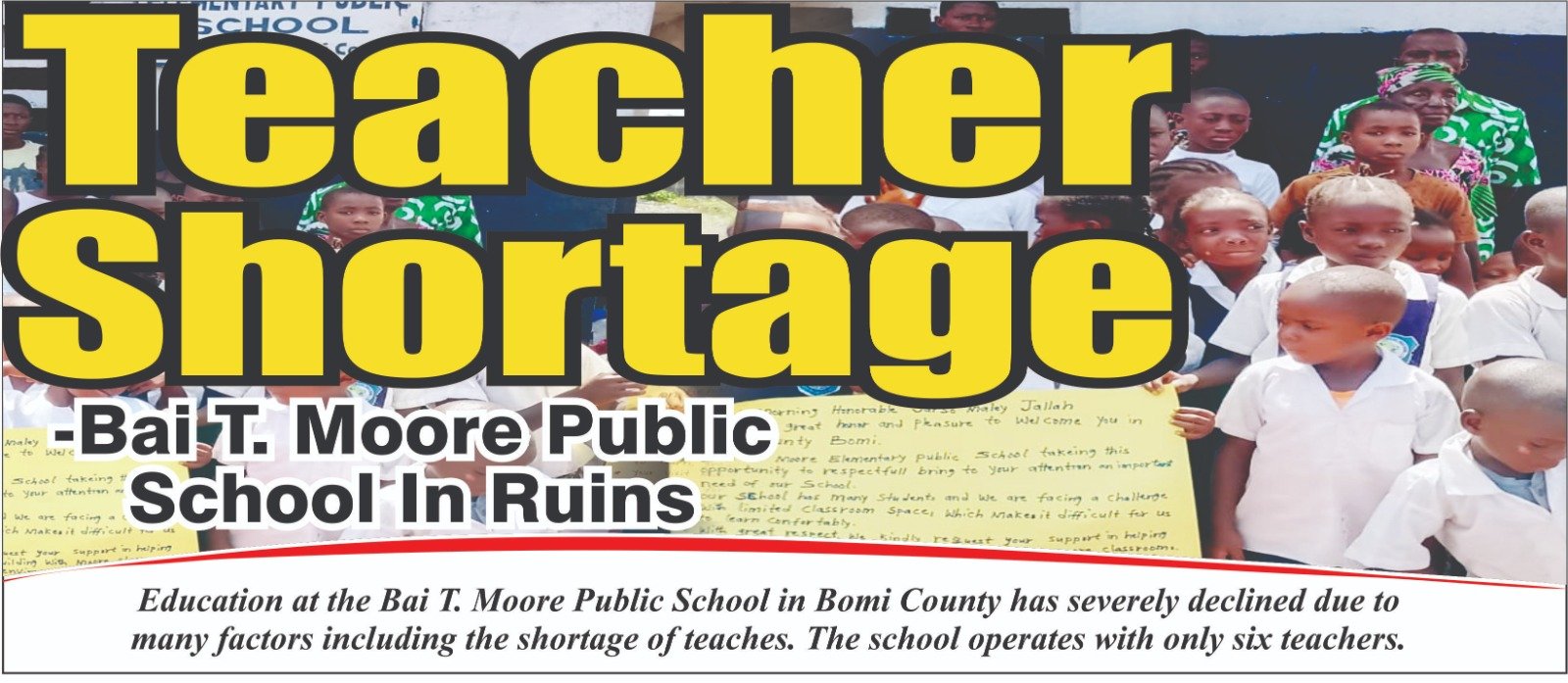
A Verity News investigation has uncovered a troubling learning environment at the Bai T. Moore Public School in Deman Town, Bomi County, where the promise of education is steadily being undermined by a web of severe challenges that threaten both teaching standards and student outcomes.
What should be a place of growth and opportunity has instead become a symbol of systemic neglect, where overcrowded classrooms, deteriorating infrastructure, and critical resource shortages define the daily reality of the institution.
The school’s physical condition tells a troubling story. Its buildings are in urgent need of renovation, with cracks, visible wear, and insufficient space rendering them unfit for effective learning environment.
With only two classrooms and a small principal’s office on campus, teachers and school administrators have been forced to rely on a privately owned structure to accommodate additional students. Even with this temporary arrangement, overcrowding persists, and multiple grade levels are merged into combined classes, severely limiting instructional effectiveness.
According to a source who spoke to this paper on condition of anonymity, revealed that where the strain is more evident is in the Early Childhood Education (ECE) section, where young learners, from foundational levels through Grade 6, are compressed into inadequate shared spaces.
This environment not only hampers concentration but also compromises the quality of foundational learning at a critical stage in child development.
Equally alarming is the shortage of teaching staff. With just six teachers, including the principal, the school operates far below acceptable staffing standards. Educators are burdened with excessive workloads, often managing multiple grade levels simultaneously, leaving little room for individualized attention or adequate lesson preparation.
The absence of basic facilities further compounds the crisis. Teachers lack proper seating and workspace, making it difficult to plan lessons or assess student work efficiently. Students, meanwhile, are deprived of a library-an essential pillar for nurturing literacy, curiosity, and independent learning.
Instructional materials are scarce, forcing teachers to improvise and limiting student engagement.
Sanitation conditions are equally dire, with poorly maintained bathrooms posing significant health risks. The lack of a perimeter fence exposes students to safety concerns, while the absence of teachers’ quarters discourages staff retention, particularly for those commuting from distant areas.
Even basic utilities remain unreliable. The lack of a functional electricity meter from the Liberia Electricity Corporation (LEC) disrupts any possibility of consistent power supply, further hindering the use of modern teaching methods.
Taken together, these challenges paint a stark picture of an institution in distress, one that urgently requires intervention. Education stakeholders, government authorities, and development partners must act swiftly. Without immediate investment and strategic support, the future of hundreds of students hangs in the balance.
For the children of Bai T. Moore Public School, the right to quality education is not merely an aspiration, it is a necessity. The question remains: how much longer can the people of Deman Town afford to wait for quality learning environment?