


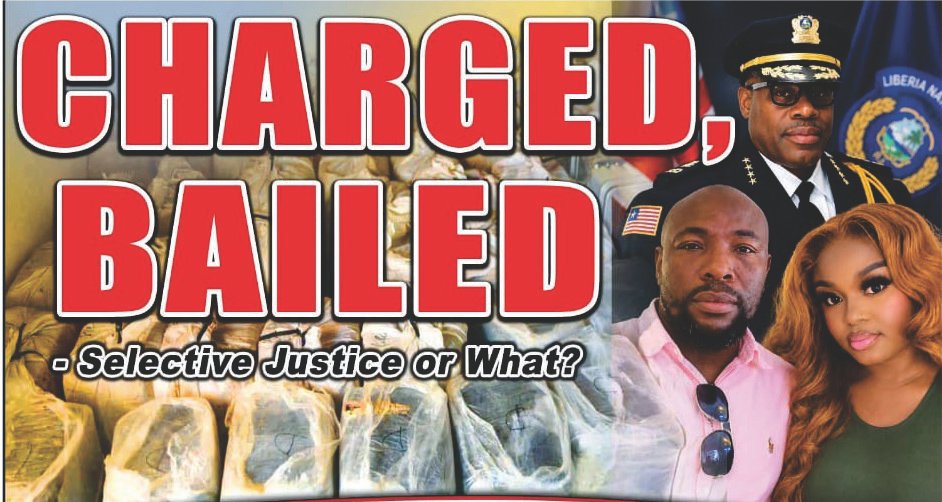
After weeks of public pressure, Police Commissioner, (unit 106) Johnny Bolar Dean, who admitted to receiving a bribe of US$10,000 from the Drug Cartel, was charged, forwarded to Court, and immediately released on bail even though he received drug money like others that are in jail.
That decision raises a troubling question: Why is Commissioner Dean out on bail while other people accused of dealing with drug money remain in jail?
This is not a question of asking the court to declare Dean guilty. He is entitled to a fair hearing and the presumption of innocence. The issue is whether the law governing bail is being applied equally.
According to a Liberia National Police charge sheet dated September 1, 2026, Dean was charged with criminal conspiracy, bribery, tampering with a criminal investigation, and obstruction of government functions by a public servant.
The charge sheet, under Case #SIT-CSD-HQ-LNP-1,195-26, says Dean admitted during an investigation that he received US$10,000 from Stephanie Fefe Mensah while her boss, Edison Brown, and his alleged accomplice, Alpha Bah, were under investigation in connection with a US$317 million illicit-drug trafficking case.
The police document states that Dean “voluntarily admitted in his written statement receiving” the money.
Dean reportedly told investigators that Mensah gave him the money “for safe keeping” and that she was his lover.
Investigators, however, allege that the money was intended to influence the investigation. They also say the US$10,000 was recovered from Dean.
“That, the US$10,000.00 was retrieved from defendant Johnny Bolar Dean,” the charge sheet states.
The Bail Question
This is where the controversy begins.
Section 14.96 of the controlled drug law expressly talks about receiving property derived from a drug offense. It states that a person commits an offense when he or she receives property knowing that it was derived from a drug offense committed by another person without legal entitlement.
The provision classifies the offense as a second-degree felony.
It also addresses bail and states:
“As to the matter of bail, only cash to the value of the bond; or cash deposit in the bank to the value of the bond as evidenced by a bank certificate.”
The question, then, is simple: What were the conditions of Dean’s bail?
How much was his bond?
Was it paid in cash?
If it was a bank deposit, was the required bank certificate provided?
And were the same conditions offered to the other defendants in cases involving drug money?
These questions deserve answers.
Why the Difference?
The police charge sheet says Dean was a public official and was serving as Commissioner of the Crime Services Department when the alleged transaction took place.
Investigators further allege that he was a member of the National Joint Investigative Task Force investigating the drug case.
They accuse him of disclosing confidential information and using his position to interfere with the investigation.
The charge sheet states:
“It was established that defendant Johnny Bolar Dean used his official position to frustrate the investigation.”
If these allegations are proven in court, they would make the case particularly serious.
But even before the case is decided, the bail question remains.
If other defendants accused of receiving or handling drug money are being held in jail, what is the legal difference between their cases and Dean’s?
There may be a perfectly lawful answer.
If there is, the public should hear it.
Equal Justice
Bail does not mean that a person has been found innocent. It simply means the accused is allowed to remain free while the case proceeds, subject to the conditions imposed by the court.
That principle applies to Dean just as it applies to everyone else.
But the principle of equal justice also means that a person’s position, title or influence should not determine whether he receives treatment that is unavailable to another defendant in a similar situation.
That is why the circumstances surrounding Dean’s release deserve public attention.
The police allege that he received US$10,000 while an investigation into a major drug-trafficking case was underway. They say he admitted receiving the money, although he gave his own explanation for why he had it. They say the money was recovered.
He was then charged and released on bail.
Meanwhile, other defendants connected to the wider drug investigation remain behind bars.
Why?
Where Is the US$10,000?
There is another issue that should not be overlooked.
Section 14.97 of the controlled drug law of Liberia also provides for the confiscation and forfeiture of proceeds derived from offenses covered by the relevant drug provisions.
It states: “Proceeds derived from offenses under this sub-chapter… shall be confiscated and upon final determination of the matter, shall be forfeited.”
Since the police say the US$10,000 was recovered from Dean, the court will eventually have to determine its legal status.
That too should be transparent.
The Court Must Explain
Nobody is suggesting that Dean should be denied his rights simply because he is a police commissioner.
Nor should anyone be convicted in the court of public opinion.
But the same law must apply to the police commissioner, the businessman, the driver, the street vendor and everyone else.
If Dean qualified for bail under the law, then say so.
If the court imposed specific conditions, make those conditions clear.
And if his case is legally different from those of defendants who remain in custody, explain the difference.
That is how confidence in the justice system is protected.
The issue is bigger than Johnny Bolar Dean.
It is about whether Liberia’s justice system can convince the public that there is one law, one standard and one measure of justice for all.
Dean will have his day in court.
But until the questions surrounding his bail are answered, many Liberians will continue to ask:
Why is he out on bail while others accused of receiving drug money are in jail?