


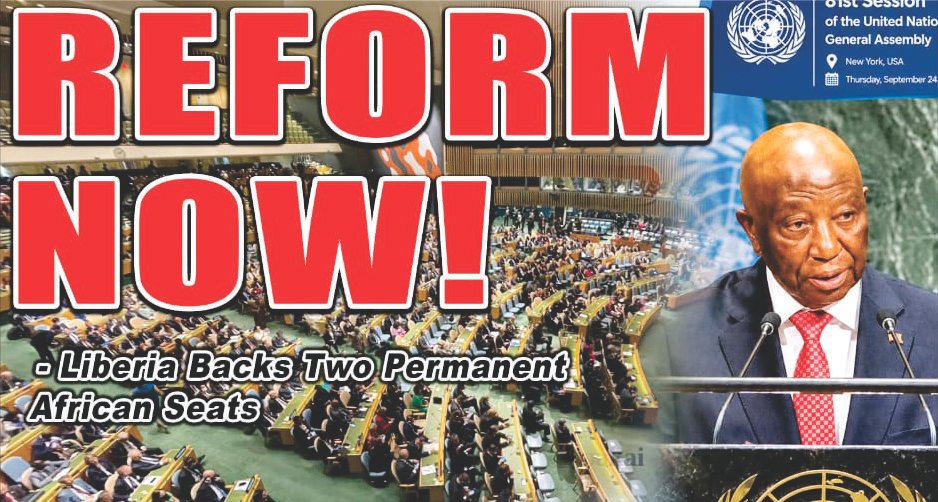
NEW YORK, September 24, 2026 — President Joseph Nyuma Boakai has called for major changes to the United Nations, saying the organization must address what he described as a growing loss of trust in the international system.
Speaking Thursday at the 81st Session of the United Nations General Assembly in New York, President Boakai said Liberia supports stronger African representation in global decision-making, including at the UN Security Council.
The President also called for changes to the international financial system, saying developing countries need greater access to affordable financing, debt relief and development funding.
“Eighty years of patience is enough,” Boakai said while calling for structural reform of the Security Council.
Liberia Backs Two Permanent African Seats
President Boakai said Africa, with about 1.5 billion people and nearly one-third of UN member states, remains underrepresented on the Security Council.
He noted that about 80 percent of the Council’s mandates concern peace and security issues in Africa, while the continent has no permanent seat on the Council.
Liberia, he said, supports the Common African Position on reforming the Security Council.
Boakai said Africa should receive at least two permanent seats, with the same rights and responsibilities attached to those seats, including the veto as long as the veto remains part of the Council’s structure.
He also called for additional non-permanent seats for Africa.
The President said the issue should be treated as a matter of correcting the structure of the United Nations rather than as a special request to the continent.
Calls for Changes to Global Financial System
Boakai also criticized what he described as an outdated international financial system that places heavy financial pressure on developing countries.
He said many developing nations are facing high debt, limited government spending capacity and rising external pressures as they work toward the UN’s 2030 development goals.
Liberia is calling for greater access to concessional financing, sustainable debt arrangements and more predictable development funding.
Boakai also called for greater representation of developing countries in the World Bank and International Monetary Fund, saying the governance of the Bretton Woods institutions continues to reflect the balance of power that existed in 1945.
“A financial system that decides the fate of billions cannot continue to be governed by so few,” he said.
Peace and Security
On international conflicts, Boakai called for an immediate end to hostilities, greater access for humanitarian assistance and respect for international humanitarian law.
He said preventive diplomacy, mediation and early warning systems should receive greater attention because preventing conflicts costs less than rebuilding countries after war.
As a current member of the UN Security Council, Liberia, he said, is working to address security threats affecting West Africa.
He identified transnational organized crime, cybercrime and illegal drug trafficking along maritime routes in the Gulf of Guinea as growing concerns.
Boakai said Liberia’s joint security forces are working against international drug networks and called on international partners to assist with coast guard surveillance, intelligence sharing and port security.
Liberia’s Development Plans
The President also highlighted his administration’s domestic development program, the ARREST Agenda for Inclusive Development, which focuses on Agriculture, Roads, Rule of Law, Education, Sanitation and Tourism.
He said Liberia has made progress in revenue collection and infrastructure development, including roads connecting farming communities to markets.
Boakai also raised the issue of climate change, saying Liberia contributes very little to global greenhouse gas emissions but continues to face coastal erosion, flooding and changes in agricultural patterns.
He said Liberia contains about 42 percent of the remaining Upper Guinean Rainforest and called on industrialized countries to meet their climate-financing commitments and support measures addressing climate-related losses and damage.
Youth, Women and Artificial Intelligence
Boakai said Africa’s young population presents an opportunity that governments must prepare for through education and technical training.
He said young people should have greater access to science, technology, engineering and mathematics education, digital skills and vocational training.
The President also reaffirmed Liberia’s support for equal political, economic and social opportunities for women and girls.
On artificial intelligence, Boakai called for international rules to guide the development and use of new technologies.
He said developing countries should not remain only users of technologies developed elsewhere and called for greater support to help them build their own digital systems and capacity.
He also supported stronger international rules on the use of artificial intelligence in warfare, saying technological development should serve human development rather than contribute to greater destruction.
Liberia’s Governance
In addressing Liberia’s own progress, Boakai said his administration is working to strengthen public accountability, improve financial management, fight corruption and support the judiciary.
He said Liberia’s experience of moving from civil conflict to constitutional democracy shows that institutions can be rebuilt through sustained national effort.
The President said restoring public confidence in government institutions remains part of his administration’s work.
A Call for UN Reform
Boakai said the United Nations must respond to changes in the world since its founding in 1945.
He welcomed the UN80 Reform Agenda, which seeks to make the organization more efficient and accountable, but said administrative reforms alone would not address the Security Council’s representation problem.
He argued that Africa’s absence from the permanent membership of the Security Council is inconsistent with the continent’s population and its role in matters considered by the Council.
“Eighty years of patience is enough. The time for structural reform is now,” Boakai said.
He urged UN member states to work toward a system that gives Africa a permanent voice in the Council.
Conclusion
In closing, President Boakai said the United Nations must restore confidence by producing results on issues affecting people around the world.
He said Liberia remains committed to the principles on which the United Nations was founded, including international law, human rights, peace and development.
“Let us leave this Assembly committed to a United Nations that not only deliberates on crises but also resolves them,” Boakai said.
He called for a UN that protects vulnerable people, respects the rights of member states and works toward lasting international peace.