
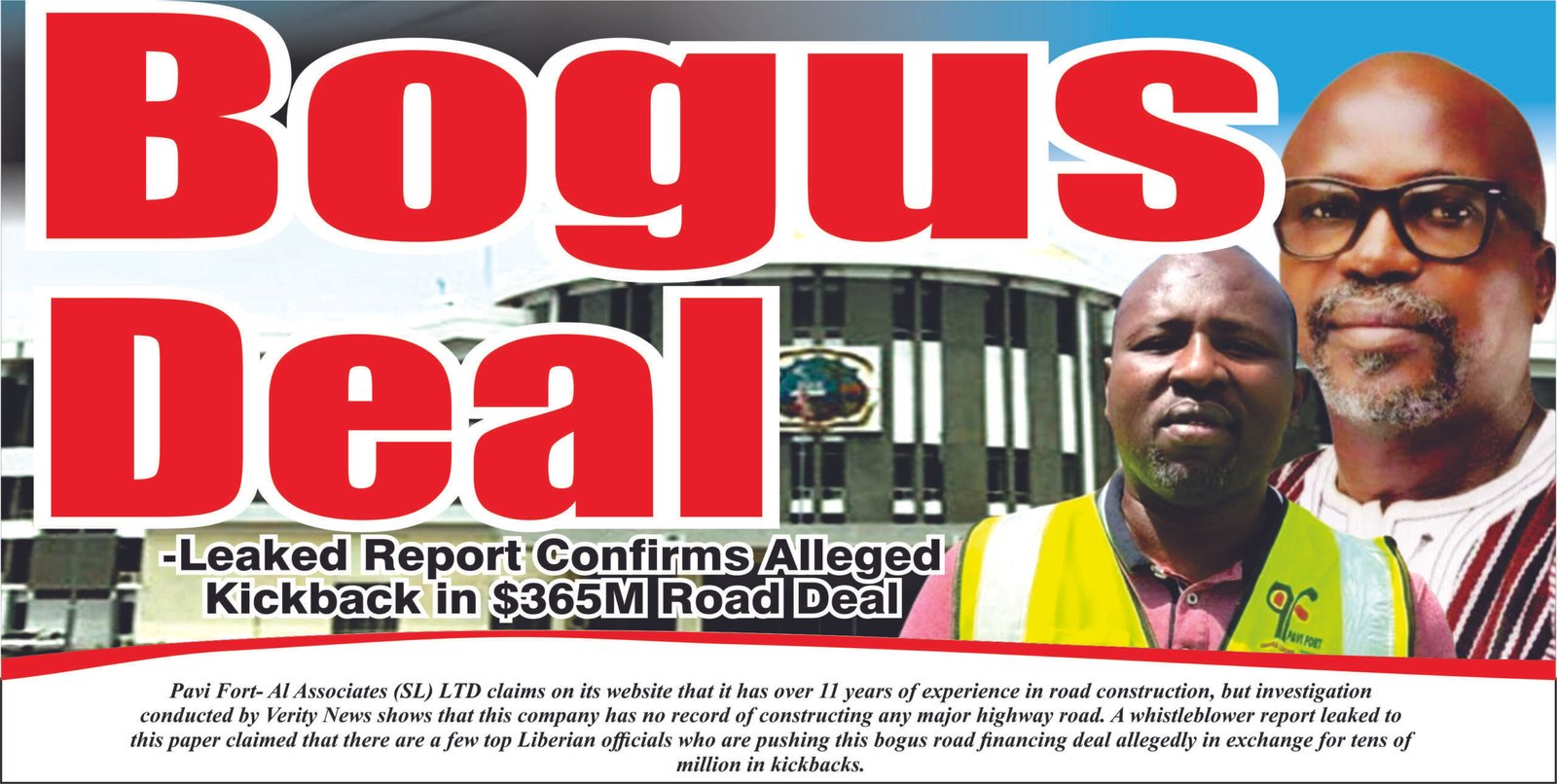
Pavi Fort-Al Associates (SL) LTD claims on its website that it has over 11 years of experience in road construction. However, an investigation by Verity News shows the company has no record of constructing any major highway.
A whistleblower report leaked to this paper alleges that top Liberian officials are pushing this road financing deal in exchange for tens of millions in kickbacks.
The Government of Liberia has confirmed that it submitted a proposed US$364 million road concession agreement with Pavi Fort-Al Associates, Inc. to the Legislature for approval.
The agreement, forwarded by the Executive Branch in July 2025, proposes a Build, Operate, and Transfer (BOT) arrangement over five years to pave 255 kilometers of major road corridors, including:
St. Paul Bridge to Klay, Bomi County
Klay to Bo Waterside
Klay to Tubmanburg
Madina to Robertsport
Voinjama to Mendikorma
Information Minister Jerolinmek M. Piah stated that the initiative reflects the Boakai administration’s commitment to improving Liberia’s road infrastructure, boosting trade, and enhancing connectivity between counties.
In contracts, professional Engineer John Kpehe Boimah, Team Lead of Boimah Engineering Incorporated (BEI) is appealing to the Liberian Senate, urging the immediate and unconditional cancellation of the proposed Pavi Fort-Al Associates road financing agreement.
Engineer Boimah warned that the deal risks replicating past problematic agreements that burdened Liberia with debt while offering limited benefits to the population.
He emphasized that Liberia’s development must be led by Liberians and for Liberians, stressing the importance of capacity, credibility, and a proven track record in national infrastructure projects.
Boimah’s analysis highlights five critical concerns with the proposed concession:
Exclusion of Liberian Professionals-Centralizing contracts and decision-making in a foreign entity locks local firms out of project funding, procurement opportunities, and professional growth.
Loss of Employment and Professional Empowerment-Critical leadership, engineering, and management roles are likely to be filled by expatriates, leaving Liberian engineers in low-level positions.
Lack of Technical Transfer and Capacity Building -The deal provides no structured mechanism for skills development, mentorship, or institutional training for Liberian engineers or the Ministry of Public Works (MPW).
Economic Disempowerment-Financial benefits, including salaries and contract profits, will flow outward, bypassing Liberian professionals and weakening the local economy.
Perpetuation of Neo-Colonial Dependency- The agreement risks locking Liberia into a model where critical technical expertise and decision-making remain foreign-controlled, undermining economic sovereignty
Boimah urging the Legislature to direct the MPW to engage a competent, well-experienced international firm through a transparent and competitive bidding process, with binding clauses for local content and capacity transfer.
A Vision for Liberian-Led Development
Boimah Engineering Incorporated, a Liberian professional services firm specializing in highway design, geotechnical investigations, and construction supervision, exemplifies local capacity.
With international experience, including twenty years at the Michigan Department of Transportation (MDOT) in the United States, Engineer Boimah stressed that Liberian engineers are fully capable of leading national infrastructure projects.
“The Honorable Legislature must recognize that sustainable development lies in empowering Liberians-not outsourcing our nation’s future,” Boimah said. “This concession, in its current form, is a direct threat to our economic empowerment and technical sovereignty.”
Sierra Leone Controversy Intensifies
The Pavi Fort deal also raises questions in Sierra Leone, where reports of alleged “ghost projects” and out-of-budget expenditures have led to IMF funding suspensions and potential financial repercussions from other multilateral agencies.
In November 2024, State House reportedly authorized a $60 million payment to Pavifort Construction, owned by businessman Alimu Barrie, a figure with close ties to top officials. Ministry of Finance insiders claim the funds were disbursed without clear justification, raising suspicions of ghost projects. Pavifort’s Operations Manager denied receiving the full $60 million at once; stating payments were tied to verified milestones.
Investigations by Calabash Newspaper suggest claims of Pavifort receiving $60 million in a single payment were “entirely false and misleading.” Nevertheless, concerns persist amid broader allegations of corruption, including accusations against Sierra Leone’s First Lady and her family of acquiring properties abroad through opaque financial means, reportedly linked to top government contractors.
The controversy highlights the need for transparency, accountability, and proper vetting of firms entrusted with national infrastructure, reinforcing Engineer Boimah’s call for a locally empowered, professionally sound, and fully accountable approach to Liberia’s road development projects.