


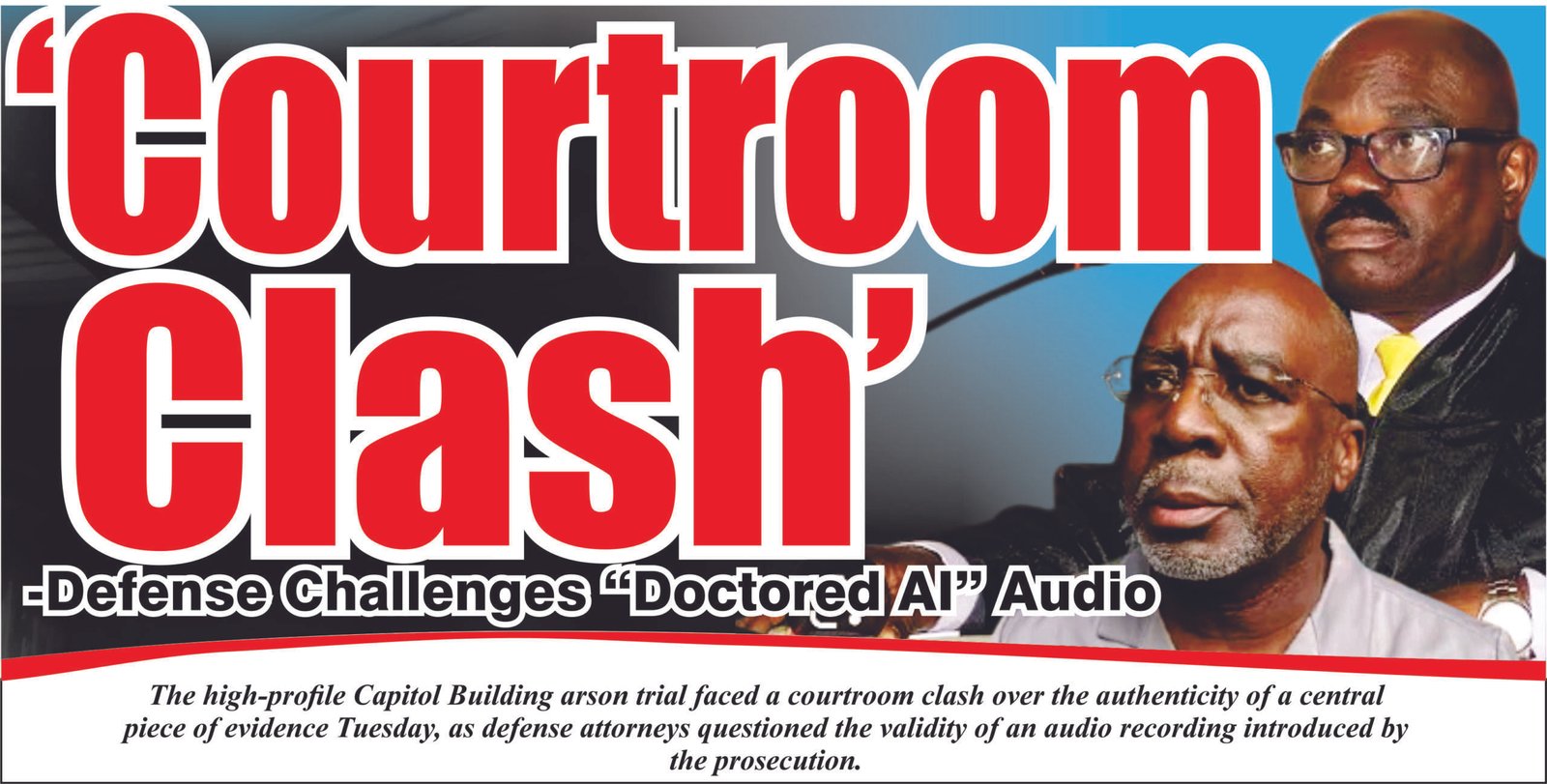
The high-profile Capitol Building arson trial faced a courtroom clash over the authenticity of a central piece of evidence Tuesday, as defense attorneys questioned the validity of an audio recording introduced by the prosecution.
The recording, which prosecutors allege captures former House Speaker Cllr. Jonathan Fonati Koffa and co-defendants discussing plans for the December 18, 2024, fire, was played in court but proved largely unintelligible to the judge, jury, and spectators.
Defense counsel immediately raised objections, describing the clip as “ducted AI,” suggesting that it may have been artificially generated or manipulated, rather than a faithful record of the defendants’ conversations.
The defense Attorneys argued that the chain of custody was unclear, no certified transcript exists, and the officer presenting the recording, Rafael Wilson of the Liberia National Police, lacked the necessary expertise to verify its authenticity.
Wilson testified that the audio had been retrieved from one of the defendants’ mobile phones, though he conceded he did not personally extract the file.
The defense highlighted that the file was initially handled by a national security officer known only as “Jay Jay,” raising further doubts about the evidence’s reliability.
Judge Roosevelt Z. Willie overruled the objections, stating, “the audio cannot be hearsay.
The court’s focus is whether the recording reflects truthful content, not the method of its creation.”
Despite the ruling, the poor sound quality left much of the recording incomprehensible, prompting visible frustration among courtroom attendees.
Prosecutors maintained that the audio was genuine and originated from the defendants’ personal phones, insisting that it was central to proving the alleged conspiracy, arson, and attempted murder charges.
In addition to the recording, prosecutors presented physical evidence, including a Clorox bottle and a box of matches.
Defense lawyers again raised concerns, pointing out discrepancies between the matchbox shown during earlier court appearances and the one submitted for forensic testing. Judge Willie allowed the items into evidence, citing minor differences in markings as insufficient to bar their inclusion.
The trial continues to unfold amid contentious disputes over the legitimacy of digital and physical evidence, highlighting the challenges courts face in an era of advanced technology and AI-generated media.