


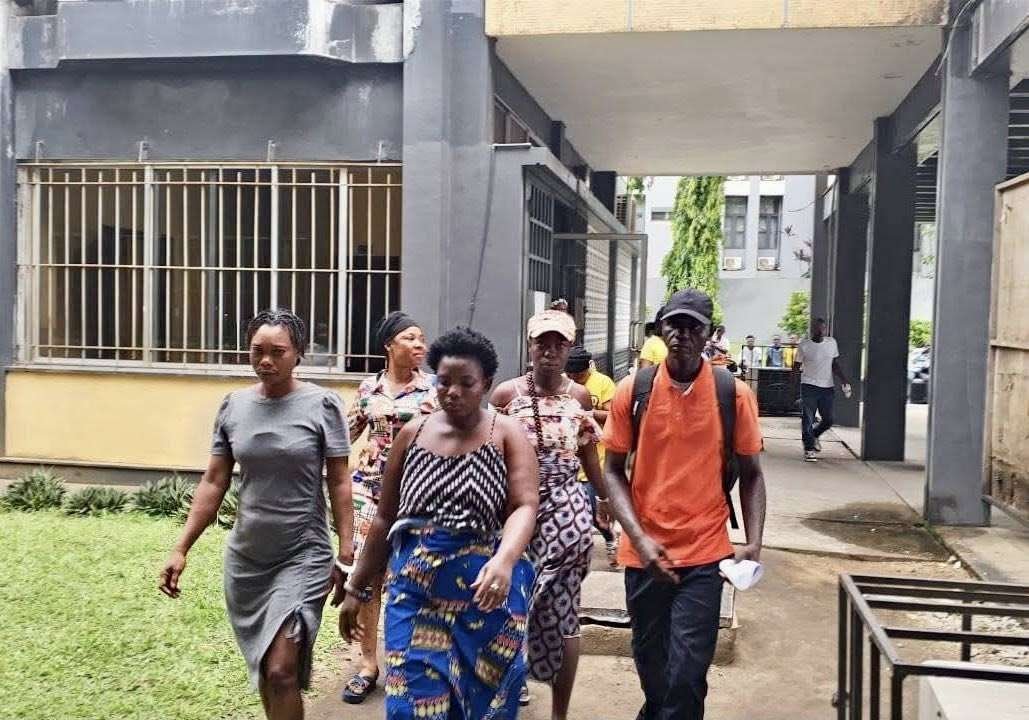
Criminal Court “A” at the Temple of Justice in Monrovia has sentenced five women to 20 years in prison each after finding them guilty of trafficking 14 minors and engaging in criminal conspiracy, in a case that has drawn national attention to child protection and cross-border exploitation.
The ruling was delivered on Monday by Judge Roosevelt Z. Willie during the court’s February Term in Montserrado County.
The convicted individuals, Halimantu Daramy, Grace Sesay, Hawa Kamara, Henrita Beayce, and Famata Doe—were prosecuted by the Ministry of Justice.
According to court records, the defendants were arrested on April 10, 2025, at the Red Light transport hub in Monrovia by officers of the Liberia Immigration Service.
They were found traveling with 14 children, most of whom were later determined not to be their biological offspring.
Investigators from the Liberia National Police testified that the women intended to transport the children through neighboring countries, including Ivory Coast and Burkina Faso, en route to Mali. Authorities alleged that the objective was to exploit the minors for financial gain, including accessing resettlement benefits from international aid programs.
Evidence presented in court further revealed that the same group had previously traveled to Mali in 2024 with eight children under similar circumstances.
Upon their return, they reportedly received financial assistance from humanitarian organizations, including the International Organization for Migration and the Red Cross.
Prosecution key witnesses
Prosecution witnesses, including immigration officers and child protection officials—described how the defendants used deception, falsified documentation, and coordinated efforts to recruit and transport the children.
Officials from the Ministry of Gender, Children and Social Protection confirmed that the children, aged between 11 months and eight years, are currently under state care. While some were temporarily reunited with relatives, all remain under government protection pending the identification of their biological families through DNA testing.
Defense lawyers argued that the children were never taken outside Liberia and therefore were not exploited. However, the court rejected this argument, ruling that trafficking does not require successful cross-border movement or completed exploitation.
Court Findings
Judge Willie held that the essential elements of human trafficking—recruitment, transportation, harboring, and intent to exploit—were clearly established.
He further ruled that the defendants acted in coordination, thereby meeting the legal threshold for criminal conspiracy.
“The crime of trafficking in persons can occur whether domestically or internationally,” the court stated, emphasizing that intent and preparatory actions alone are sufficient under Liberia’s 2021 Trafficking in Persons Act.
The judge also noted that two of the defendants’ decisions not to testify allowed the jury to draw reasonable inferences from the unchallenged evidence presented by the prosecution.
Sentencing and Orders
All five defendants were sentenced to 20 years’ imprisonment.
The court ordered the immediate enforcement of the judgment at Monrovia Central Prison.
Additionally, the Ministry of Gender has been mandated to maintain custody of the 14 children, ensuring access to food, shelter, healthcare, and education.
The court also ordered DNA testing for any individual claiming parental or familial ties before custody determinations are made.
The case underscores ongoing challenges in combating child trafficking in West Africa, where porous borders and economic vulnerability often facilitate exploitation.
“This judgment reinforces Liberia’s commitment to fighting human trafficking and safeguarding vulnerable populations,” a justice official said following the verdict.