

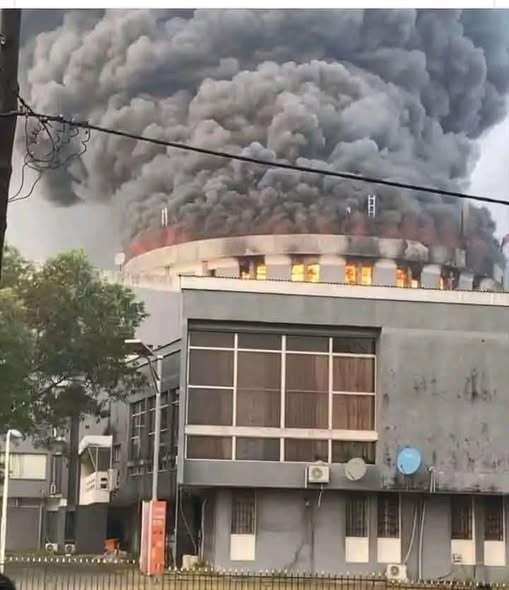
Dramatic courtroom exchanges unfolded at the Criminal Court “A” this week as defense lawyers in the alleged Capitol Building arson case challenged the credibility of prosecution evidence, raising an alibi defense for one of the accused, Thomas Etheridge, and pointing to contradictions in witness testimony and forensic reports.
Disputed Vehicle Involvement
Under cross-examination, a prosecution witness testified that Vehicle 98 was initially arrested at the Capitol Building and later taken to the Liberia National Police (LNP) headquarters along with Mr. Etheridge and other defendants.
The witness said the vehicle was later determined not to have been directly linked to the accident under investigation, and that Cllr. Massaquoi signed for the release of both the suspects and the vehicle.
However, the witness further claimed that investigators later gathered information suggesting the vehicle was used to transport individuals and materials allegedly connected to the arson, prompting its return to the LNP for further examination to determine whether it played a role in the incident.
Defense counsel objected, arguing that the testimony was highly prejudicial and misleading, as it implied the vehicle’s involvement in the crime without definitive proof.
The defense maintained that such testimony unfairly suggested guilt before the jury.
Call Logs and Alibi Defense
A central focus of the trial was call-log evidence presented by the defense, which they say places Thomas Etheridge away from the Capitol Building at the time the crime was allegedly committed.
According to the call records, Etheridge’s phone showed activity at:
5:07 a.m., LEC facility in Waterside
5:51 a.m., Capitol Bypass
6:25 a.m., Capitol Building
Defense lawyers argued that the crime occurred before Etheridge could have been at the Capitol, making it physically impossible for him to have participated.
They formally announced an alibi defense, asserting that the call logs create reasonable doubt as to his presence at the scene during the commission of the crime.
The prosecution countered that the witness was not called as a technical expert and that GPS and call-log interpretation would be addressed by a qualified specialist.
However, the defense insisted the witness should explain the data, noting that he had already testified about Etheridge’s location.
The court overruled the objection and instructed the witness to respond.
Judge Notes Contradictions
Presiding Judge Roosevelt Z. Willie observed that the prosecution witness appeared not properly prepared, particularly where his oral testimony conflicted with the call-log evidence.
The witness clarified that he never testified that the Capitol Building was already on fire at 5:00 a.m., stating instead that:
At 5:07 a.m., Etheridge was near the LEC facility;
At 5:51 a.m., he was near the Capitol Bypass.
He further testified that the call logs showed Etheridge communicating with Kevi Bai and other co-defendants during the early morning hours.
Conflicting Accounts of Physical Evidence
Further contradictions emerged regarding the discovery of physical evidence at the alleged crime scene.
When asked about an empty chloride bottle and matches, the witness testified that:
The chloride bottle was found on the morning of December 18, 2024, approximately 25 feet from where the Speaker’s vehicle was parked;
A box of matches was discovered on the second floor of the Capitol Building.
However, the defense pointed to the Special Investigative Report, signed by the same witness, Rafael Wilson, Assistant Commissioner of Police and head of the Crime Services Department.
The report states that:
“The Liberia National Police forensic team lifted from the grounds of the Capitol Building, precisely around the William R. Tolbert Hall, an empty chloride bottle with blue.
The forensic team also found a box of matches with several sticks of matches on the second floor of the building that hosts the joint chamber of the Legislature.”
Defense lawyers argued that the discrepancies between the witness’s testimony and the written forensic report further undermine the credibility of the prosecution’s case.
The trial continues as the court prepares to hear from forensic and technical experts, including those expected to testify on GPS and call-log analysis.
The outcome of the alibi defense and the weight of the disputed evidence are expected to play a critical role in the jury’s determination.