


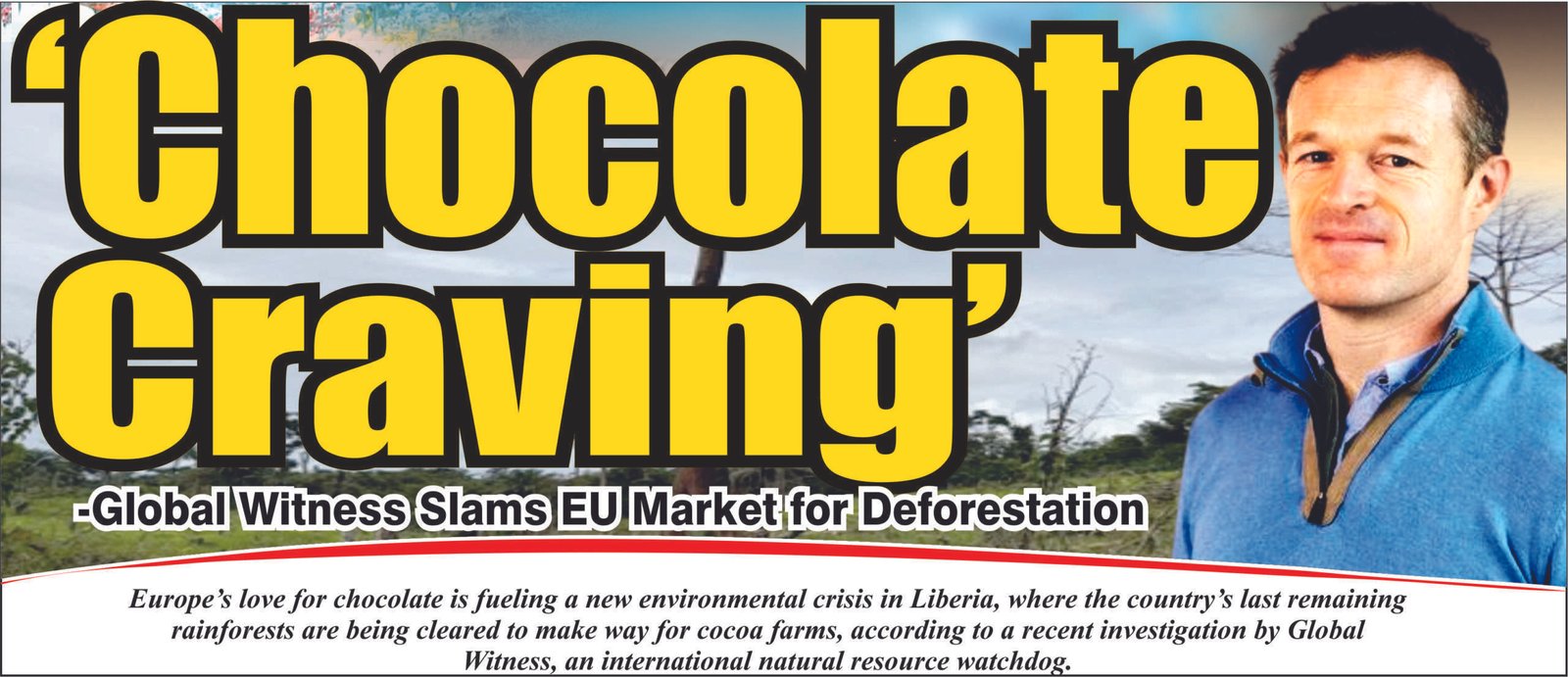
Europe’s love of chocolate is fueling a new environmental crisis in Liberia, where the country’s last remaining rainforests are being cleared to make way for cocoa farms, according to a recent investigation by Global Witness.
Satellite imagery and on-the-ground reporting reveal that Liberia’s cocoa-producing “belt,” spanning Bong, Nimba, and Lofa counties, has lost over 250,000 hectares of forest between 2021 and 2024, an area larger than the European country of Luxembourg.
This rapid deforestation is driven by soaring global cocoa prices, rural poverty, and the arrival of migrant farmers from Côte d’Ivoire and Burkina Faso.
Opaque Supply Chains
The investigation uncovered how major chocolate brands, including Mars, KitKat, Hershey’s, Dairy Milk, and Mondelēz (Cadbury), are indirectly linked to Liberian deforestation.
While these companies do not source cocoa directly from Liberia, they purchase bulk cocoa through European traders using a system known as “mass balance.”
This method allows cocoa from deforested areas to be mixed with certified “sustainable” beans from other countries, making it impossible to trace the origins of individual beans.
Global Witness found that more than 20 million kilograms of high deforestation-risk Liberian cocoa were imported into the EU between 2022 and 2025. Traders such as ECOM, Touton, OFI (Olam), and Cargill play a central role in moving these beans from Liberian exporters to global chocolate markets.
Ironically, many of these “deforestation-linked” cocoa beans carry certifications from the Rainforest Alliance, raising concerns about the reliability of voluntary sustainability labels.
The Role of Middlemen
Most Liberian cocoa farms are smallholdings, averaging around two hectares. Farmers sell their beans to local “middlemen,” who then transport the cocoa to exporters in Monrovia. These middlemen buy indiscriminately, and exporters rarely demand proof that the cocoa is deforestation-free, ensuring a steady flow of beans from cleared forests into global supply chains.
Exporters such as Aya Group, Granex, and Trade Link are beginning to map their supplier farms in response to upcoming EU regulations, but efforts remain patchy.
EU Deforestation Regulation: A Glimmer of Hope?
The European Union’s Deforestation Regulation (EUDR), set to take effect at the end of this year, aims to ensure products sold in Europe are fully traceable and free from deforestation. Some exporters and chocolate companies, such as Mars and Nestlé, are supporting the law, while others, including Mondelēz, have lobbied for delays.
European campaigners argue that the law has already incentivized Liberian exporters to begin mapping their suppliers, a step toward traceable and sustainable cocoa. Yet the proposed delay threatens to slow progress and leave Liberia’s forests increasingly vulnerable.
Lessons from Côte d’Ivoire
Liberia’s forests are home to the Upper Guinean Rainforest, a vital habitat for endangered species like chimpanzees and a crucial regulator of regional rainfall.
Experts warn that if deforestation continues at the current pace, Liberia could face the same fate as Côte d’Ivoire, where cocoa expansion has nearly eradicated forests outside protected areas.
Farmers in Liberia, motivated by high cocoa prices, are embracing “slash-and-burn” methods to clear land for cocoa cultivation, often intercropping with rice or cassava. One farmer in Bong County noted: “Cocoa has money.”
The cocoa boom, while a lifeline for rural communities, carries long-term risks. Environmental changes from deforestation-including reduced rainfall and increased pests; threaten future cocoa productivity, potentially creating a vicious cycle of “boom and bust.”
A Global Responsibility
Global Witness emphasizes that chocolate companies, traders, and international actors all have a role in halting deforestation in Liberia. Without clear supply chain accountability and support for smallholder farmers, the country’s forests could vanish within a decade.
For Europe’s chocolate lovers, the cost of an afternoon treat may be higher than they realize, it could come at the expense of some of West Africa’s last rainforests.