


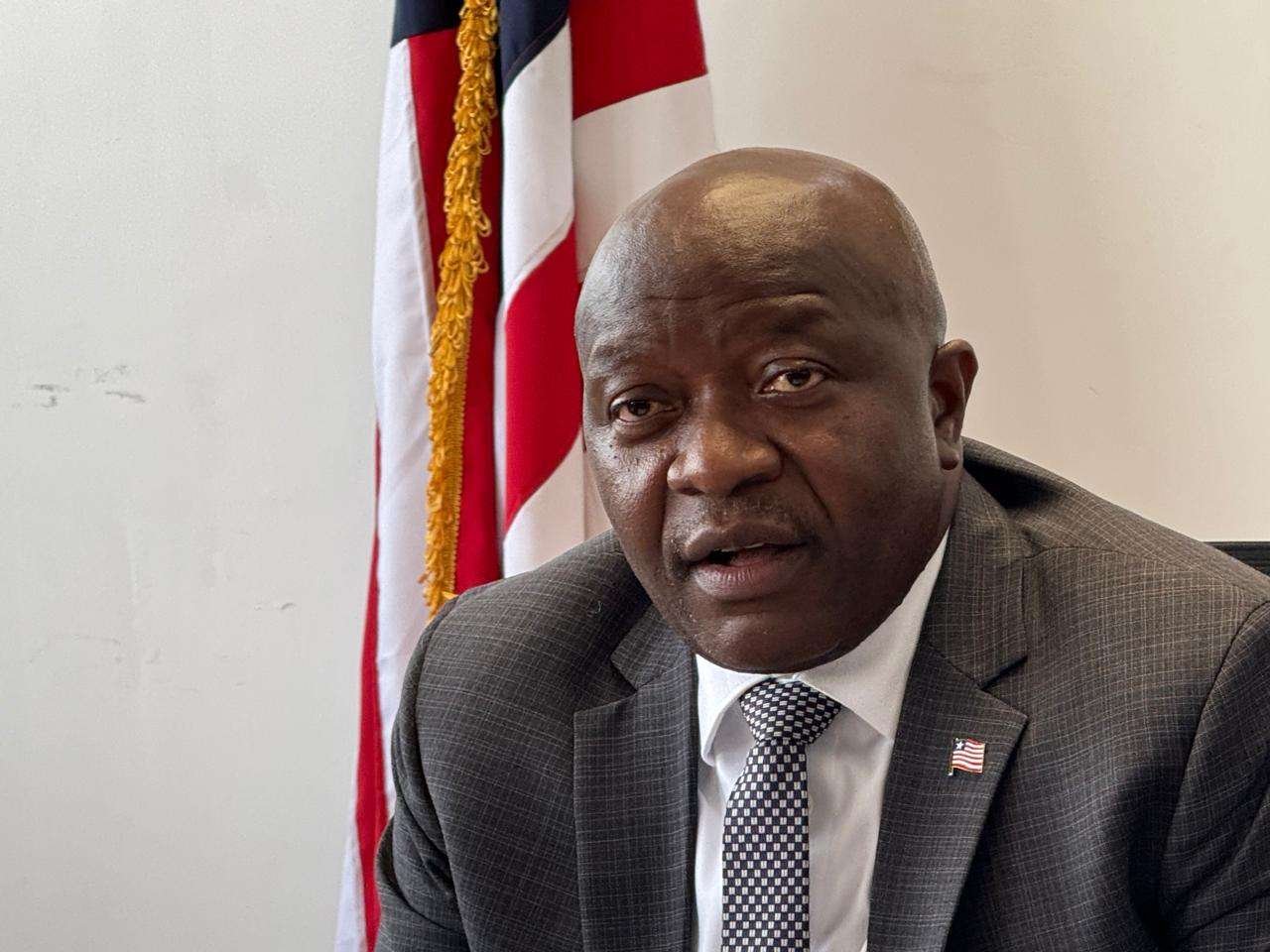
Monrovia — Liberia’s Minister of Finance and Development Planning, Augustine Kpehe Ngafuan, says the country’s economy is in a stronger position today than it was two years ago, citing solid economic growth, historically low inflation, record domestic revenue collection, and improved fiscal discipline—achieved despite a sharp reduction in donor support.
The Finance Minister made the remarks Tuesday during a special press engagement aimed at expanding on President Joseph Nyuma Boakai Sr.’s Annual Message to the Nation. According to Ngafuan, the President’s address went beyond a constitutional obligation and should be understood as what he termed “a national accounting”—a results-based assessment of progress made and challenges ahead.
“The central truth of the President’s message is clear,” Ngafuan told journalists. “Liberia’s economy is stronger today than it was two years ago, and the evidence supporting this is clear.”
To back that assertion, the Minister outlined several key economic indicators. He disclosed that Liberia recorded economic growth of 5.1 percent in 2025, surpassing earlier projections and improving on the previous year’s performance. Inflation, he noted, dropped to 4 percent—the lowest level in more than two decades—while international reserves rose by 101 million United States dollars. In a development he described as historic, Minister Ngafuan said the Central Bank of Liberia posted two consecutive operational surpluses for the first time in many years.
Taken together, he explained, these improvements have helped stabilize the market, strengthen confidence in the Liberian dollar, and create a more predictable business environment.
Beyond macroeconomic stability, the Finance Minister pointed to strong domestic revenue performance as another major milestone. According to him, the government collected 847.7 million United States dollars in domestic revenue—the highest amount in Liberia’s history—exceeding its target by more than 43 million dollars.
He attributed the achievement to tighter fiscal controls, reduced leakages, and strengthened oversight by institutions such as the Liberia Revenue Authority, the General Auditing Commission, the Liberia Anti-Corruption Commission, and the Central Bank of Liberia.
“These results show that Liberia can finance a greater share of its own development when governance is disciplined and institutions are empowered,” Minister Ngafuan averred.
Importantly, the Minister emphasized that these gains were made during a period of declining donor support—an outcome many observers feared would destabilize the economy. Instead, he said, the government responded by tightening expenditure management while protecting critical sectors such as health, education, and infrastructure.
“We did not allow external disruptions to dictate our destiny,” he insisted. “We kept the country stable, preserved confidence in our institutions, and demonstrated that Liberia can stand on its own feet.”
Minister Ngafuan also used the engagement to address criticism that the government is taking credit for projects initiated under previous administrations, particularly in roads, electricity, and health infrastructure. Rejecting that narrative, he argued that development projects belong to the Liberian people, not individual political leaders.
“The projects being implemented are not projects for government officials,” he said, citing the regional hospital project that began in 2016 using excess Ebola funds. He stressed that successive governments have a responsibility to continue and complete national projects, regardless of when they were initiated.
While acknowledging that challenges remain, the Finance Minister maintained that Liberia is on a better trajectory today than it was two years ago.
“We are not yet where we want to be, but we are certainly not where we were,” he said. “Today is better than yesterday. Tomorrow will be better than today.”
Pushing Back on Opposition Criticism
During the same engagement, Minister Ngafuan strongly defended President Boakai’s Annual Message against criticism from opposition figures, dismissing some of the attacks as shortsighted and disconnected from the administration’s long-term economic strategy.
Responding specifically to comments from Alternative National Congress (ANC) leader Alexander Benedict Cummings—who questioned the government’s emphasis on infrastructure rather than immediate “bread-and-butter” concerns—the Finance Minister argued that job creation remains the central focus of the Boakai administration.
According to him, investments in roads, energy, and other critical infrastructure are not a distraction from livelihoods, but rather the foundation for sustainable employment and economic growth.
“People don’t understand the link between infrastructure investment and job creation,” Hon. Ngafuan said. “When you reduce the cost of electricity and transportation, you reduce business expenses. That leads to higher profits, expansion, and ultimately, hiring.”
Energy, Jobs, and the Cost of Doing Business
Focusing on the energy sector, Minister Ngafuan noted that Liberia’s electricity access rate remains below 40 percent. He revealed that energy has once again been identified as a priority under the proposed Millennium Challenge Corporation (MCC) compact, with the government targeting access levels above 75 percent in the coming years.
He explained that high electricity costs remain one of the biggest burdens on small and medium-sized businesses, forcing many to rely on generators and expensive fuel.
“Ask any small business what their biggest cost is—they will tell you power,” he said. “Cheaper and reliable electricity directly improves profitability and job creation.”
Responding to Job Creation Doubts
Minister Ngafuan also defended President Boakai’s claim of creating more than 70,000 short- and medium-term jobs over the past two years, rejecting suggestions that the figure is unrealistic.
Breaking it down, he said the target translates to roughly 35,000 jobs per year, or just over 2,000 jobs annually per county—numbers he described as achievable.
He disclosed that the Ministry of Finance alone supported 277 interns last year, while acknowledging the need for improved systems to better track job creation across ministries and agencies.
“Criticism is part of democracy,” Minister Ngafuan underscored, “but we should also be honest about what is possible and what is already being done.”
Roads, Inflation, and Everyday Living
Addressing Cummings’ popular phrase— “Da cotal we will eat” —which implies prioritizing immediate consumption over long-term investment, the Finance Minister rejected the idea that infrastructure spending ignores everyday economic hardship.
He pointed to improved road connectivity to southeastern Liberia, explaining that better roads have reduced travel time, lowered transportation costs, expanded market access for farmers, and contributed to lower domestic food prices.
“When farmers can bring food to market faster, prices fall,” he insisted. “That affects inflation and puts more food on the table for ordinary Liberians.”
Minister Ngafuan emphasized that roads, energy, education, and health emerged as top national priorities during consultations for the government’s development agenda.
Openness, Accountability, and Confidence in the Path Ahead
The Finance Minister said his engagement with the media reflects a renewed culture of openness and transparency under the Boakai administration, stressing that public trust must be earned through accountability and data-driven dialogue.
He encouraged journalists to continue questioning government policies and spending, noting that progress must ultimately be felt in households, markets, and communities across the country.
“Liberia is moving forward,” Minister Ngafuan asserted. “And together, we will ensure that the progress outlined by the President is not only seen but felt.”