


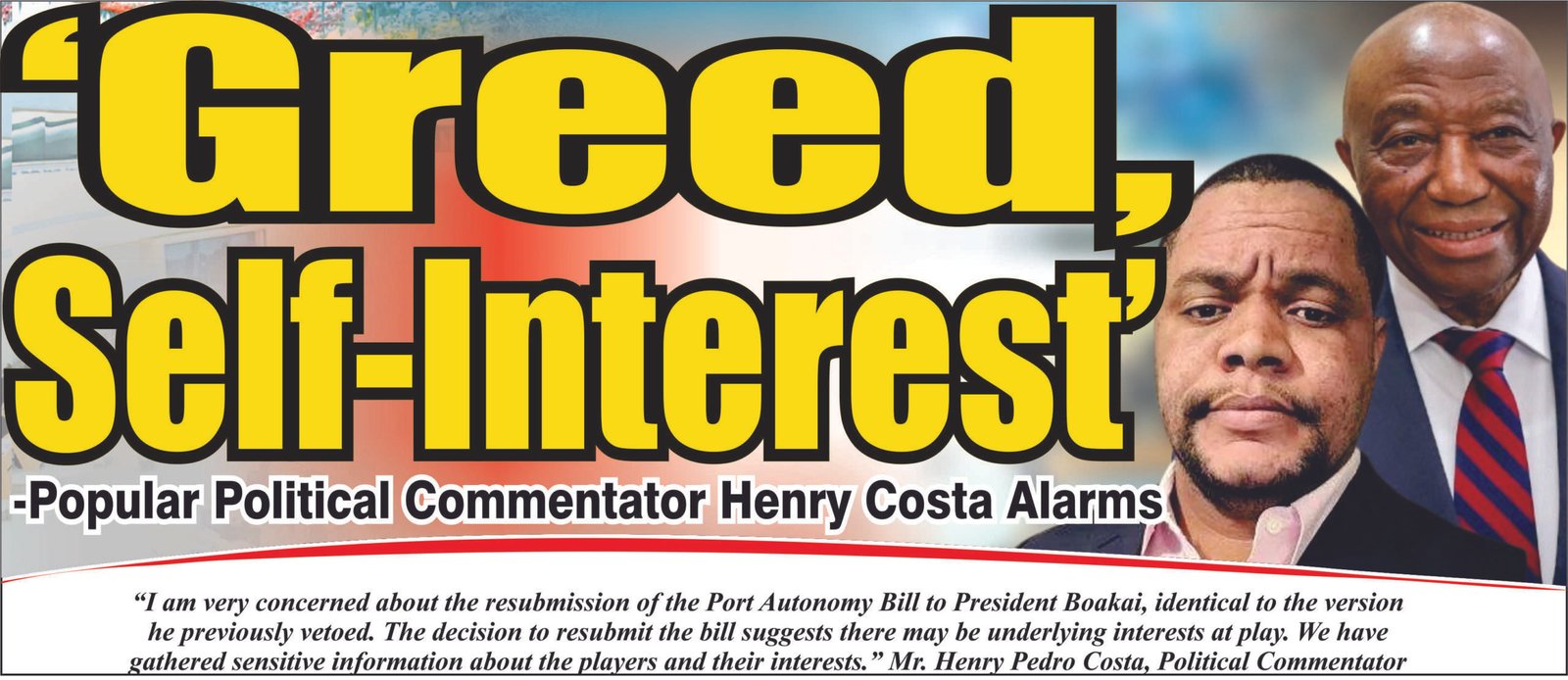
“I am very concerned about the resubmission of the Port Autonomy Bill to President Boakai, identical to the version he previously vetoed. The decision to resubmit the bill suggests there may be underlying interests at play. We have gathered sensitive information about the players and their interests,” Costa noted.
The resubmission of the Port Autonomy Bill to President Joseph N. Boakai has reignited national debate, with prominent political commentator Henry P. Costa sounding a sharp alarm over what he describes as “greed and self-interest” driving the process.
According to Costa, the Legislature’s decision to return a bill that is virtually unchanged from the version earlier vetoed by the President raised serious questions about motive, transparency, and commitment to national interest.
“This action prompts questions about the motivations behind it. The decision to resubmit the bill suggests there may be underlying interests at play. We have gathered sensitive information about the players and their interests. We will speak soon,” Costa stated.
Despite these concerns, Costa expressed confidence in President Boakai’s leadership, describing him as “a wise and good leader” who he trusts will act in the best interests of the nation.
The Legislature recently resubmitted the previously vetoed port reform acts to the Office of the President for assent. However, a review of the so-called “revised” legislation now before the President shows that lawmakers largely maintained the same provisions that prompted the initial veto.
The core policy and governance issues cited by the President remain unaddressed, even as the Senate has argued publicly that the veto was limited to matters of naming, formatting, or minor drafting errors, claims that critics say are inconsistent with the record.
The National Port Authority (NPA) has responded with disappointment, while reaffirming its respect for the Legislature’s constitutional authority to make laws.
For the second time, the NPA noted, the bill was passed without the involvement of key institutions, despite the President’s veto clearly calling for broader consultation across the Executive branch.
Consistent with that veto, the NPA said it had expected to be invited to participate in revising the legislation, along with the Liberia Maritime Authority, Ministry of Finance and Development Planning, Liberia Revenue Authority, Ministry of Justice, and other relevant stakeholders.
The absence of such engagement, the Authority said, represents a missed opportunity to build consensus around reforms that carry far-reaching implications for Liberia’s maritime sector and national economy.
There is broad agreement among policymakers and experts that reform of the port sector is urgently needed, particularly given that Liberia’s current legal framework dates back to 1971.
However, critics argue that reform must be guided by proven models. Regional and global experience consistently shows that successful port reforms are anchored in unified landlord port systems, which balance operational authority at outstation ports with strong national oversight, regulatory clarity, and institutional coordination.
Many development and port experts have warned that the proposed decentralization of Liberia’s seaports risks institutional fragmentation, unnecessary fiscal pressure, and weakened regulatory coherence. Such outcomes, they argue, could undermine the statutory roles of existing institutions without any compelling justification.
The Senate’s push to grant autonomy to outstation ports operating under the NPA has drawn widespread criticism, with several experts describing the proposal as a “recipe for chaos.”
In 2025, Senate Pro-Tempore Nyonblee Karnga-Lawrence was accused of politicizing port management, alleging that selfish commercial interests-particularly surrounding control of the Port of Buchanan-may be influencing the legislative push.
Some have further suggested that such control could serve as an economic base for future political ambitions, though these claims remain matters of public debate.
Research by Verity News shows that regional competitors such as Ghana, Nigeria, and Côte d’Ivoire operate centralized port systems, with multiple outstation ports managed under a single national port authority-an approach widely regarded as efficient and consistent with international best practices.
Despite repeated calls from experts and advocacy groups to abandon the decentralization effort, the Liberian Senate, under the leadership of Pro-Tempore Karnga-Lawrence, has continued to pursue passage of the bill.
On Tuesday, October 17, 2025, a report from the Joint Committee on Public Corporations and Judiciary, Human Rights, Claims and Petitions on the proposed “Act to Create the Liberia Sea Port Regulatory Authority and Liberia Sea Port Decentralization” appeared on the Senate’s agenda.
However, without clear explanation, the Senate did not proceed to debate the report.
Among the strongest critics of the proposal is David F. Williams, former Managing Director of the NPA.
In a statement shared with Verity Newspaper, Williams warned that the bill is economically unsound and inconsistent with global port industry standards.
“The recommendation by the Liberian Senate to make the outstation ports autonomous should be rejected in its entirety,” Williams said. “There is no empirical study to support such a dramatic shift, and it does not align with port industry best practices, whether in the sub-region or globally.”
Williams cautioned that introducing multiple autonomous port authorities would lead to inefficiency, duplication of services, and fragmentation that Liberia can ill afford. Other experts echoed his concerns, noting that many outstation ports are not financially self-sufficient and rely on the NPA to absorb liabilities and operational shortfalls.
Autonomy, they warned, could result in unsustainable debts and even port closures in less commercially viable areas.
They have also raised alarms, arguing that decentralized port management could weaken national oversight and create vulnerabilities in security and regulatory enforcement. Fragmented systems, they say, could increase risks of smuggling, unauthorized entry, and non-compliance, while fostering costly duplication and inconsistent service standards.
As the Port Autonomy Bill once again awaits President Boakai’s decision, the debate continues to expose deeper concerns about governance, accountability, and whether Liberia’s port reforms are being shaped by national interest-or by the very “greed and self-interest” Henry Costa has warned the nation about.