

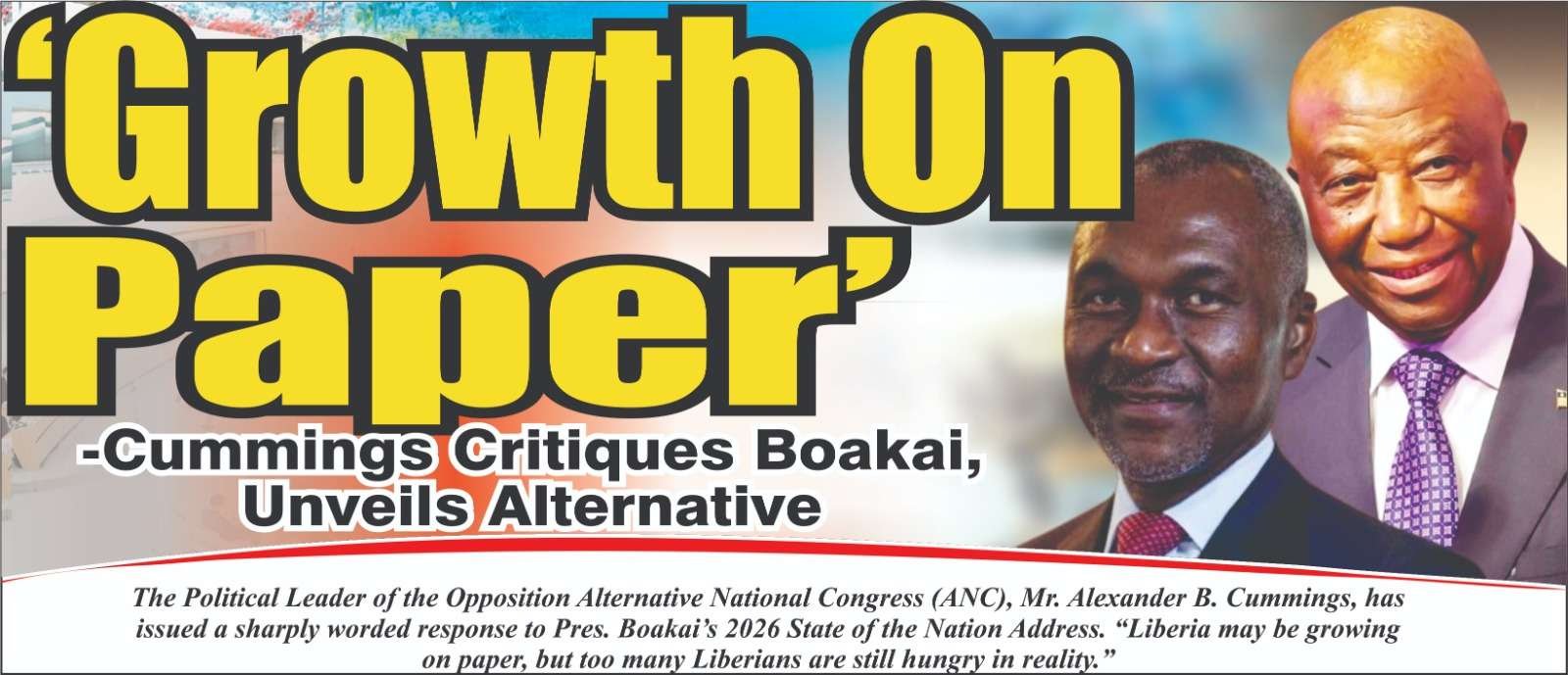
“Liberia may be growing on paper, but too many Liberians are still hungry in reality,” Mr. Alexander Cummings.
The Political leader of Opposition Alternative National Congress (ANC) and former presidential candidate Mr. Alexander B. Cummings on Tuesday, January 27, 2026, issued a sweeping and sharply worded response to President Joseph Nyuma Boakai’s 2026 State of the Nation Address, challenging the administration’s claims of economic recovery and unveiling what he called a “People’s Alternative” focused on jobs, food security, decentralization, and accountability.
Responding to President Boakai’s 2026 State of the Nation Address, Mr. Cummings questioned whether the government’s reported economic gains are translating into real improvements in the lives of ordinary Liberians.
“Macroeconomic stability is not the same as microeconomic survival,” Cummings said, while asking pointedly: “Recovery for whom? Progress for who? Results where?”
While acknowledging President Boakai’s leadership and personal commitment to Liberia, Cummings argued that official statistics on growth and inflation mask deepening hardship across the country.
He cited Liberia’s ranking near the bottom of the Global Hunger Index- that 112th out of 123 countries-and warned that hunger, not GDP growth, remains the defining reality for millions.
“Two in every five Liberians do not eat sufficiently,” he said, describing hunger as a national emergency that undermines education, health, and long-term development.
Using popular street expressions to underscore his message, Cummings added: “Da roads we will eat? You cannot cook coal tar.”
A ‘Moral Budget’ Under Fire
A central focus of Cummings’ critique was the government’s US$1.2 billion national budget, the largest in Liberia’s history. He described the budget not merely as a financial plan, but as “a moral document” that reveals national priorities.
He questioned rising allocations to the Legislature-now exceeding US$51 million-and a 50 percent increase in funding for the National Security Agency, while public hospitals lack basic supplies and schools struggle without materials.
Cummings also raised concerns about how expected windfalls, including a US$200 million ArcelorMittal signature bonus, are being absorbed into what he called a “bloated system” rather than producing visible improvements in people’s lives.
Farmers, Women, and Youth at the Center
Presenting his alternative agenda, Cummings called for allocating at least 10 percent of the national budget to agriculture, in line with international commitments.
He emphasized investment in agro-processing, feeder roads, and storage facilities to move farmers from subsistence to profitability.
He placed particular emphasis on women, noting that they own more than half of Liberia’s small businesses but remain locked out of credit and vulnerable to violence.
“A nation that cannot protect its daughters cannot claim to be recovering,” he said, calling for stronger prosecution of sexual and gender-based violence and the creation of a national micro-loan scheme for market women.
For youth, Cummings proposed a National Youth Service Program, expanded technical and vocational training, and apprenticeships aimed at transforming short-term “hustle” jobs into sustainable careers.
Decentralization, Energy, and Anti-Corruption
Cummings also criticized what he described as superficial decentralization, arguing that counties remain financially dependent on Monrovia. He called for devolving real resources, not just authority, and strengthening county service centers to reduce the burden on citizens.
On energy, he urged immediate deployment of solar mini-grids and off-grid solutions, particularly for clinics, schools, and agro-processing facilities, warning that “a nation cannot develop in darkness.”
Addressing corruption, Cummings said indictments alone are insufficient. He called for special anti-corruption courts, aggressive asset recovery, and fully autonomous integrity institutions.
“Two convictions in two years is not an anti-corruption revolution,” he said.
Cummings concluded by framing his address as both a critique and a governing vision, positioning the People’s Alternative as a practical roadmap rather than political rhetoric.
“If the economy is growing, the people should feel it. He Leadership is not just service-it is delivery,” he noted.
With national elections still ahead, the address signals a clear escalation in political debate, drawing a stark contrast between government assurances of recovery and an opposition narrative centered on hunger, inequality, and unmet promises.
According to Cummings, the time for empty rhetoric is over, stating that the time for action is now.