
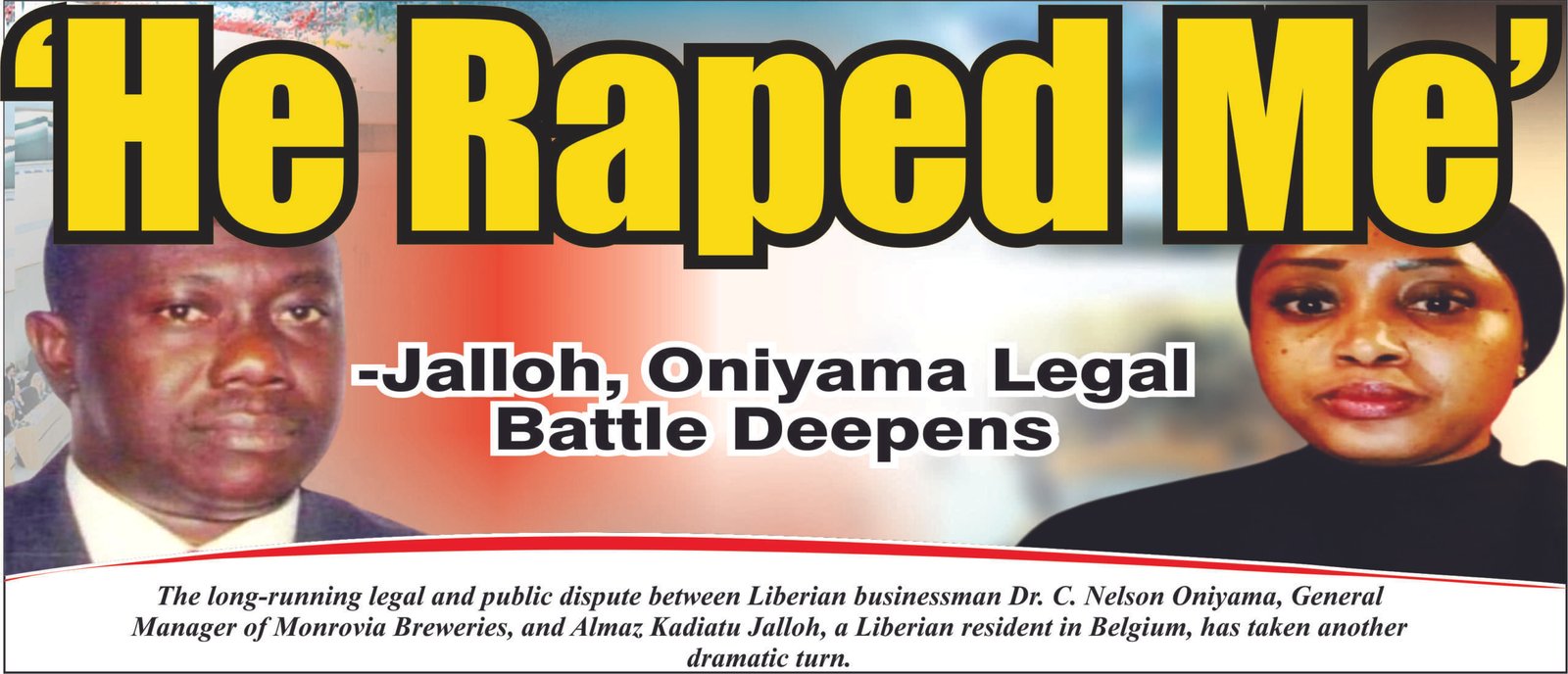
The long-running legal and public dispute between Liberian businessman Dr. C. Nelson Oniyama, General Manager of Monrovia Breweries, and Almaz Kadiatu Jalloh, a Liberian resident in Belgium, has taken another dramatic turn following a ruling by the Supreme Court of Liberia during its October Term, A.D. 2024.
The Supreme Court presided over by Chief Justice Sie-A-Nyene G. Yuoh, with Associate Justices Jamesetta H. Wolokollie, Yussif D. Kaba, Yamie Quiqui Gbeisay, Sr., and Ceaineh D. Clinton Johnson, heard arguments on October 30, 2024, and delivered its decision on December 19, 2024.
The case arose from a Petition for a Writ of Prohibition filed by Ms. Jalloh against proceedings at the Civil Law Court in Monrovia, where Dr. Oniyama had instituted an Action of Damages for Wrong Defamation against her.
Background of the Dispute
Dr. Oniyama initiated the defamation lawsuit, seeking damages reportedly under US$5 million, alleging that Ms. Jalloh had embarked on a campaign of false accusations intended to damage his character, professional standing, and business reputation.
The suit, filed through Sherman & Sherman, Inc., asserts that the relationship between the two parties was consensual and that allegations of rape and threats are false and malicious.
In a public statement issued as far back as February 18, 2019, Dr. Oniyama described the allegations against him as a “smear campaign” designed to blackmail and disgraces him, vowing to pursue legal redress.
Jalloh’s Allegations
Ms. Jalloh, however, maintains that she was a victim of rape, intimidation, and manipulation, and insists that her pursuit of justice has been obstructed through threats and alleged tampering with medical and DNA evidence.
In a detailed letter to Gender, Children and Social Protection Minister Williametta Saydee Piso-Tarr, Ms. Jalloh claimed she never had a consensual relationship with Dr. Oniyama. She alleged that the pregnancies that resulted in her two children were the product of repeated sexual abuse.
According to Ms. Jalloh, multiple DNA tests conducted between 2014 and 2016 produced contradictory results, which she believes were manipulated.
She alleged that medical institutions and individuals involved in the testing process were influenced to falsify outcomes in Dr. Oniyama’s favor.
“She insisted that DNA markers from the same child differed across tests, an anomaly she says is scientifically impossible,” the letter stated, adding that the inconsistencies point to deliberate interference.
Ms. Jalloh further alleged that she was subjected to repeated threats against her life and family, which prevented her from speaking out earlier.
She said her decision to go public was motivated by a desire for justice and to set a precedent against sexual violence in Liberia.
Court-Ordered Subpoena and Medical Records
In a related development, the Monrovia City Court, presided over by Stipendiary Magistrate L. Ben Barco, issued a Writ of Subpoena compelling Hope for Women International Hospital in Paynesville to provide names and contact information of medical personnel allegedly involved in altering Ms. Jalloh’s medical records dating back to January 23, 2014.
In response, the hospital submitted names of three former staff members, while maintaining that an internal review found no evidence of document alteration.
The hospital pledged continued cooperation with the court.
Supreme Court Proceedings
The Supreme Court case centered on whether the Civil Law Court judges acted within their jurisdiction in entertaining Dr. Oniyama’s defamation suit while related allegations were still contested.
Ms. Jalloh, as appellant, sought to prohibit further proceedings, arguing that her rights were being violated and that the lower court proceedings were improper under the circumstances.
The Supreme Court’s ruling on December 19, 2024, effectively clarified the procedural posture of the case, allowing the underlying legal battle to continue within the framework of the law.
Public Interest and Broader Implications
The case has attracted significant public attention, touching on sensitive issues of sexual violence, women’s rights, defamation, and judicial accountability.
Advocacy groups and members of civil society continue to monitor developments closely, citing the case as emblematic of broader challenges facing survivors of sexual abuse in Liberia.
As the matter proceeds through the courts, both parties remain entrenched in their positions-Dr. Oniyama seeking vindication and reputational restoration, and Ms. Jalloh pressing for recognition of what she describes as years of abuse and injustice.
For now, the legal confrontation remains unresolved, with the courts expected to further adjudicate the competing claims in the months ahead.