

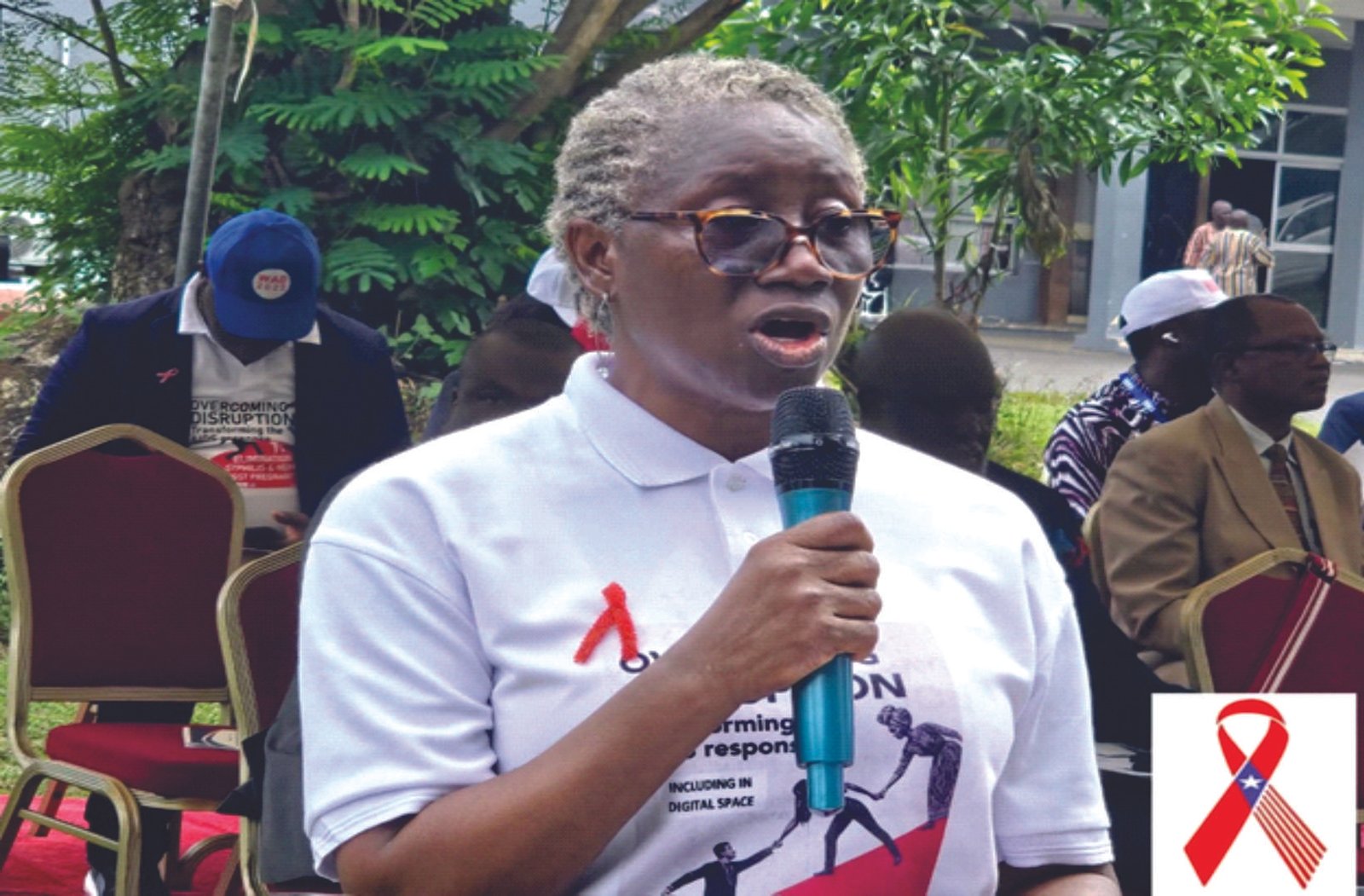
The National AIDS Commission of Liberia on Monday, December 1, 2025, commemorated World AIDS Day with a renewed call for accurate understanding, compassion, and strengthened national commitment to the HIV response.
The ceremony, held under the global theme “Overcoming Disruption, Transforming the AIDS Response” and the national theme “Mobilizing Domestic Support, Transforming the AIDS Response,” brought together government leaders, international partners, civil society organizations, and communities of people living with HIV.
Delivering the opening remarks, the Chairperson of the National AIDS Commission Dr. Cecelia Nutah described World AIDS Day as a moment of reflection and recommitment.
She welcomed dignitaries including the Vice President, lawmakers, and cabinet ministers, members of the diplomatic corps, development partners, traditional and religious leaders, and representatives of people living with HIV.
“This day carries profound meaning for us as a country; A day that prompts us to reflect on where we have come from, to assess where we stand, and to reaffirm our shared responsibility to safeguard the health and dignity of the Liberian people,” she stated.
Clarifying Liberia’s Updated HIV Estimates
Addressing recent public debate over new national HIV projections, the Commission clarified that the estimated 36,000 people living with HIV in 2025, compared to 34,000 in 2024, should not be interpreted as an increase in new infections.
According to the Chairperson, the numbers reflect progress, not setbacks.
“More persons living with HIV are alive today because treatment is working. Fewer people are dying because our health system is improving. More people know their HIV status because testing services have expanded,” she explained.
She added that individuals on treatment who achieve viral suppression are not transmitting HIV to partners or children-one of the strongest indicators of progress.
“These outcomes demonstrate that the national HIV response is moving forward,” she said, crediting the Ministry of Health and both local and international partners for implementing treatment programs that continue to save lives.
The Chairperson emphasized that higher survival rates represent hope and a healthier population-not worsening conditions.
“When people stay alive, the numbers may appear higher,” she said. “But behind those numbers is a powerful message: HIV is no longer a death sentence. People on treatment can live long, healthy, and productive lives.”
Combatting Stigma and Misinterpretation
She cautioned that public dialogue about HIV must remain “grounded in facts, compassion, and national unity,” warning that stigma, fear, and misinformation threaten to undermine years of progress.
“Liberia cannot allow misinterpretation to weaken the momentum we have worked so hard to build,” she said. She urged the country to shift from fear to understanding, from blame to support, and from silence to informed action.
Strengthening Systems and Domestic Support
Reflecting on this year’s theme, the Commission stressed that economic, social, and global disruptions should motivate-not derail the national HIV response. Stronger health systems, empowered community leadership, and sustained domestic investment, she said, are essential to transforming the fight against HIV.
A Call to Embrace People Living With HIV
In one of the evening’s most resonant messages, the Chairperson underscored that Liberia cannot end AIDS without fully embracing and supporting those living with HIV.
“They are mothers raising families, young people pursuing their dreams, workers, leaders, advocates, and citizens contributing every day to the growth of our country,” she said. “Their inclusion is essential to stopping new infections.”
Concluding her remarks, she called on Liberia to continue building a nation where every person is valued, supported, and empowered to live a healthy life.
“Together,” she affirmed, “let us build a future where every Liberian is valued and empowered.”