


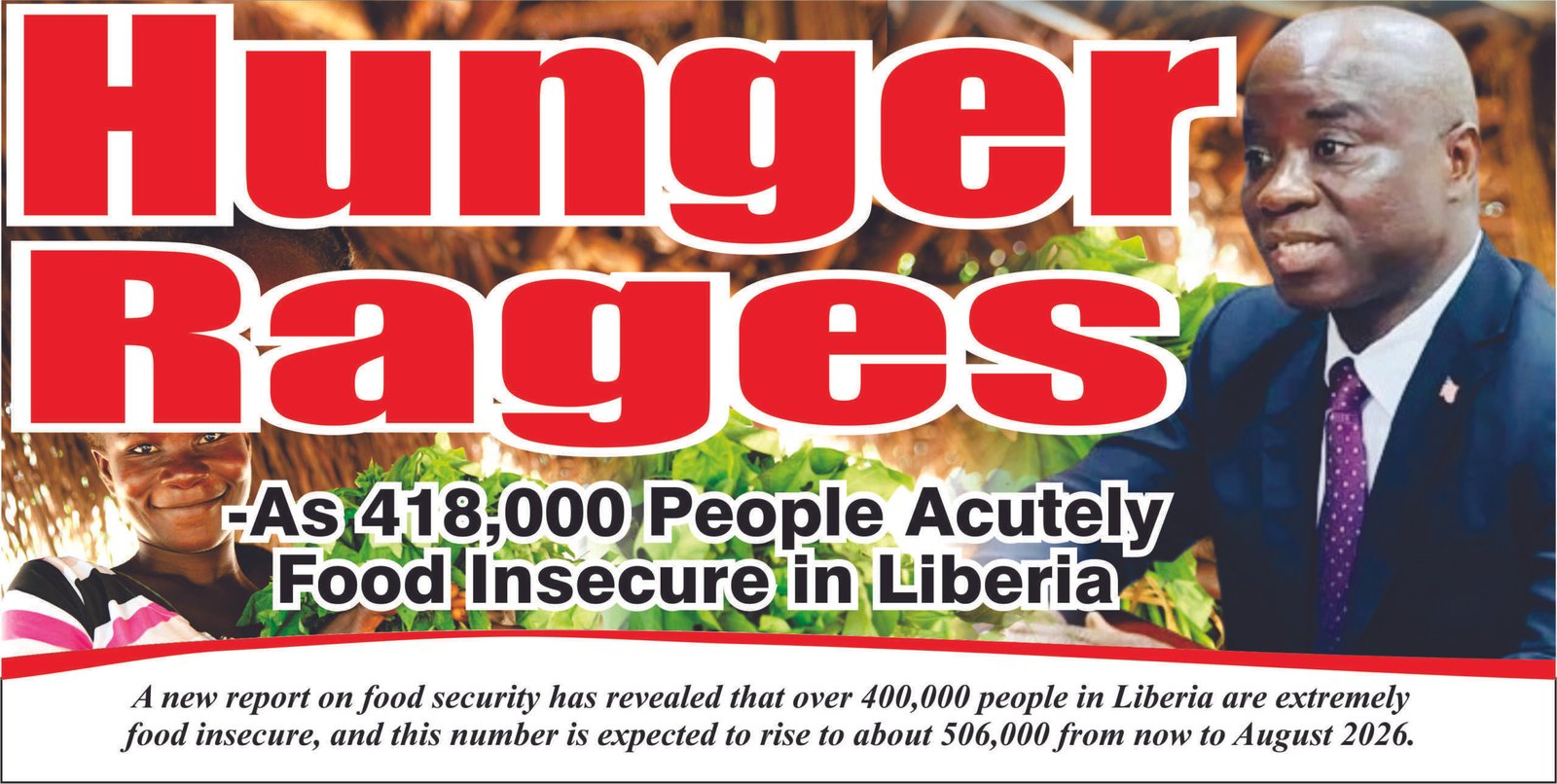
A new report on food security has revealed that over 400,000 people in Liberia are extremely food insecure, and this number is expected to rise to about 506,000 people from now to August 2026.
Despite some improvement in domestic rice production, Liberia continues to face a severe food and nutrition crisis that threatens the lives and livelihoods of hundreds of thousands of people.
Recent data show that 35.5 percent of the population is undernourished, while 26.9 percent of children under the age of five are stunted, 3.4 percent are wasted, and 7.3 percent die before reaching their fifth birthday-alarming indicators of widespread vulnerability.
Preliminary assessments indicate that rice production in 2025 was above average. Harvesting of the 2025 paddy crop, virtually the only cereal cultivated in the country, was completed in December.
The rainy season started favorably in March, with near- to above-average rainfall recorded through April, supporting planting activities and early crop germination across most regions.
However, satellite-based data show that rainfall levels between May and August were near or below the long-term average, with several dry spells affecting crops nationwide. Rainfall improved between September and October, allowing for partial recovery of vegetation.
At the same time, excessive rains in Grand Bassa, Margibi, Montserrado and Sinoe counties caused flooding, resulting in localized crop losses during the 2025 season.
Rice output was further boosted by enhanced government support under the 2024–2030 Liberians Feed Yourselves Agenda. One of the programmer’s key targets is the development of 50,000 hectares of lowland areas for irrigated rice production in Lofa, Nimba and Bong counties over five years.
In 2025, farmers received cash assistance for land preparation, agricultural inputs, access to mechanization services and equipment, enabling expansion of cultivated areas and improved yields.
Official preliminary forecasts presented at the November 2025 meeting of the Regional Food Crisis Prevention and Management Mechanism (PREGEC) for the Sahel, West Africa and Cameroon estimated aggregate paddy production at about 322,000 tones-around seven percent above the average of the previous five years.
Nonetheless, food insecurity remains widespread. According to the latest Cadre Harmonisé (CH) analysis, approximately 418,000 people-seven percent of the analyzed population-were facing acute food insecurity (CH Phase 3: Crisis) between October and December 2025.
Early projections indicate that the number of acutely food-insecure people could rise to about 506,000, or nine percent of the population, during the June to August 2026 lean season.
The 2025 Comprehensive Food Security and Nutrition Survey highlights key shocks affecting households, including the death of income-earning family members, flooding, chronic illness, unemployment or loss of livelihoods, and volatile food prices.
These challenges continue to undermine household resilience, raising concerns that gains in agricultural production may not be sufficient to stem the growing hunger crisis across the country.