


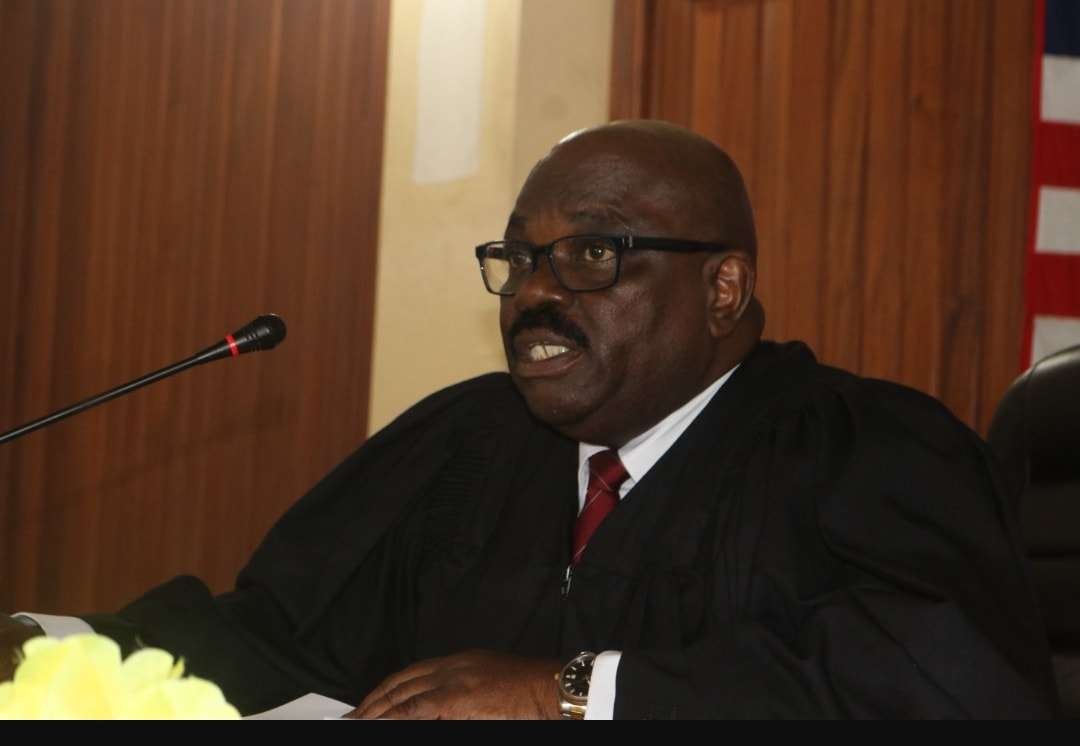
The resident Circuit Judge of Criminal Court ‘A’ Roosevelt Z. Willie on Tuesday, December 2, 2025, ordered the removal of a seated juror Antoinette Mulbah, identified as (J30-9550), on grounds that her leadership role within the Congress for Democratic Change (CDC) created a “propensity for bias” in the ongoing high-profile trial involving CDC-affiliated defendants.
The ruling followed hours of legal arguments between State prosecutors and Defense lawyers, who sharply disagreed over whether Mulbah’s political ties were legally sufficient to justify her removal from the already-sworn jury.
The State prosecutors, in its argument relied on Section 19.3.3 of the Criminal Procedure Law, alleged that Juror J30-9550 misrepresented herself during voir dire when she claimed not to know the defendants.
Central to the Prosecution’s claim was an allegation that the juror in question, identified as Juror J30-9550, is a member of the Congress for Democratic Change (CDC) and serves as Chairperson of District #13.
They argued that her purported position as District #13 Chairlady for the CDC made it “impossible” for her not to have a personal or professional relationship with the accused, many of whom are prominent figures in the party.
However, when questioned directly by the Court, Mulbah admitted she is a member of the CDC but denied being a district chairperson.
“I am a member of the CDC. But the information that I am the Chairlady for District #13 is false and misleading. I am only a Coordinator,” she told the court.
In their resistance to the prosecution’s Bill of Information and accompanying motion, the defense counsel vigorously opposed the prosecution’s motion, calling it “baseless” and an attempt to intimidate jurors and derail the trial.
They argued that the repeated filings of motions by the State prosecution were part of a strategy aimed at delaying the trial and ultimately disbanding the jury panel.
According to the Defense, the Prosecution’s actions violate the 1986 Constitution of Liberia, which prohibits discrimination against citizens based on political association.
The Defense argued that no Liberian citizen should be prevented from performing civic duties-including jury service-because of their membership in a political party.
They contended that the Prosecution had both the opportunity and legal means to challenge the juror during voir dire, including the use of peremptory challenges.
The defense, among other things noted that the government lawyers have failed to do so at that time, insisted that the prosecution had effectively forfeited any later objection.
Photos purportedly showing the juror participating in partisan activities were attached to the motion filed by the prosecution team.
However, Defense Counsel dismissed the images as “not scientific or virtual proof,” arguing that they failed to meet the evidentiary standard required to justify the juror’s removal.
The Defense further noted that the court had previously denied a similar Prosecution motion seeking the removal of another juror, Juror 130-9819, also based on alleged political affiliation and a photo submitted as evidence.
That precedent, they argued, should guide the court to again reject the Prosecution’s attempt to eject a juror on constitutional grounds. Additionally, Defense Counsel invoked Article 17 of the Liberian Constitution, which guarantees the right of citizens to associate freely, including membership in political parties.
Removing a juror solely for political affiliation, they maintained, amounts to a violation of those constitutional protections. Despite these arguments, Judge Willie moved to excuse the juror, a decision that is expected to generate further legal debate as proceedings continue.
One of the defense legal counsels asserted that the removal of juror J30-9550 highlights broader concerns over political influence, impartiality, and constitutional rights within the judicial process.
The defense argued that the challenge by State prosecution violated Article 17 of the 1986 Constitution, which guarantees citizens the right to participate in civic duties without discrimination based on political affiliation.
They further contended that the prosecution had ample opportunity during jury selection to challenge Mulbah’s inclusion and therefore “suffered waiver and laches.”
Defense lawyers also argued that compelling the juror to answer questions about her political activities infringed upon her constitutional rights and amounted to compelled self-incrimination.
In a detailed ruling, Judge Willie emphasized that the challenge was not grounded merely in her CDC membership, but in the influential role she holds within the party.
“For a juror who will decide this matter based on facts, to be a Coordinator of the CDC, this Court says she has a propensity to be biased,” the Judge stated.
He distinguished the case from an earlier ruling involving Juror J30-9819, where the Court denied a similar application due to lack of evidence and the juror’s denial that the photo presented by prosecutors belonged to her.
In the present case, however, the juror herself confirmed holding an active organizational role within the party.
Judge Willie concluded that her political position could reasonably compromise her impartiality, especially given the defendants’ affiliation with the same political structure.
Judge Willie ordered Mulbah’s immediate ejection from the panel.
Following the ruling, the Defense noted its exception on the record and requested that the first alternate juror be elevated to the regular panel.
They also argued that no new juror should be brought in, since the indictment had already been read.
Judge Willie acknowledged the objection and said the Court would determine the appropriate next steps concerning alternate jurors.
With one juror removed and alternates standing by, the trial is expected to resume on Wednesday, December 3, 2025, at 10 a.m. in the chambers of Criminal Court ‘A’ at the grounds of the Temple of Justice.
The Court has not yet announced whether it will accept the Defense’s request to proceed with the existing alternates or call additional jurors to complete the panel.
The case continues to draw national attention due to its blend of legal, political, and constitutional stakes, and Tuesday’s ruling is likely to intensify the debate over political neutrality in Liberia’s justice system.