


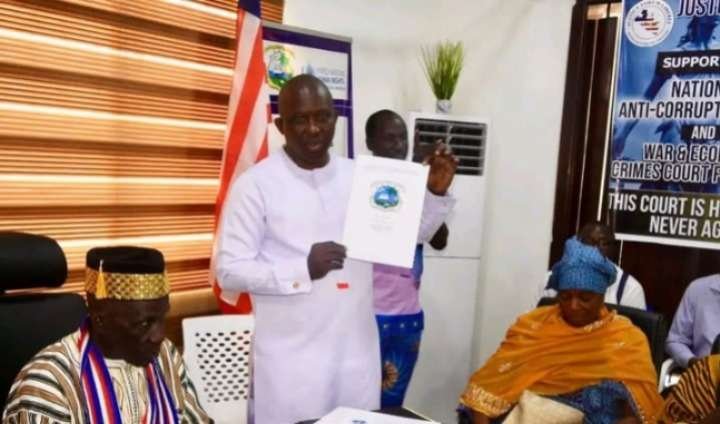
Liberia is moving closer to establishing a War and Economic Crimes Court, a long-awaited milestone in the country’s quest for justice and accountability for past atrocities.
The Executive Director of the Office to Establish the War and Economic Crimes Court (OWECC), Dr. Cllr. Jallah Barbu, announced the submission of two key draft documents aimed at establishing the court.
Speaking after presenting the documents to the Council of Chiefs and Elders, Dr. Barbu emphasized that the process is guided by a clear and structured roadmap.
“The War and Economic Crimes Court Office was established to lead the creation of both the War and Economic Crimes Court and the National Anti-Corruption Court,” Dr. Barbu explained.
The roadmap outlines timelines for the establishment of the courts, with the National Anti-Corruption Court expected to be operational by November 2026.
The War and Economic Crimes Court is projected to follow by November 2027, with Dr. Barbu stressing that these are deadlines, not starting points.
“When I say ‘by November,’ I underline it in bold to mean between now and that time, not after,” he said.
Dr. Barbu emphasized the urgency of the process, saying, “The Liberian people deserve timely redress, and we are committed to doing all we can to make that happen.”
The draft documents have been formally communicated to relevant institutions, including the Ministry of Justice and the Office of the Legal Advisor to the President.
The Council of Chiefs and Elders was consulted as a matter of respect and national tradition, with Dr. Barbu describing them as the “fathers and mothers of the land.”
The Ministry of Justice is now engaged in technical discussions with OWECC, with the Office of the Legal Advisor to the President leading presidential engagement on the matter.
Dr. Barbu expressed optimism that necessary steps would be completed before the festive season, paving the way for formal submission to President Joseph N. Boakai.
The establishment of the War and Economic Crimes Court has long been advocated by civil society groups and victims of Liberia’s civil wars.
The proposed Anti-Corruption Court is expected to strengthen the fight against graft and promote transparency in governance.
Liberians are watching the process closely, eager for justice and accountability for past crimes.
The establishment of these courts could mark a significant step forward for Liberia’s justice system and national healing.