

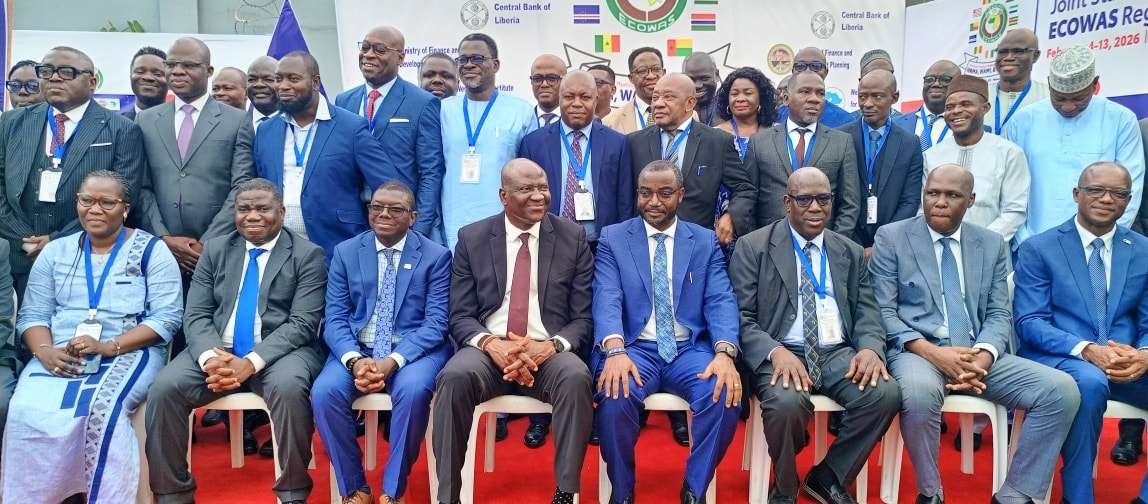
Liberia has reaffirmed its commitment to regional monetary integration as it hosted the second joint meeting of the Economic and Monetary Affairs Committee of the West African Monetary Agency (WAMA) and the Macroeconomic Policy Technical Committee of the ECOWAS Commission, a key milestone in the region’s drive toward a single currency by 2027.
Speaking at the opening of the meeting in Monrovia, Central Bank of Liberia (CBL) Executive Governor Henry F. Saamoi said the choice of Liberia as host at a critical phase of the Monetary Union Project underscored growing confidence in the country’s dedication to regional cooperation and macroeconomic discipline.
“This joint committee stands as the technical backbone of ECOWAS’ monetary integration architecture,” Governor Saamoi said. “Our task is to strengthen convergence, deepen coordination, and ensure that the dream of a single currency transitions from aspiration to reality.”
The meeting brought together senior policymakers and technical experts from across West Africa at a time of heightened global economic uncertainty marked by geopolitical tensions, volatile commodity prices, and tightening financial conditions.
Despite these challenges, Saamoi noted that the ECOWAS region has shown resilience, supported by improving fiscal positions, moderating inflation, and sustained growth.
According to regional projections cited at the meeting, West Africa’s economic growth rose to 4.8 percent in 2025, up from 4.3 percent in 2024, and is expected to reach 5 percent in 2026.
Fiscal deficits across the region have narrowed, public debt ratios have declined, and external positions have strengthened, moving several member states closer to meeting the convergence benchmarks required for monetary union.
Governor Saamoi highlighted progress toward macroeconomic convergence, noting that four member states are expected to meet all four primary convergence criteria in 2025, compared with two in the previous year. He also pointed to advances in reserve pooling, the capitalization of the proposed Central Bank of West Africa, and the development of legal and institutional frameworks that support the single currency.
“Macroeconomic convergence lies at the heart of our regional integration agenda,” he said. “While progress is encouraging, sustaining these gains will require continued fiscal discipline, monetary coordination, and structural reforms across the community.”
Turning to Liberia’s domestic performance, Saamonoted that the country recorded strong macroeconomic outcomes in 2025, with real GDP growth reaching 5.1 percent, driveprimarilyly by mining and infrastructure investment. Inflation declined sharply over the year, falling to 4 percent by December — its lowest level in more than two decades.
Liberia’s fiscal position also improved significantly, with revenue and grants rising by 18.6 percent in the first half of 2025 and the budget remaining within ECOWAS’ 3 percent deficit threshold.
Public debt declined to an estimated 54.2 percent of GDP, while foreign exchange reserves rose to US$575.5 million.
“These outcomes demonstrate Liberia’s steadfast commitment to regional integration and macroeconomic convergence,” Saamoi said. “We met two of the four primary convergence criteria and all secondary criteria in 2025, and we remain committed to achieving the remaining targets in the medium term.”
The CBL Governor also highlighted reforms in the financial sector, including improved bank capitalization, declining non-performing loans, and the successful launch of Liberia’s inclusive instant payment system, which has expanded nationwide interoperability and enhanced access to formal financial services.
As the region moves closer to the 2027 target for the launch of the single currency, Saamoi urged member states to maintain momentum and political will.
“Economic integration is not an option for West Africa; it is a necessity for our stability and our future,” he said. “The choices we make today must strengthen our unity and secure prosperity for future generations.”
The meeting is expected to deliberate on outstanding technical and policy issues, including the location of the future Central Bank of West Africa, funding for regional payment and settlement systems, and the harmonization of financial sector policies across member states.
Liberia, Saamoi said, remains committed to working with ECOWAS institutions, regional partners, and development agencies to ensure the successful realization of a credible and irreversible monetary union.