

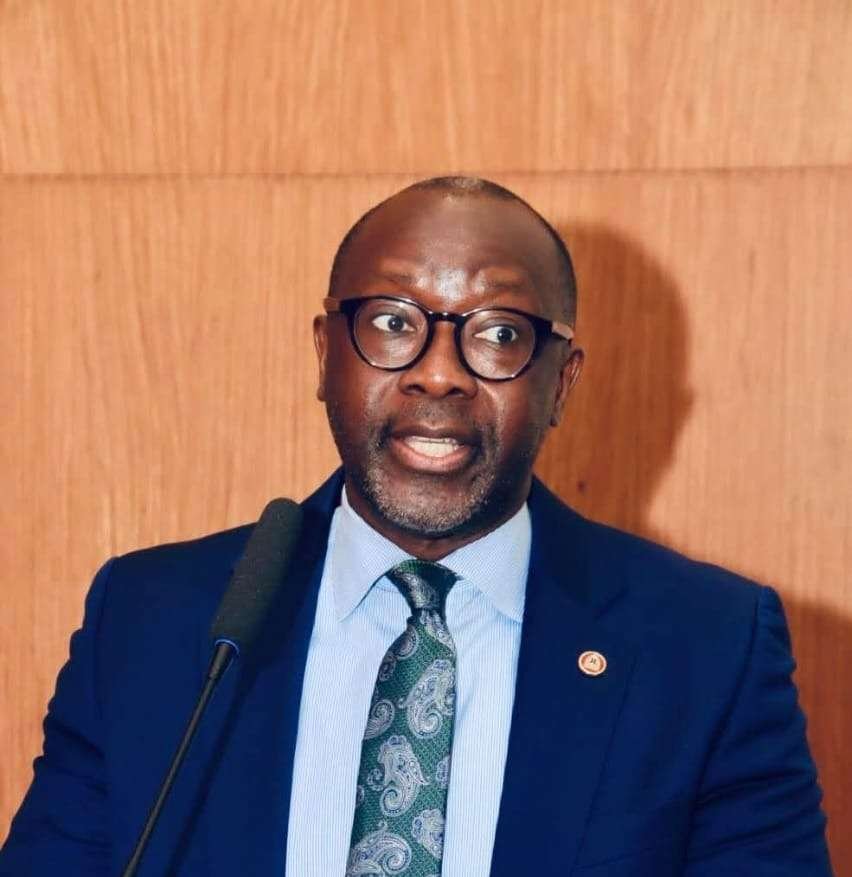
Monrovia — Gbapolu County Senator Amara M. Konneh has called on the Liberian Legislature to adopt a comprehensive legal framework to protect the informal economy and fully enforce laws reserving key business sectors and public procurement opportunities for Liberians.
Speaking on the floor of the Liberian Senate, Sen. Konneh said thousands of Liberians who depend on petty trading, transportation, tailoring, block making, mechanics, and other small-scale enterprises are being marginalized despite forming the backbone of the national economy.
According to the senator, nearly 68 percent of Liberia’s labor force operates within the informal economy, yet many lack protection, access to finance, and fair participation in economic opportunities guaranteed under existing laws.
“These hardworking Liberians wake up every day hustling for survival in an economy that depends on them, yet too often fails to protect them,” Konneh said.
He warned that Liberians are steadily losing control of business sectors reserved exclusively for citizens under the Liberianization Act, including petty trading, used clothing sales, small retail businesses, transportation, auto repair, bakeries, and block making. Konneh attributed this trend to weak enforcement, poor market governance, and harassment of local traders.
“To be clear, this is not because Liberians are unwilling or lazy,” he said. “It is because the State has failed to enforce its own laws.”
To address the problem, Sen. Konneh proposed a new legislative framework titled the Informal Economy Development and Protection Act, aimed at modernizing and strengthening protections for informal workers.
He explained that the proposed law would recognize the informal economy as a legitimate sector of national importance, enforce the 26 business activities reserved for Liberians, establish a unified registration and citizenship verification system, and create designated trading zones with improved sanitation and security.
The framework would also organize sector associations, protect traders from harassment and arbitrary confiscation of goods, coordinate enforcement among key government agencies, and expand access to microfinance, skills training, and business development support.
Beyond market reforms, Konneh emphasized the importance of enforcing the Small Business Act, which mandates that 25 percent of all public procurement be awarded to Liberian-owned small and medium enterprises.
He noted that the FY2026 National Budget includes approximately US$467.3 million in procurement-eligible spending, meaning about US$116.8 million should, by law, go to Liberian-owned businesses.
“For years, this provision has existed on paper but failed in practice,” he said. “This budget gives us a real chance to change that.”
Konneh argued that formalizing even a portion of informal businesses would allow market women, petty traders, block makers, tailors, mechanics, and micro-contractors to benefit directly from government contracts, turning legislation into tangible economic opportunity.
He cited the United States as an example, noting that federal procurement policies there delivered over US$178 billion in contracts to small businesses in 2023, supporting more than one million jobs.
“This is economic justice. This is national security. This is the future of Liberian enterprise,” Konneh told his colleagues.
He urged the Legislature to act decisively by passing laws that protect Liberians’ economic space and transform the 25 percent procurement rule into a meaningful engine for job creation and growth.