


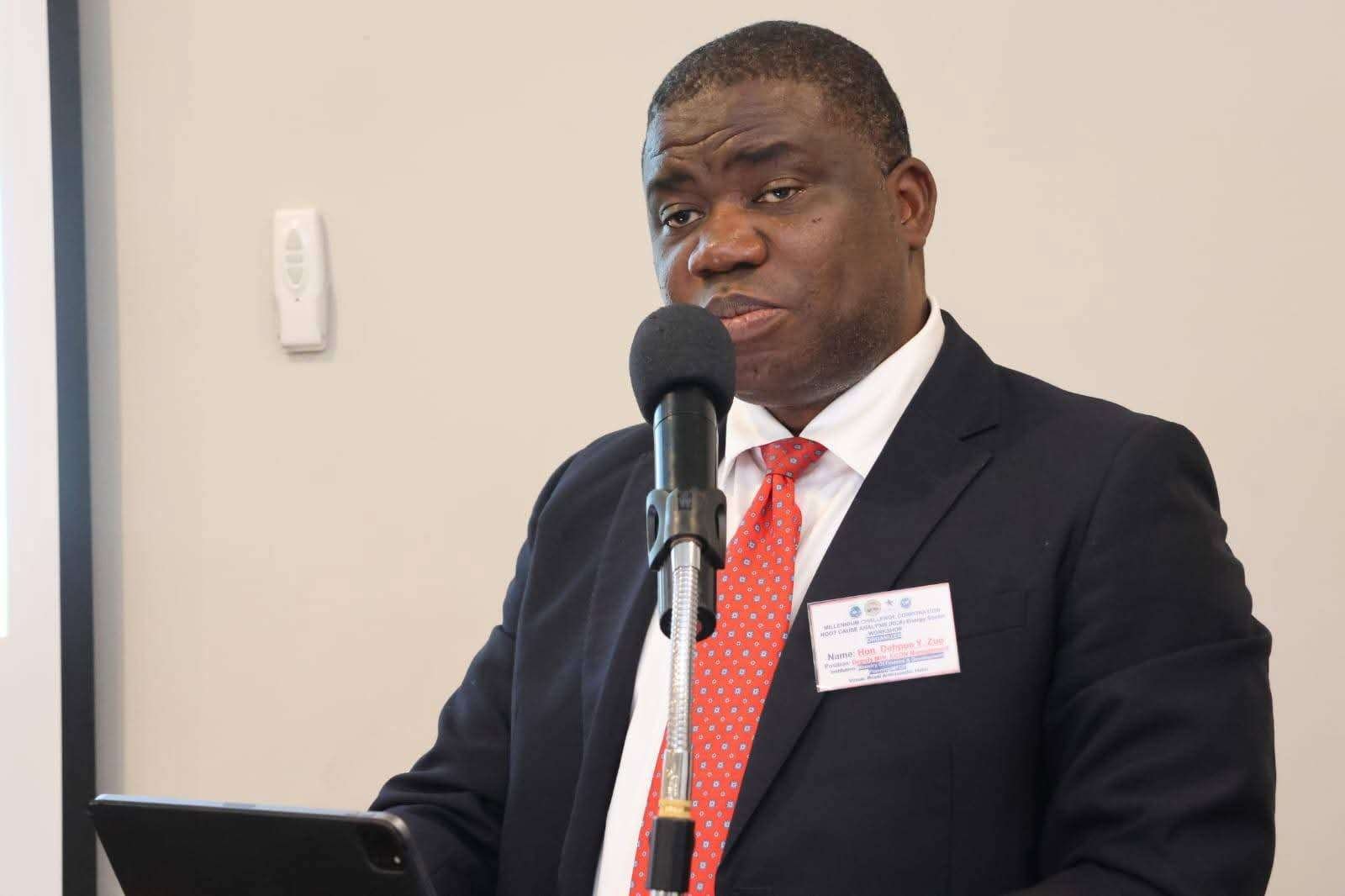
The Government of Liberia, in partnership with the Millennium Challenge Corporation (MCC) of the United States, on Thursday launched a Root Cause Analysis Workshop as part of preparations toward a potential Second MCC Compact aimed at transforming Liberia’s beleaguered energy sector.
The workshop, hosted in Margibi County, brought together government officials, MCC representatives, private sector leaders, and development partners to begin a thorough review of systemic constraints hindering reliable power delivery across the country.
Deputy Minister for Economic Management at the Ministry of Finance & Development Planning (MFDP), Dehpue Zuo, officially welcomed participants, describing the event as “a clear demonstration of leadership and partnership” between the Governments of Liberia and the United States.
“This workshop is an important milestone in our joint efforts to address the root causes of energy challenges that continue to slow national development,” Deputy Minister Zuo said at the opening. “Liberia’s qualification for a Second MCC Compact comes at a pivotal moment for our national agenda.”
Officials highlighted that while Liberia has made progress in stabilizing its economy and expanding infrastructure—including partial gains in electricity connectivity—persistent weaknesses in the power sector remain a drag on growth.
“Too many Liberians still lack access to reliable and affordable electricity, increasing the cost of doing business and limiting opportunities for our youth and entrepreneurs,” Zuo added.
The MCC compact development process, which officially began earlier this year, is expected to span two years. It includes several phases: constraints analysis, root cause analysis, identification of priority projects, feasibility studies, and the establishment of key policy reforms known as conditions precedent that must be met before funding commits.
Representatives from the MCC stressed that Liberia’s current compact eligibility follows careful evaluation of governance and economic indicators, a process reaffirmed when Liberia was cleared to negotiate a second compact late last year.
“MCC’s partnership with Liberia is grounded in mutual accountability and shared goals for sustainable economic growth,” an MCC spokesperson told journalists on the sidelines of the workshop.
Among the key issues for analysis are Liberia’s weak regulatory frameworks governing the energy sector, insufficient generation capacity, and institutional constraints that undermine efficient power distribution—factors similar to those identified in earlier MCC diagnostics.
Deputy Minister Zuo said that engaging stakeholders transparently in the analysis process will ensure that any interventions are evidence-based and aligned with Liberia’s long-term energy strategies and investment plans.
“Our objective is to foster a more enabling environment where strategic investments can unlock affordable and dependable energy for all Liberians,” Zuo said. “We must confront these root causes directly to chart a new trajectory for growth.”
Energy sector experts at the workshop urged accelerated reforms and private sector participation, noting that generation constraints and policy bottlenecks have compounded Liberia’s electricity deficits.
The findings from the workshop will inform the design of potential compact projects, which may include investments in generation facilities, grid expansion, and institutional strengthening tailored to Liberia’s energy needs.
As the analysis phase progresses, government officials reiterated their commitment to meeting all conditions precedent and policy benchmarks required by MCC, with the aim of securing transformative funding that could reshape Liberia’s energy landscape.
Participants agreed that sustained political will and cross‑sector collaboration will be essential for the success of Liberia’s compact development and, ultimately, for ensuring that the country’s energy sector supports equitable economic growth and improved living standards.