

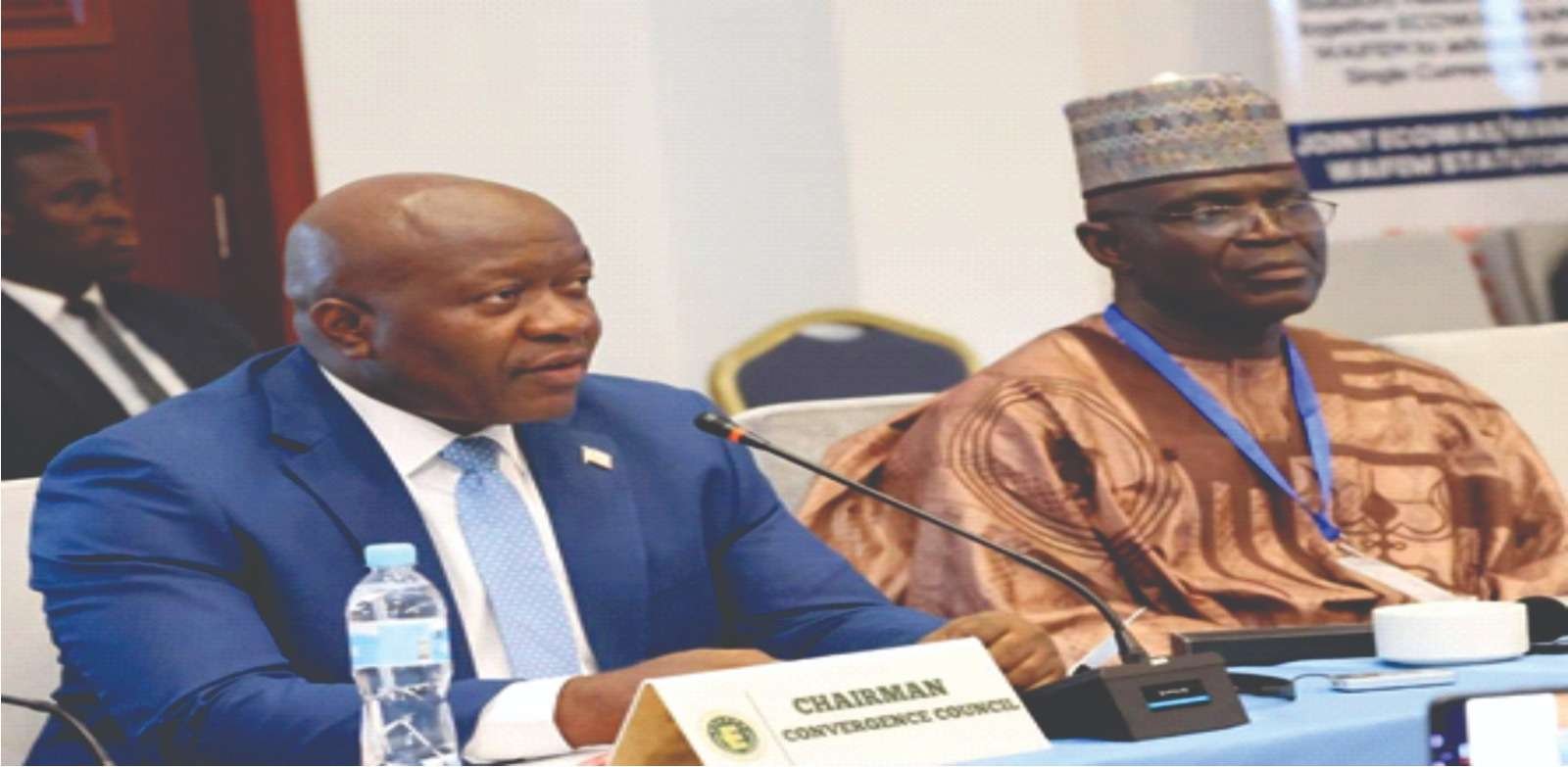
The Minister of Finance and Development Planning, Augustine Kpehe Ngafuan, has called for accelerated reforms across West Africa, warning that the region must act decisively if it is to meet the 2027 target for launching the long-delayed Eco single currency.
Addressing the 55th End-Year Convergence Council Meeting of the Economic Community of West African States (ECOWAS) at the Farmington Hotel in Harbel City, Ngafuan told regional finance ministers and central bank governors that time was running short to meet the bloc’s macroeconomic convergence benchmarks.
“We no longer have the luxury of drifting. The moment demands decisive action, rigorous implementation, and unwavering commitment from every member state,” Ngafuan said.
The high-level meeting convened policymakers, representatives of the ECOWAS Commission, and officials from key regional institutions, including the West African Monetary Institute (WAMI), the West African Monetary Agency (WAMA), and the West African Institute for Financial and Economic Management (WAIFEM).
Liberia’s Performance Highlighted
Ngafuan pointed to Liberia’s improving macroeconomic outlook as evidence that disciplined reforms can yield measurable gains. He reported that real GDP growth reached an estimated 5.1 percent in 2025, up from 4.0 percent in 2024, driven by mining, agriculture and services.
“These gains are the result of deliberate policy choices, not chance,” he said, adding that growth is projected to rise further to 5.4 percent in 2026, alongside continued declines in inflation.
The minister also cited record domestic revenue mobilization, noting that Liberia surpassed its fiscal targets despite reduced donor inflows-a development he described as proof that stronger governance and policy consistency can strengthen economic resilience.
Convergence Still a Challenge
Despite progress in several member states, Ngafuan acknowledged that meeting ECOWAS convergence criteria remains uneven across the region. The benchmarks- covering inflation, fiscal deficits, and central bank financing and foreign reserve levels- are central to the Eco’s credibility and sustainability.
“Meeting the convergence criteria is not a ceremonial exercise-it is a test of discipline,” he said. “Mountains are not moved by wishing; they are moved by climbing. And climb we must.”
While projections indicate that more countries are on track to meet at least three of the primary criteria in 2025 compared to the previous year, full compliance across all benchmarks remains limited.
Beyond Technical Targets
Ngafuan emphasized that the Eco is not merely a currency reform but a broader integration project aimed at deepening trade and economic cooperation.
“The journey toward the Eco is about building a shared economic space that delivers real benefits to our people,” he said. “A single currency is like a bridge-it connects markets, reduces costs, and brings communities closer.”
He urged member states to strengthen fiscal discipline, harmonize monetary policies and address political and structural barriers that have slowed progress toward monetary union.
A Defining Countdown
With July 2027 set as the new launch date, Ngafuan concluded by stressing that the region’s credibility depends on sustained action.
“History will judge us by our actions, not our intentions,” he said. “The people of West Africa are counting on us.”
The Convergence Council is expected to conclude with updated policy recommendations aimed at reinforcing macroeconomic stability and accelerating the path toward the long-envisioned single currency.