

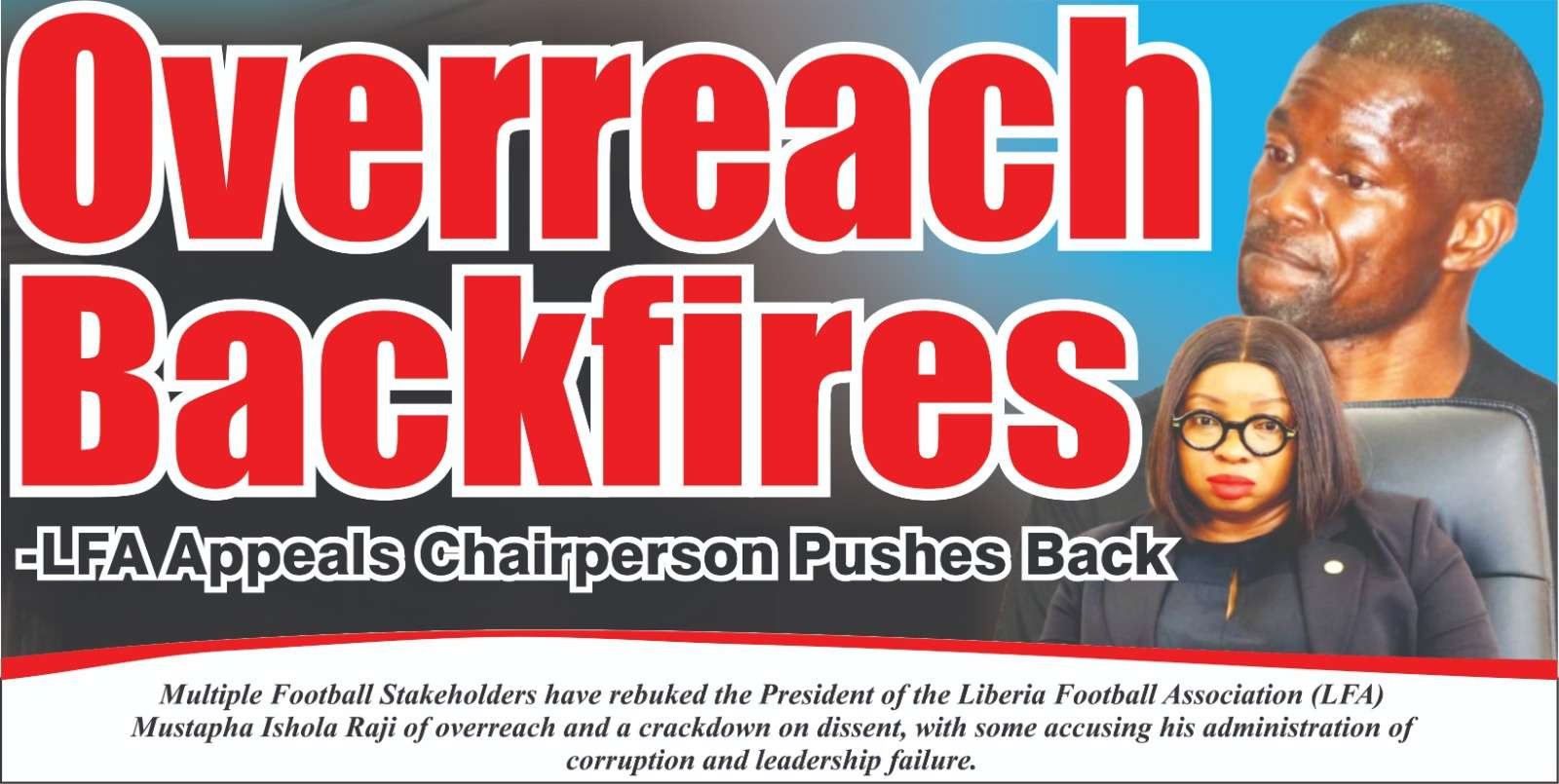
Multiple Football Stakeholders have rebuked the President of the Liberia Football Association (LFA) Mustapha Ishola Raji of overreach and a crackdown on dissent, with some accusing his administration of corruption and leadership failure.
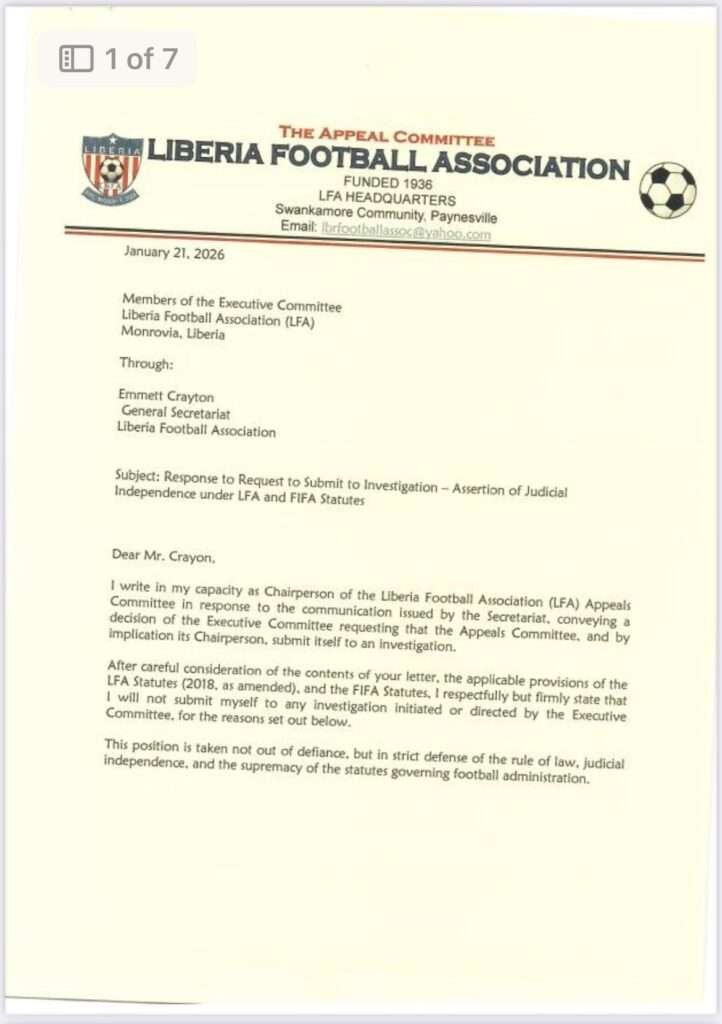
Leaked correspondence obtained by this newspaper indicates that the Chairperson of the LFA Appeals Committee, Cllr. Edwina Edjerah Barchue, has rejected a request from the LFA Executive Committee seeking to subject her and the Appeals Committee to an investigation.
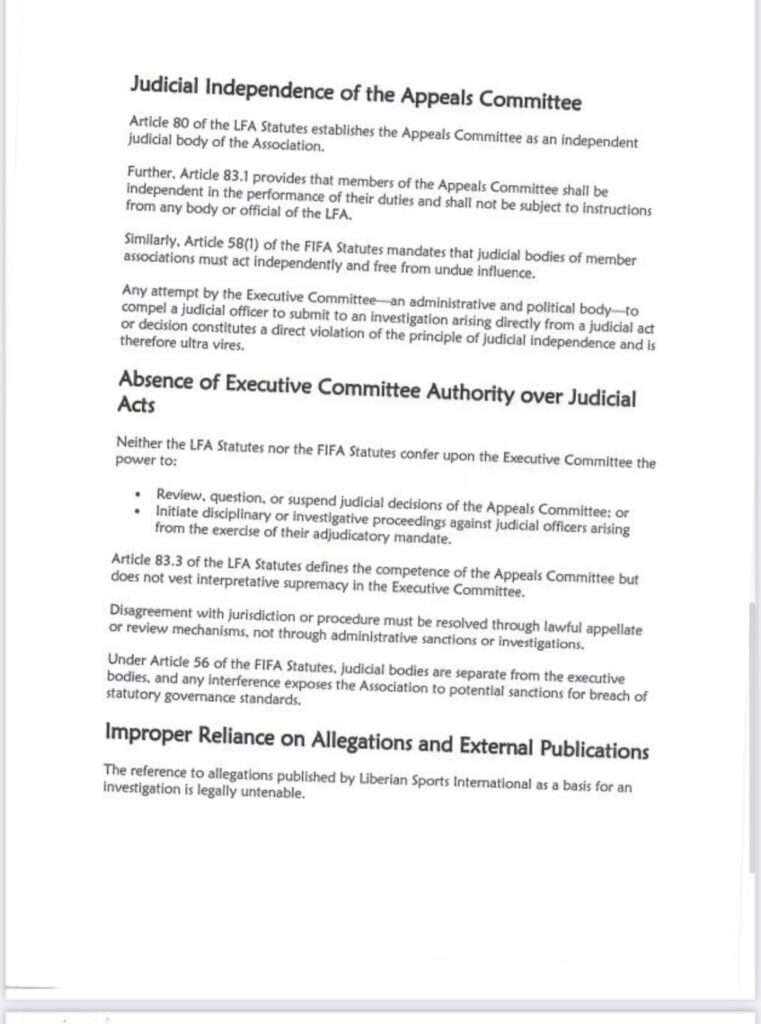
Cllr. Barchue argues that the move violates the principle of judicial independence as enshrined in both the LFA and FIFA statutes.
In a letter dated January 21, 2026, and addressed to the Executive Committee through the LFA Secretariat, Cllr. Barchue emphasized that the Appeals Committee is a constitutionally independent judicial body and is not answerable to the Executive Committee in matters arising from judicial decisions.
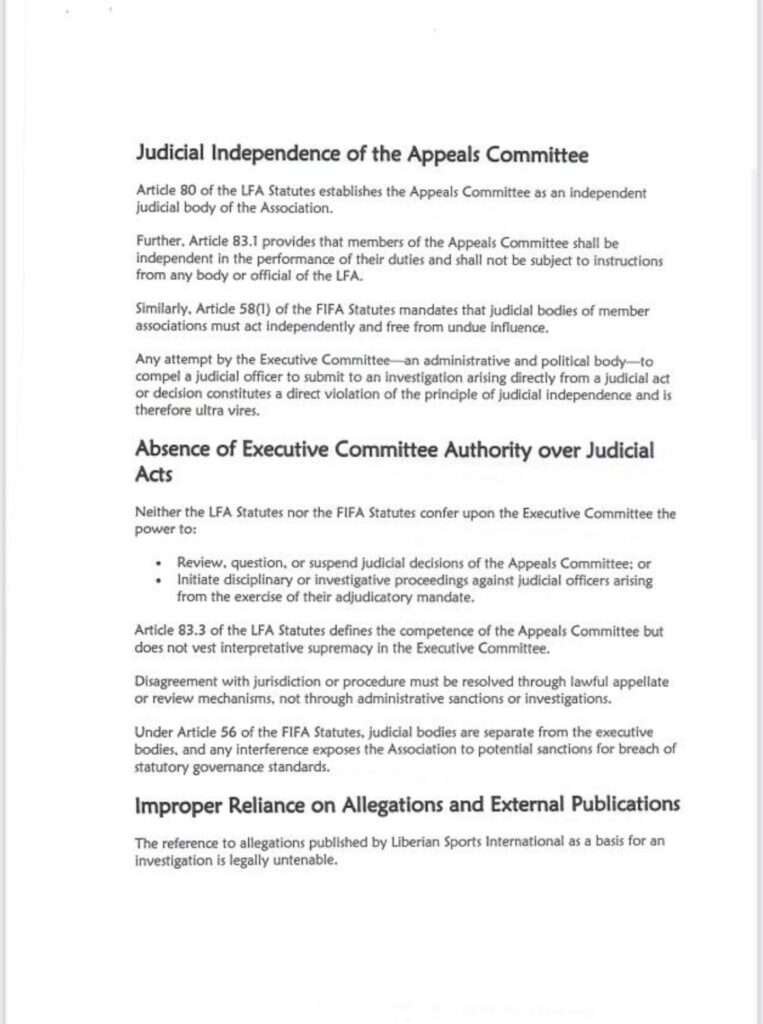
She stated that any attempt by the Executive Committee-an administrative and political organ-to investigate or direct a judicial body over its rulings constitutes an overreach of authority and a breach of established football governance principles.
The letter cites Articles 80 and 83.1 of the LFA Statutes, which guarantee the autonomy of the Appeals Committee, as well as Article 58(1) of the FIFA Statutes, which requires member associations to ensure that their judicial bodies operate independently and without external influence.
According to the leaked correspondence, Cllr. Barchue also challenged the Executive Committee’s reported decision to suspend “stay” proceedings before the Appeals Committee, asserting that such action has no legal foundation. She maintained that only the Appeals Committee itself or a higher judicial authority recognized under FIFA regulations, has the power to regulate or halt its proceedings.
The letter further questions the Executive Committee’s reliance on allegations published by Liberian Sports International, stressing that media reports do not constitute formal complaints or admissible evidence capable of triggering disciplinary or investigative action against judicial officers.
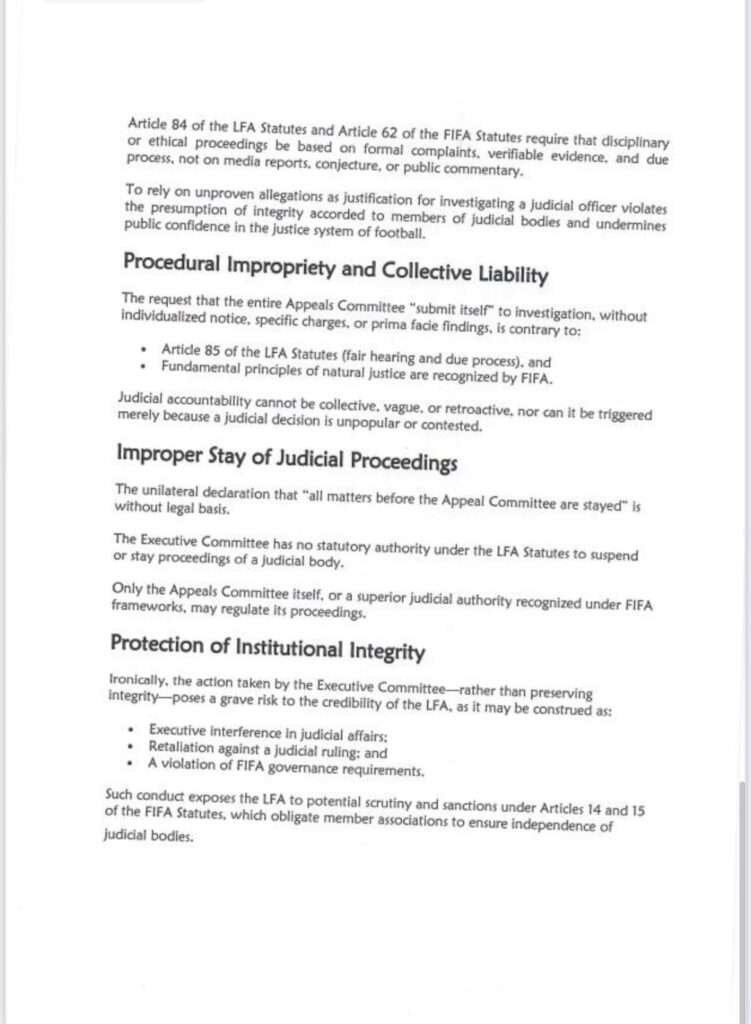
She noted that any disciplinary process must be grounded in due process, verifiable evidence, and properly instituted complaints, rather than public commentary or press publications.
Cllr. Barchue also warned that interference by the Executive Committee in judicial matters could expose the LFA to sanctions under Articles 14 and 15 of the FIFA Statutes, which obligate member associations to safeguard the independence of their judicial bodies.
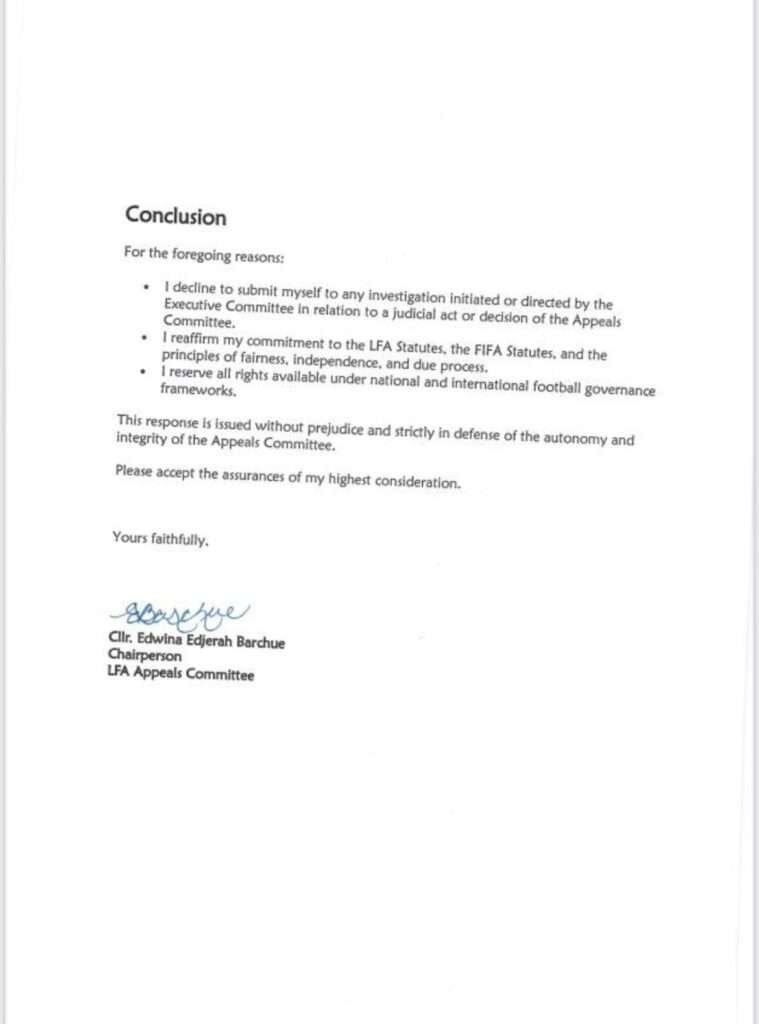
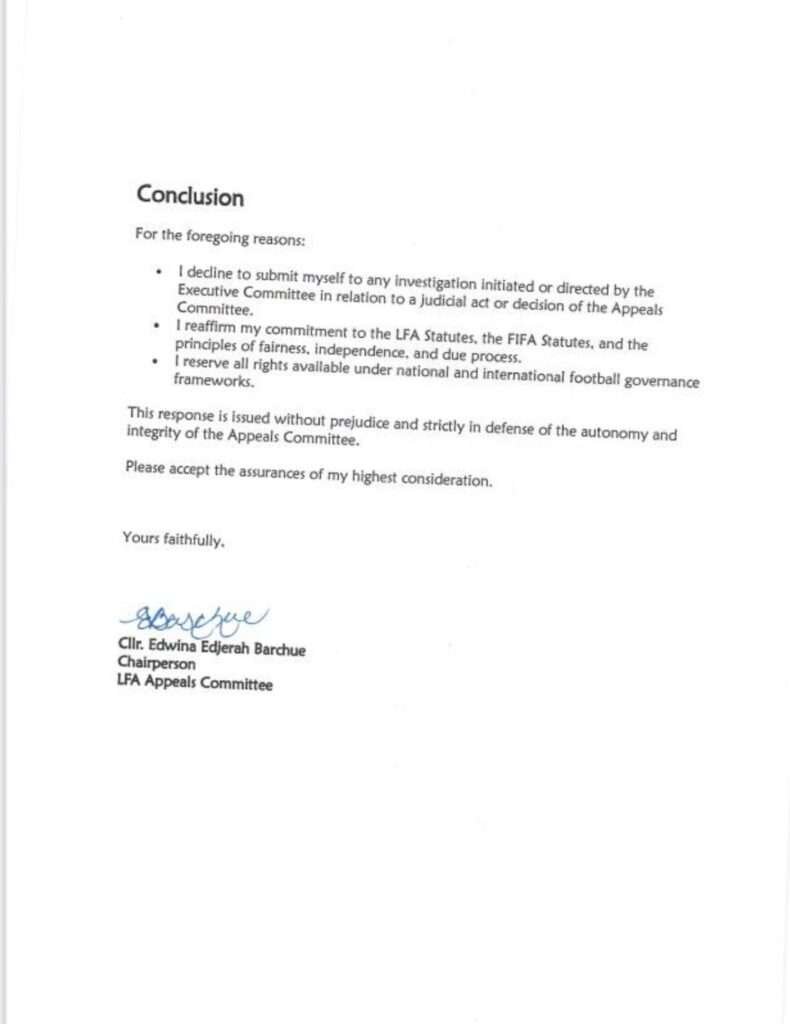
The correspondence concludes with a categorical refusal to submit to the requested investigation, a reaffirmation of loyalty to the LFA and FIFA statutory frameworks, and a reservation of all rights available under national and international football governance mechanisms.
The leaked documents also include a recent decision issued by the LFA Appeals Committee in an appeal filed by Jubilee Football Club against a January 2, 2026 decision of the LFA General Secretariat rejecting the club’s request for the convening of an Extraordinary Congress and the submission of proposed amendments to the LFA Statutes.
In that decision, the Appeals Committee—chaired by Cllr. Barchue and joined by Co-Chairperson Mr. Sensee Kaidii and member Mr. John Bonah—held that it was properly seized of the matter pursuant to Articles 80.1 and 80.2 of the LFA Statutes, which empower it to review Secretariat decisions for compliance with applicable football regulations.
After reviewing documentary evidence and applicable statutes, the Committee addressed six key issues, including Jubilee FC’s standing, the status of Second Division clubs, the applicability of Article 36.1, alleged withdrawals of support, the role of the Beach Soccer Association, and the absence of signatory titles.
The Committee found that Jubilee Football Club, as an active First Division club, enjoys full membership rights under Article 18.1 of the LFA Statutes and therefore has standing to invoke Articles 36.1 and 44.2. It further ruled that Second Division clubs are recognized members entitled to Congress representation and that their exclusion by the Secretariat was inconsistent with the Statutes.
The Appeals Committee also held that Article 44.2-not Article 36.1-governs the submission of proposed statutory amendments and that the Secretariat acted outside its authority by rejecting the submission on improper grounds.
While acknowledging uncertainty over whether certain clubs had withdrawn their support, the Committee ruled that such uncertainty warranted clarification rather than outright rejection of the request.
In its final orders, the Appeals Committee partially granted the appeal, set aside the Secretariat’s decision on most grounds, and directed the Secretariat to obtain written clarification from four clubs within seven days before recalculating whether the statutory threshold for convening an Extraordinary Congress had been met.
The Committee declared its legal findings final, binding, and immediately effective, stressing that its decision is subject only to remedies expressly provided under the LFA Statutes.
The LFA Executive Committee and Secretariat had not issued an official response to the leaked correspondence or the Appeals Committee’s ruling.