


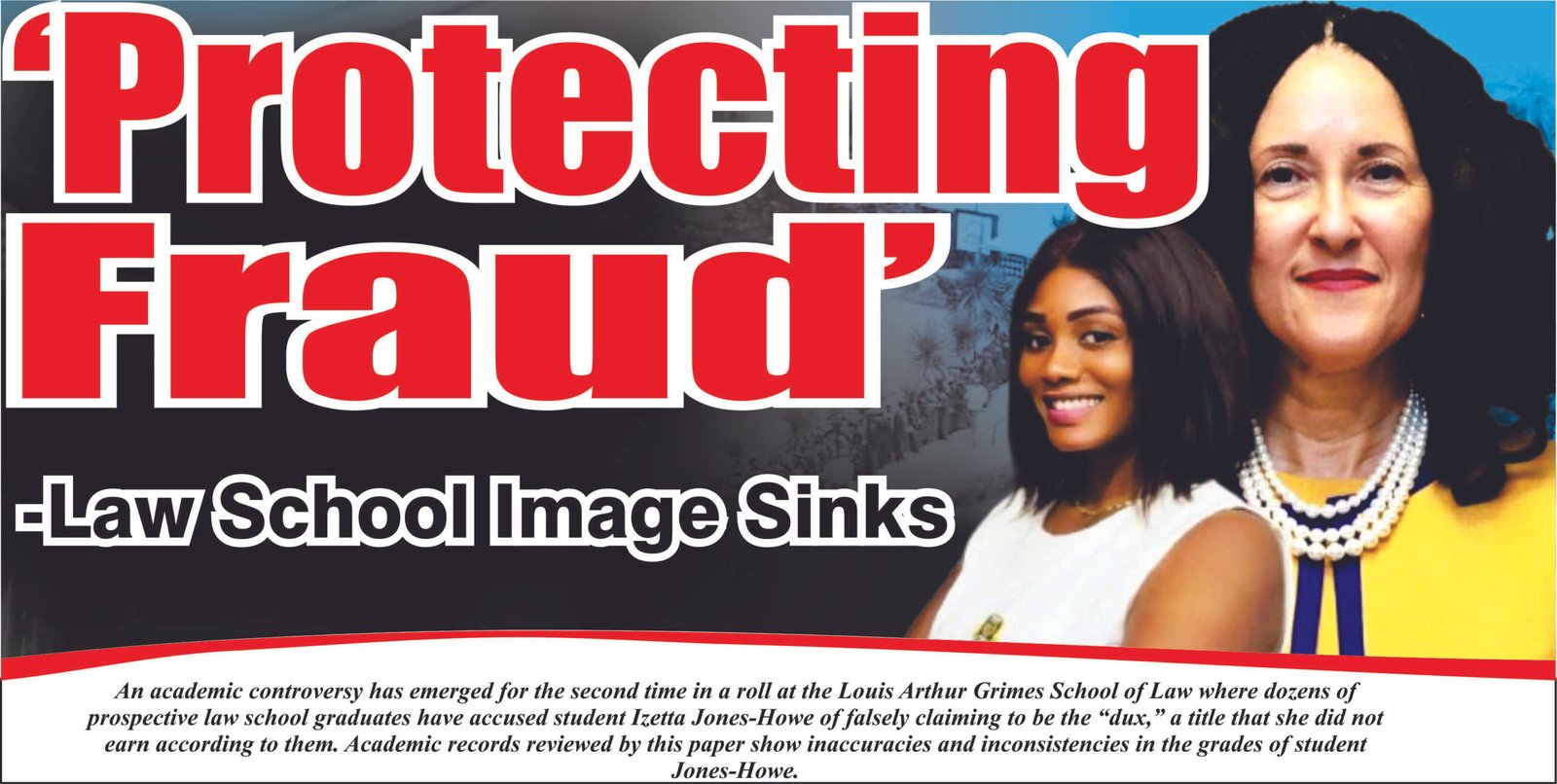
An academic controversy has emerged for the second time in a roll at the Louis Arthur Grimes School of Law where dozens of prospective law school graduates have accused student Izetta Jones-Howe of falsely claiming to be the “dux,” a title that she did not earn according to them. Academic records reviewed by this paper show inaccuracies and inconsistencies in the grades of student Jones-Howe.
The fierce dispute over academic honors at the University of Liberia has erupted into a public battle of allegations, counter-allegations and political intrigue, casting a shadow over the 105th commencement of the Louis Arthur Grimes School of Law.
At the center of the controversy is Ms. Izetta Jones-Howe, President of the Law Students Association (LAWSA), whose designation as valedictorian-commonly referred to as “Dux”, has been challenged by activist Martin K. N. Kollie and a group of graduating students.
Allegations from Students and Activist
A graduating senior, speaking to Verity News on condition of anonymity, questioned the accuracy and honesty of Jones-Howe’s academic record.
“She claims to have scored an A+ in Human Rights Law with Prof. Gongloe. This is factually incorrect. We did this course together. Prof. Gongloe gave no student A+,” the student said.
The same student further alleged discrepancies in Jones-Howe’s academic ledger: “Her self-written ledger she attached reveals that she completed 20 credit hours in Semester III. However, one course is omitted (probably the one with lower grade) from her Law School ledger, thereby reducing her credit hours to 18 for that semester. The result is an otherwise inflated GPA.”
Kollie, who says dozens of students filed a formal complaint to the University, framed the issue as one of principle and integrity that must be handled with caution, fairness, and transparency.
“Students who’ve worked very hard must not be deprived or dispossessed of academic feats they’ve truly earned. ‘Dux-ship’ is earned and not favored or imposed. The truth will always win no matter how long it takes. Academic rigors and scrutiny should apply to everyone and at all times. This is not about whether someone is a woman or a man,” he wrote.
In a detailed public statement, Kollie alleged that Law School authorities “never declared student Izetta Jones-Howe as the ‘dux’” and that she “hurriedly declared herself ‘the Dux’ on social media.”
He further claimed Jones-Howe did not meet the 150-point threshold on the Law School Admission Test and entered under what he described as an “enrichment/dispensation” arrangement not provided for in the 2018 Revised Student Handbook.
“It is important to note that student Jones-Howe did not even satisfy the academic rigors at the entry level,” he stated.
Kollie also alleged that Jones-Howe carried fewer than the required 15 credit hours in certain semesters-a benchmark he cited from the Student Handbook as necessary for honor roll eligibility-and that she repeated more than two courses, which he argues disqualifies a student from graduating with special honors.
“Topping up one’s grade from ‘C’ to ‘A’ by repeating is even a form of cheating other students who scored better marks at the first attempt,” he wrote.
Referencing another student, Joshua Kpelewah, Kollie added: “Prospective Graduate Kpelewah will be graduating with Magna Cum Laude simply because he only repeated one course unlike Ms. Jones-Howe who repeated multiple courses.”
He also alleged that some administrators, including Vice President for Academic Affairs Dr. Agnes Reeves Taylor, were protecting Jones-Howe, and suggested parallels with another graduating student. No evidence has been publicly presented to substantiate those claims.
Kollie concluded with a direct challenge: “This is an open challenge to Ms. Izetta Jones-Howe, the University of Liberia, or anyone to provide counterevidence to what we’ve exposed, with the full backing of the law.”
University President Dismisses Claims
The President of the University of Liberia, Dr. Layli Maparyan, has categorically dismissed the allegations following what she described as an internal review.
In a letter dated February 23, 2026, Maparyan affirmed that Jones-Howe “is the legitimate valedictorian (Dux) of the 105th graduating class of the Louis Arthur Grimes School of Law.”
According to Maparyan, an anonymous complaint had triggered an internal investigation even before Kollie submitted his concerns via WhatsApp and email.
She explained that valedictorians are recommended and nominated by the Registrar, authorized by the Vice President for Academic Affairs and approved by the Faculty Senate.
The President clarified that while the 2018 Student Handbook defines Honor Roll, Honors Program, Special Distinction and Special Honors, the terms “Valedictorian” and “Dux” are not explicitly defined but traditionally refer to the student with the highest academic achievement.
“Following consultations and a review of academic records,” Maparyan concluded that Jones-Howe “was duly selected” and urged critics to pursue concerns “through dignified and lawful channels.”
Jones-Howe: “The Burden of Proof Lies with the Accuser”
In a lengthy rebuttal titled A Statement of Defense and Demand for Integrity, Jones-Howe strongly denied all allegations.
“The law, which we have spent years studying, is clear on a fundamental principle: Ei incumbit probatio qui dicit, non qui negat-he who alleges must prove,” she wrote. “The burden of proof lies with the accuser, not the accused.”
She described the allegations as “a calculated abuse of power and a political vendetta designed to discredit me.”
“To begin with, let me be unequivocally clear. I have never been associated with fraud in any capacity, academic or otherwise. The suggestion is not only false but laughable to anyone who has shared a classroom with me,” Jones-Howe stated.
She maintained that grade tabulation is the sole responsibility of the Dean’s office and is confidential. If unauthorized individuals accessed student files, she argued, that would itself constitute “a serious breach of students’ privacy and a violation of established administrative protocols.”
Jones-Howe pointed to her prior academic record as evidence of consistent excellence, noting that she graduated Cum Laude from Cuttington University and earned an MSc with Distinction from Coventry University in the United Kingdom.
“To now suggest that I would need to commit fraud to emerge at the top of my class … is an insult to the very institutions that molded me. My track record speaks for itself. Res Ipsa Loquitur,” she wrote.
Addressing claims that she repeated courses to inflate her GPA, Jones-Howe acknowledged improving a grade after identifying what she described as an oversight in grading.
“I took my exam book to her to review, she saw that she had left some questions unmarked … which prompted me to do that course over and scored the highest that got me an A+,” she said. “I have never failed a course at the Louis Arthur Grimes School of Law.”
She denied enrolling as a “dispensation student,” asserting instead that she entered through “a rigorous process (enrichment).”
Jones-Howe further linked the controversy to internal disputes within the Law School, including disagreements over a proposed $168 souvenir fee for graduating students and tensions with the Dean over student governance issues.
“My defiance of this mandate was met with a direct threat by the Dean; I was told that I will not graduate for challenging her authority,” she alleged.
She called for “an immediate, transparent review” by the University and an independent committee, adding: “I welcome the scrutiny.”
Reputation at Stake
The dispute has polarized the students’ community and many Liberian, raising broader concerns about transparency, governance and academic integrity at Liberia’s flagship public university.
While the University’s leadership maintains that due process was followed and that the selection stands, critics insist that unresolved questions could erode public confidence in the Law School’s standards.
As graduation proceeds, the controversy underscores a deeper institutional challenge: reconciling competing narratives of merit, procedure and trust-and ensuring that academic distinctions, especially at a law school, are beyond reproach.