


By Patrick Teah
Residents of southeastern Liberia are once again counting their losses after a devastating fire reduced multiple businesses to ashes, exposing a dangerous and long-standing failure by the Government of Liberia to provide basic firefighting services to the region.
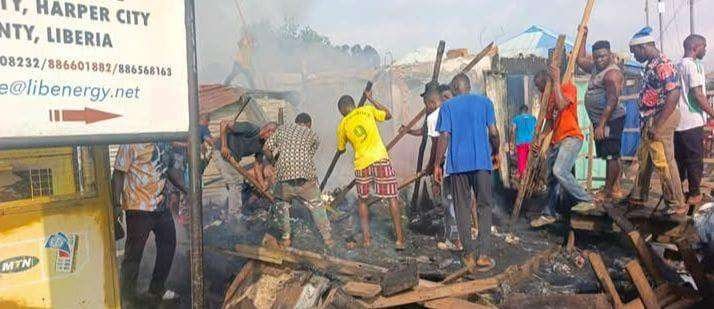
On Sunday, January 25, a fierce blaze tore through Airfield Junction, one of Harper City’s busiest commercial hubs, completely destroying four business centers and partially damaging four others. Thousands of United States and Liberian dollars’ worth of goods and equipment were lost —losses that residents say were entirely preventable.
Southeastern Liberia, among the most populated regions of the country, remains without a single functional fire truck. As fire incidents continue to rise, communities are left to fend for themselves, battling infernos with buckets of water, sand, and bare hands — methods that are no match for fast-spreading flames.
Eyewitnesses reported that the fire began in one shop before rapidly spreading to adjacent businesses. Desperate calls were placed to the Liberia National Fire Service (LNFS) detachment on Green Street in Harper. However, as has become routine, no effective response followed — not because of a lack of personnel, but because firefighters have no equipment to work with.
Despite the presence of LNFS staff on the government payroll throughout southeastern counties, residents say there is no known record of successful firefighting operations in the region. The reason, they argue, is simple and inexcusable: firefighters are deployed without fire trucks, protective gear, or modern tools.
“This is abandonment,” one business owner lamented as he watched the remains of his shop smolder. “We pay taxes, but when disaster strikes, we are on our own.”
The tragedy has reopened wounds from a similar fire at the same Airfield Junction late last year, which damaged two residential homes. For residents, the pattern is clear—fires erupt, properties burn, livelihoods are destroyed, and authorities offer condolences instead of solutions.
Community members are now raising their voices louder than ever, demanding urgent government action. They are calling on national authorities to immediately equip the Liberia National Fire Service with functional fire trucks, modern firefighting equipment, and adequate logistical support —before the next fire claims not just property, but lives.
As southeastern Liberia continues to grow, residents insist that safety and emergency response cannot remain an afterthought. The cost of inaction, they warn, is already far too high.