

Danesius Marteh
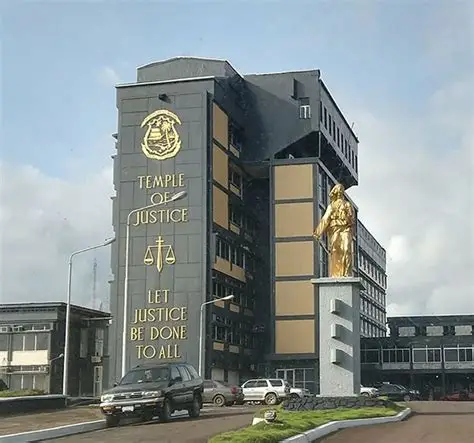
The Supreme Court of Liberia will hear arguments into an “in re” petition on the constitutionality of article 58, subsection 58.1 of the Liberia Football Association (LFA) statutes approved in 2018 [amended in 2021], which provides qualification to contest the positions of president, vice president and executive committee members at 11:00AM on 23 March .
An “in re” is a Latin phrase that translates literately to “in the matter of” or “concerning” and seeks an interpretation from a high court on a particular issue.
Filed on 27 January, Counselor Jimmy Bombo wants the court to declare article 58, subsection 58.1, which says “the president, vice presidents and members of the executive committee shall not be younger than 25 years.
“A candidate for the office of the president, vice presidents and executive committee members must have played an active role in football (e.g. as former player, former referee, former coach, medic and an official within the LFA etc.) for two years of the last five years before been proposed as a candidate for elections. The president, vice presidents and executive committee members shall have minimum qualification of high school diploma. They shall not have been found guilty of criminal offence. They shall have the Liberian nationality and shall have residency within the territory” as unconstitutional because it contradicts article 21(k) of the 1986 Liberian constitution.
Article 21(k) says “any person who, upon conviction of a criminal offense, was deprived of the enjoyment of his civil rights and liberties, shall have the same automatically restored upon serving the sentence and satisfying any other penalty imposed, or upon an executive pardon.
Bombo argues that article 58, subsection 58.1 of the LFA statutes should be declared unconstitutional because the constitution provides in article two, subsection one that “this constitution is the supreme and fundamental law of Liberia and its provisions shall have binding force and effect on all authorities and persons throughout the republic”.
He also cites article two, subsection two, which says “any laws, treaties, statutes, decrees, customs and regulations found to be inconsistent with it shall, to the extent of the inconsistency, be void and of no legal effect.
“The Supreme Court, pursuant to its power of judicial review, is empowered to declare any inconsistent laws unconstitutional” as another reason why the court must act.”
In concluding, Bombo hopes that the Supreme Court will act in keeping with article 66, which says “it shall be final arbiter of constitutional issues and shall exercise final appellate jurisdiction in all cases whether emanating from courts of record, courts not of record, administrative agencies, autonomous agencies or any other authority, both as to law and fact except cases involving ambassadors, ministers, or cases in which a country is a party.
“In all such cases, the Supreme Court shall exercise original jurisdiction. The Legislature shall make no law nor create any exceptions as would deprive the Supreme Court of any of the powers granted herein”.
The Supreme Court has held in a number of opinions that the constitution is the supreme law of the land and any law found contrary will be declared null and void.
This brings to four the number of cases against the LFA and President Mustapha Ishola Raji.
There are three cases at the Civil Law Court, including the legitimacy of Raji’s Liberian citizenship and how the electoral guidelines violate the statutes.
The LFA is expected to hold an elective ordinary congress in Harper, Maryland County on 18 April.