


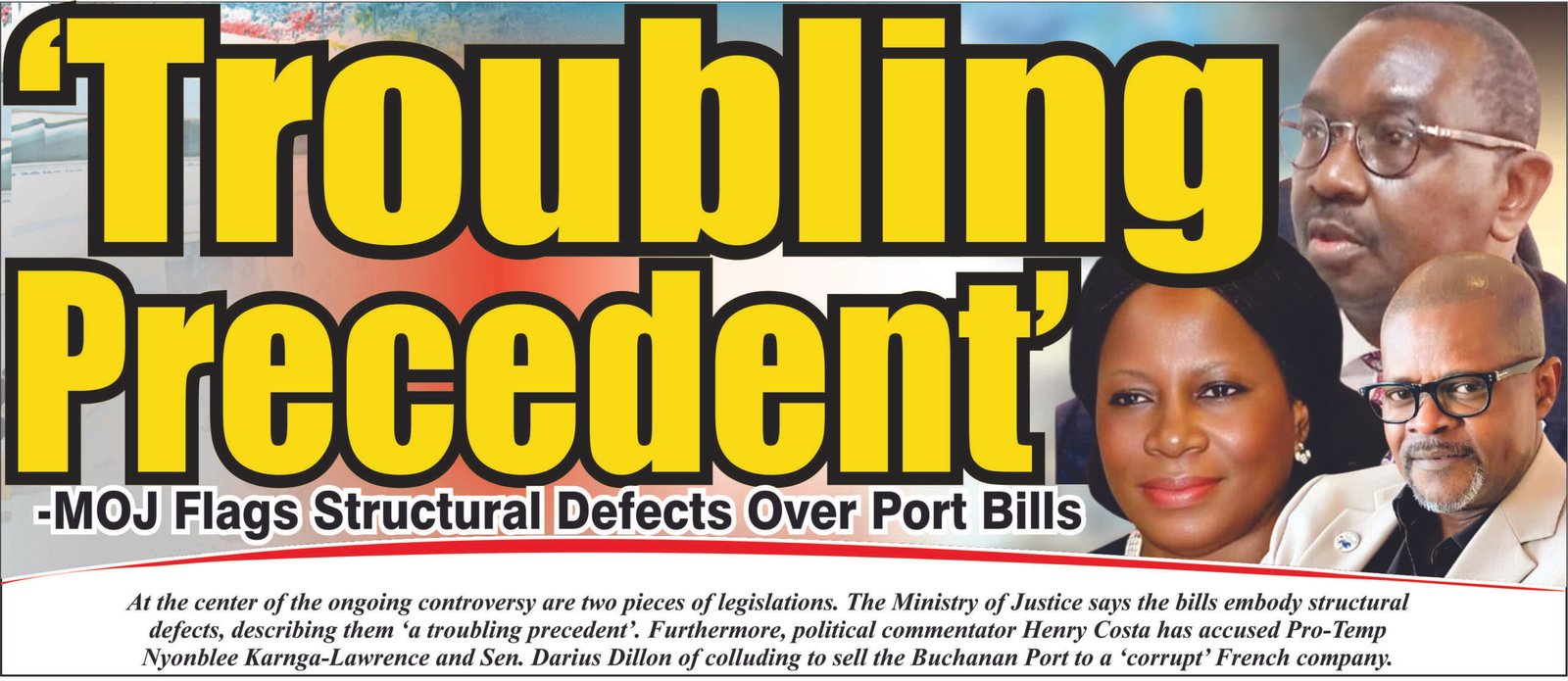
The proposed restructuring of Liberia’s port governance system has ignited an intensifying national debate following a formal veto opinion from the Ministry of Justice, sharp public accusations by political commentator Henry P. Costa, and official correspondence from the Office of the President Pro-Tempore of the Liberian Senate.
At the center of the controversy are two pieces of legislations passed by the National Legislature but vetoed by the President on the advice of the Justice Ministry: the Liberia Sea and Inland Ports Regulatory Act and the Liberia Sea and Inland Ports Decentralization and Modernization Act.
Justice Minister: Bills Are Structurally and Substantively Defective
In a detailed legal opinion addressed to Senate President Pro-Tempore Senator Nyonblee Karnga-Lawrence, Justice Minister and Attorney General Cllr. Natu Oswald Tweh, Sr. outlined extensive concerns that informed the recommendation for a presidential veto.
According to the Justice Minister, the proposed laws contain fundamental structural inconsistencies, including conflicting titles and schedules that alternately reference the existing Liberia Ports Authority and a newly proposed regulatory body. Such inconsistencies, the opinion warned, could expose the laws to legal challenges and cause administrative confusion.
More critically, the opinion noted that the proposed Liberia Sea and Inland Ports Regulatory Agency would assume powers that directly overlap with-and significantly undermine-the statutory mandate of the Liberia Maritime Authority (LiMA). These include port security, vessel inspection, tariff approvals, safety regulation, and enforcement of international maritime conventions.
“If signed into law,” the opinion cautioned, “the Act would substantially render the Liberia Maritime Authority partially redundant,” leaving it largely confined to ship registration functions already outsourced to the Liberia International Ship & Corporate Registry (LISCR).
The Justice Ministry further warned that consolidating regulatory, operational, and oversight authority within a single entity violates principles of regulatory independence, creates conflicts of interest, and risks breaching Liberia’s international maritime obligations.
Decentralization Law Raises Constitutional Concerns
On the proposed decentralization and modernization law, the Ministry highlighted weak transition provisions, warning that the immediate dissolution of the National Port Authority (NPA)-without a comprehensive framework for managing assets, liabilities, contracts, and personnel-could violate Article 25 of the Constitution, which protects contractual obligations.
The opinion further argued that the proposed six-month transition period is unrealistic and could lead to operational disruption, litigation, and institutional instability.
The Ministry also criticized the law for failing to clearly define or provide for inland ports, despite their inclusion in the Act’s title, and questioned the necessity and financial burden of establishing nine-member boards for each autonomous port authority.
Costa Alleges Hidden Agenda and Foreign Influence
While the Justice Minister’s opinion focused on legal and institutional shortcomings, radio personality and political commentator Henry P. Costa framed the issue as a political power struggle.
Speaking publicly, Costa accused Senate President Pro-Tempore Karnga-Lawrence of advancing a hidden agenda, alleging that the bills were not truly about decentralization but rather about fragmenting the port system to enable foreign concessions-drawing parallels to previous controversial arrangements at the Free Port of Monrovia involving APM Terminals.
Costa claimed the legislation could open the door to foreign corporate control of strategic ports, particularly Buchanan, which is expected to experience increased iron ore traffic.
He further alleged-without presenting evidence publicly-that politically connected individuals were being positioned within port management structures and that a foreign billionaire was financing the reform effort.
Describing the decentralization narrative as “a malicious lie,” Costa argued that creating a new regulatory agency funded by 10 percent of total port revenues contradicts claims of efficiency and independence, while expanding bureaucracy and centralizing power.
Development Expert: “This Is About Control of Assets, Not Decentralization”
Adding a technical and governance-based critique, development and infrastructure expert Ambulah Mammy raised serious concerns about the structure and intent of the proposed reforms.
Mammy pointed to Section 720 of the legislation, which transfers all port regulatory authority from the Liberia Maritime Authority to the new regulatory agency-a move he described as excessive and inconsistent with international best practices.
He highlighted what he described as a central contradiction: while the law declares each port “independent,” all major port assets-including piers, warehouses, land, and office buildings-would remain owned and controlled by the new central regulatory agency.
“Ports in Liberia generate revenue primarily by leasing assets and collecting fees,” Mammey noted. “Yet under this law, so-called independent ports would not control their own assets.”
He contrasted the proposal with existing regulatory models in Liberia, noting that: the Liberia Petroleum Regulatory Authority (LPRA) regulates NOCAL but does not own its assets; the Liberia Electricity Regulatory Commission (LERC) regulates LEC without controlling LEC’s infrastructure; and the Liberia Telecommunications Authority (LTA) regulates LIBTELCO without owning its assets.
“This law has never been about port governance,” Mammey argued. “It is about the struggle to control port assets.”
According to Mammey, genuine port reform would decentralize decision-making, financial authority, procurement, and operational control at the port level-measures proven to improve efficiency and accountability in other sectors.
He also noted that previous sector reforms under the Unity Party (UP) administration followed transparent, consultative processes, adding that Senator Karnga-Lawrence presided over many of those reforms and is well aware that successful institutional restructuring is neither secretive nor rushed.
Legislature Urged to Revisit the Bills
Official correspondence from the Office of the Senate President Pro-Tempore confirms receipt of the President’s veto and the Justice Minister’s legal opinion.
The communication describes the legislative effort as well-intentioned while acknowledging the need for further review.
The Justice Minister emphasized that the veto was issued under Article 35 of the Constitution and urged the Legislature to revisit the bills in consultation with the Executive Branch and key stakeholders, including the NPA, Ministry of Finance, and Liberia Maritime Authority.
The opinion warned that excluding the Executive from sweeping institutional reforms risks undermining inter-branch cooperation and eroding public trust in governance.
A Debate Far From Settled
With the President’s veto still in effect, the future of port reform in Liberia remains uncertain. What is clear, however, is that the issue has moved beyond technical legislation into a broader national conversation about governance, transparency, decentralization, and control of public assets.
As lawmakers weigh whether to revise or reintroduce the bills, legal objections from the Justice Ministry, political accusations from Costa, and technical critiques from development experts ensure that Liberia’s port system-and the power dynamics surrounding it-will remain firmly under public scrutiny.