

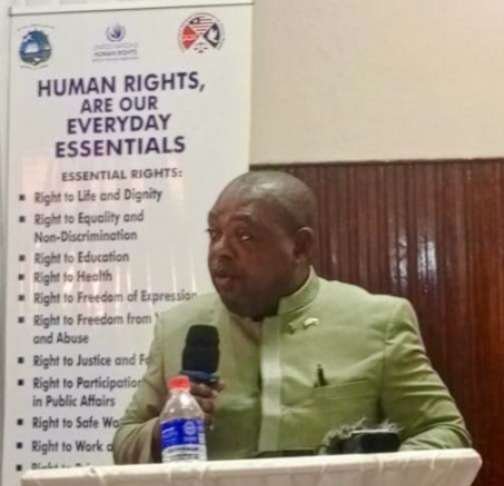
The President of the Liberian National Bar Association (LNBA), Cllr. Bornor M. Varmah, has issued a public appeal for Liberia to confront the legacy of its civil conflict, insisting that the establishment of a war and economic crimes court is essential for the nation’s moral recovery and long-term stability.
Speaking during the commemoration of International Human Rights Day on December 10, 2025, Cllr. Varmah argued that Liberia cannot continue to sidestep accountability while hoping to achieve genuine peace, justice, and development.
“The call for accountability for war and economic crimes is not a call for revenge; it is a call for national moral clarity,” he said.
“Justice Delayed Weakens the Entire Nation”
Delivering a keynote address marked by urgency and reflection, Cllr. Varmah described Liberia’s delayed transitional justice process as one of the country’s most critical human rights challenges. Nearly two decades after the end of the conflict, he noted, many victims still await acknowledgment and redress.
“A society that refuses to confront historical violations leaves open the door for new abuses,” he warned.
“A nation that does not reckon with old injustices teaches the young that wrongdoing carries no consequence.”
He said Liberia’s failure to implement key recommendations of the Truth and Reconciliation Commission (TRC) has entrenched a culture of impunity while deepening the suffering of survivors.
A Call to Confront the Past With Courage
According to Cllr. Varmah, Liberia must confront both wartime atrocities and the pervasive corruption that continues to undermine governance. Accountability—whether for war crimes or economic crimes—is non-negotiable if Liberia is serious about building durable democratic systems.
“Impunity cannot be a Liberian inheritance,” he said. “Our children deserve a country where the law is truly supreme.”
Why a War and Economic Crimes Court Matters
Cllr. Varmah outlined several key reasons why establishing such a court is vital for national progress:
To provide justice for victims still living with trauma
To rebuild public trust in the rule of law
To deter future abuses of power
To strengthen fragile state institutions
To demonstrate Liberia’s commitment to international human rights norms
He cautioned that avoiding accountability continues to weaken democracy, fuel corruption, and expose the nation to recurring cycles of abuse.
LNBA’s Position: Accountability Must Prevail
Reaffirming the Bar’s long-standing position, Cllr. Varmah said the LNBA remains dedicated to promoting transparency, justice-sector reforms, and mechanisms that protect human rights—including the establishment of a war and economic crimes court.
He emphasized that legal professionals, public officials, and judges must ensure that justice is not selectively applied and that the law protects all citizens equally.
A National Moral Responsibility
Cllr. Varmah stressed that transitional justice is not merely a legal requirement but a moral imperative central to national healing.
“No nation can fully embrace the future while ignoring the shadows of its past,” he said.
“Justice is not only for victims; it is for the strength of the entire nation.”
He ended with a powerful appeal for collective action, calling on government, civil society, international partners, and the citizenry to ensure that accountability becomes a foundation of Liberia’s democratic future.
As Liberia reflects on this year’s International Human Rights Day, Cllr. Varmah’s message stands as a renewed challenge for the country to confront its history—and to finally take decisive steps toward justice, healing, and national renewal.