


Let’s be very clear. The style of communication (vulgarity) often used by ‘Prophet Key’ is un-African, un-Liberian, un-cultured, and uncivilized. We condemn it in every form.
However, the recent Court’s judgement is more of a revenge and not justice. The bias is clearly seen. They predominantly ignored the Principles of Procedural Fairness.
Here’s how they violated the rights of Mr. Justine Oldpa Yeazeahn alias ‘Prophet Key’ (10 Tips):
1) The entire Supreme Court violated a common principle in Law called ‘Nemo Judex in Causa Sua,’ which states ‘a judge who is a party to case is not qualified to preside over such a matter.’ Why did Chief Justice Yamie Quiqui Gbeisay, Sr. preside?
2) Chief Justice Gbeisay served as ‘The Complainant’, ‘The Jury’, and ‘The Judge’ at the same time. The Supreme Court violated/undermined the Law of Natural Justice which forms the legal basis of a fair hearing. A party (complainant) to the case passed a judgment that jailed his accuser/defendant for 6 months. Where is fairness when Chief Justice Gbeisay did not recuse himself?
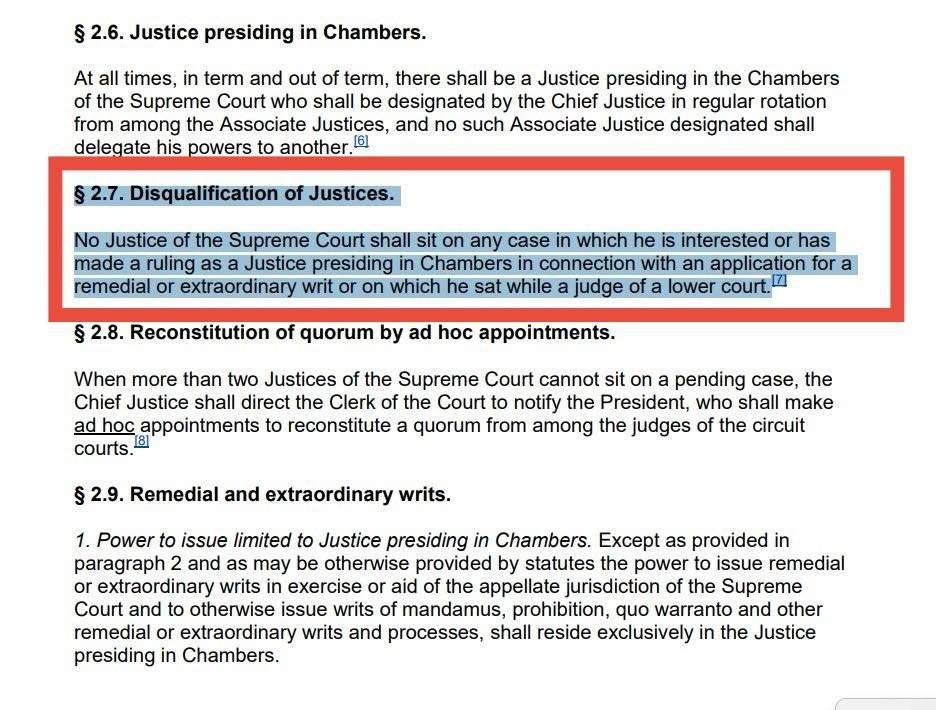
3) The Supreme Court also violated Judicial Canon Twenty-Eight of the Judicial Cannons of Liberia, which states, “A judge should abstain from performing or taking part in any judicial act in which his personal interests are involved or in which he has personal litigation…” Chief Justice Gbeisay had personal interests in this case. So, why didn’t he abstain? Were his colleague judges afraid to tell him to abstain? Furthermore, Section 2.7 of the 1972 Judiciary Law states, “No Justice of the Supreme Court shall sit on any case in which he is interested or has made a ruling as a Justice presiding in Chambers…” Why did Chief Justice Gbeisay sit on this case when he was a party to it? This is another clear violation by the Supreme Court. Isn’t it?
4) The Kamara Abdullah Kamara (KAK) Act of 2019, which repealed Chapter 11 of the 1978 Penal Law, decimalizes all speech offenses in Liberia including insults. This means that speech offenses, including insults, can no longer be treated as a criminal matter, but rather a civil matter. But the Supreme Court charged and jailed Prophet Key for “Criminal Contempt of Court.” Treating Prophet Key’s case as a criminal matter also violated his rights.
5) Liberia is a 2012 Signatory to the Declaration of Table Mountain of June 3, 2007 which urges African Countries to abolish all forms of criminal defamation and ‘insult’ laws. The Declaration largely considers “Insults” as PROTECTED Speech. Why did the Supreme Court ignore this international obligation?
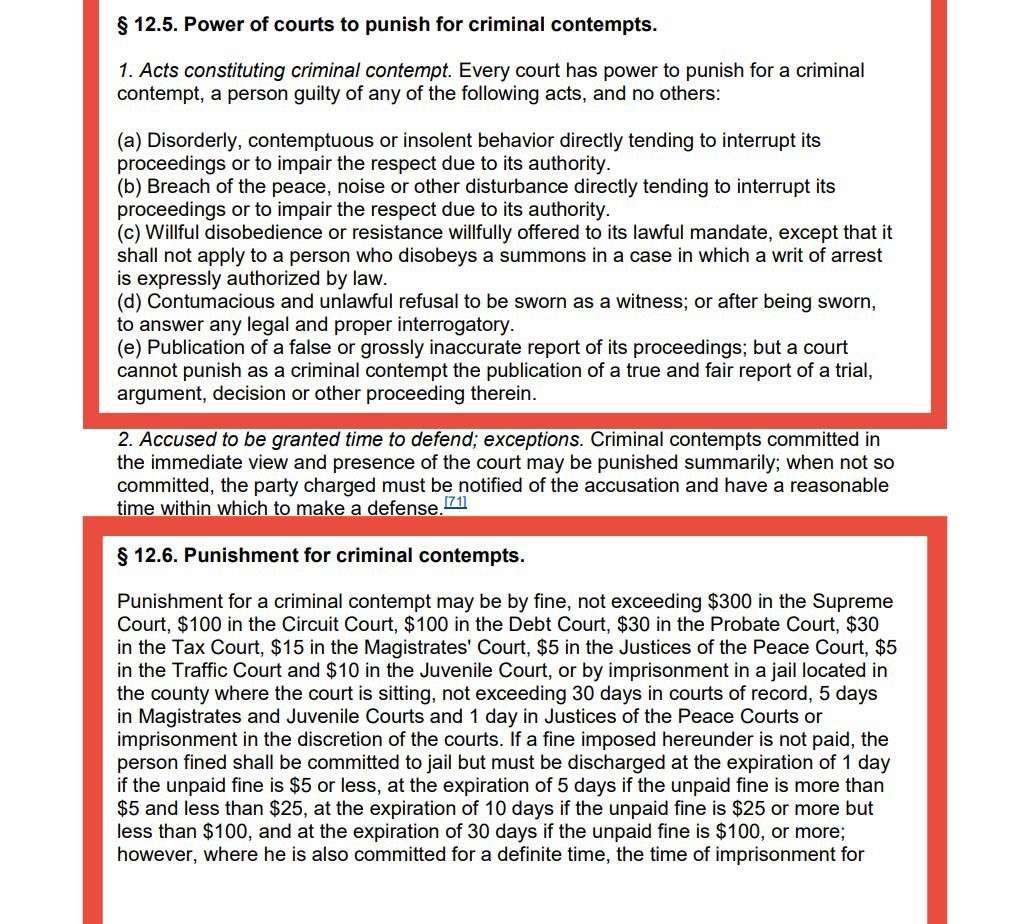
6) Section 12.5 of the Judiciary Law of Liberia (Title 17, Liberian Code of Laws Revised) clearly defines what constitutes ‘Criminal Contempt of Court.’ The five (5) elements that constitute ‘Contempt of Court’ according to Section 12.5 are: a) Disorderly behavior that interrupts the Court’s proceedings; b) Breach of peace or disturbance that tends to interrupt the Court’s proceedings; c) Willful resistance to Court’s mandate or order; d) Refusal to be sworn as a witness; and e) Publication of false report of Court’s proceedings. The action of Prophet Key did not fall in any of these categories or parameters. So, why did the Supreme Court charge and jail him for “Criminal Contempt of Court?”
7) Section 12.6 of the Judiciary Law states, “Punishment for a criminal contempt may be by fine, not exceeding $300 in the Supreme Court or by imprisonment in a jail, not exceeding 30 days. 30 days is equivalent to 1 month and not 6 months. The LAW is crystal clear on the question of punishment for Contempt. So, why did the Court send Prophet Key to jail for 6 months, which is far beyond 30 days as required by the law?
8)The Supreme Court may want to argue “Discretionary Power” in this case. But this is not true. This is not how to apply discretionary power or judicial discretion. The Law already set a jail limit of 30 days, and not beyond. Discretionary Power can only be exercised in this case if the Supreme Court would have sent Prophet Key to jail for less than 30 days (say 10 days or 15 days or 29 days which is below 30 days, the ceiling). The Court cannot suddenly decide/derive its own punishment contrary to what the law says/requires. This is not justice. It is RAGE against a man whom the Court or a Judge of the Court wants to prove strength/power against. The Supreme Court did exercise excessive power (e.g., abuse of power). So, judicial discretion pertinent to punishment as in “6 months in prison” holds untrue and invalid in Prophet Key’s case. The truth has to be said now, because anyone who’s critical of the Court or a Judge could be affected by this same bad precedent tomorrow. The Court is not immune from criticism(s). Why did the Court even ignore the corruption allegation as also raised by Prophet Key?
9) In Re: Scott and Roberts, 32 LLR, 313, 326-327 (1984) as referenced by a former Chief Justice of Liberia, Cllr. Emmanuel N. Gbalazeh*, said this about CONTEMPT, “…that before utterances can be punished as contempt, it must constitute a clear and extremely serious danger working as a substantial evil in the administration of justice.” Did Prophet Key’s utterances against Chief Justice Gbeisay constitute “an extremely serious danger in the administration of justice?” The answer is a big NO. So, why did the Court charge or punish him for Contempt?
10) Free Speech and Press Freedom are PROTECTED under Article 15 of the 1986 Constitution of Liberia. If immediate caution is not taken to accord ‘Prophet Key’ DUE PROCESS in line with THE LAW, the entire Government could be blacklisted by international human rights organizations/reports as anti-free speech just because of this single case. Remember, ‘Prophet Key’ is a politically active person. Some rights groups could assume “political prisoner” because of this speech-related action.
LET JUSTICE BE DONE TO ALL. We will stop here for now. It’s our hope that the Court will also exert similar energy to fast-track cases of corruption, rape, sodomy, abuse of power, etc.
Please go through the attachments.
About The Author: Martin K. N. Kollie is a Liberian activist in exile and a former student leader in Liberia. He is currently studying for an LL.M. degree.