

The World Bank Group has praised the Central Bank of Liberia (CBL) for what it described as significant progress in maintaining monetary stability, strengthening the banking sector, and expanding digital financial services, amid a challenging global economic environment.
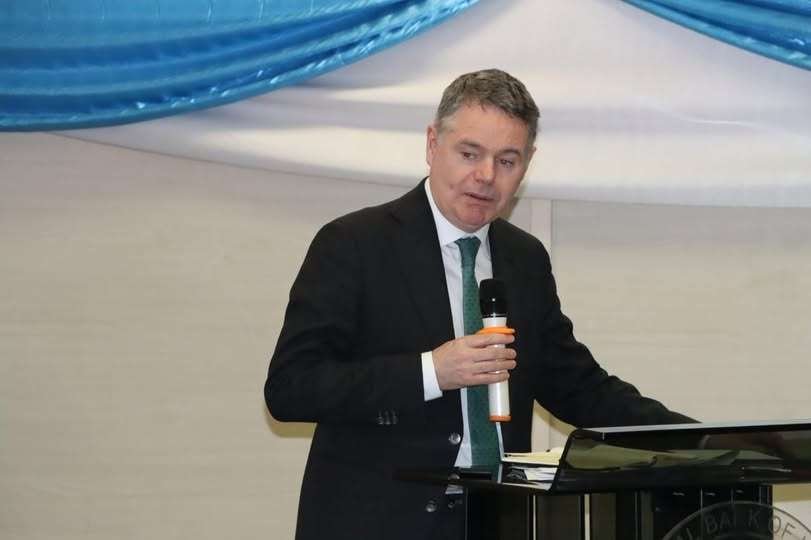
Speaking during an official visit to Monrovia on March 20, the World Bank Group’s Managing Director and Chief Knowledge Officer, Pascal Donohoe, described Liberia’s recent economic trajectory as “a great moment of opportunity,” while cautioning that global risks remain elevated.
Donohoe emphasized the central role of private sector development in driving employment, noting that approximately 90 percent of Liberian businesses employ fewer than eight people. He pointed to ongoing initiatives such as the Liberia Investment, Finance and Trade (LIFT) Project, which has disbursed about $6 million through seven financial institutions to more than 200 small and medium-sized enterprises (SMEs), with roughly 40 percent of beneficiaries accessing commercial credit for the first time.
He also reaffirmed the World Bank’s commitment to supporting key financial infrastructure reforms, including the rollout of Liberia’s Credit Reference System—expected to launch in April 2026—and broader insolvency reforms. According to Donohoe, strong domestic revenue mobilization must be complemented by a dynamic private sector to achieve sustainable economic growth.
“This is a great moment of opportunity,” Donohoe said, adding that Liberia’s reform momentum should be sustained to build resilience against external shocks.
Welcoming the World Bank delegation, the Executive Governor of the Central Bank of Liberia, Henry F. Saamoi, outlined a series of macroeconomic and financial sector improvements achieved under the Bank’s current reform agenda.
Quoting from a Central Bank release, Saamoi said, “prudent monetary policy has contributed to a stable and predictable inflation environment,” with inflation falling to 4 percent at end-December 2025—the lowest level recorded in nearly two decades. The disinflation trend has continued into 2026, with inflation easing further to 3.2 percent in January and 3.1 percent by the end of February.
The Governor also highlighted improvements in the banking sector, noting that tighter supervision and stronger regulatory compliance have significantly reduced non-performing loans. According to the CBL, NPLs declined from 21.6 percent in January 2025 to 12.79 percent by end-February 2026.
On currency reforms, Saamoi cited the successful introduction of a new family of Liberian banknotes, which he said has boosted public confidence and improved the efficiency of cash transactions nationwide.
Digital financial services have also seen rapid growth. The CBL reported that its Instant and Inclusive Payment System (IIPS), launched on December 16, 2025, has processed more than 1.53 million transactions valued at approximately LRD 1.43 billion and $9.03 million as of March 15, 2026. These transactions were conducted using only two initial services—person-to-person and government-to-person payments.
“These figures demonstrate strong early adoption and the potential for deeper financial inclusion,” the CBL noted in its release.
Saamoi added that the Bank is advancing work on a National Electronic Payment Switch aimed at integrating all financial institutions into a unified payments ecosystem, a move expected to further enhance efficiency and interoperability across the sector.
The Governor also pointed to progress in institutional governance, including strengthened internal controls and transparency measures. These reforms have enabled the Central Bank to record operational surpluses in both 2024 and 2025—its first such achievement in over two decades.
Donohoe’s visit marked his first trip to West Africa since assuming his role at the World Bank Group in November 2025, and signals continued international backing for Liberia’s economic reform agenda.