

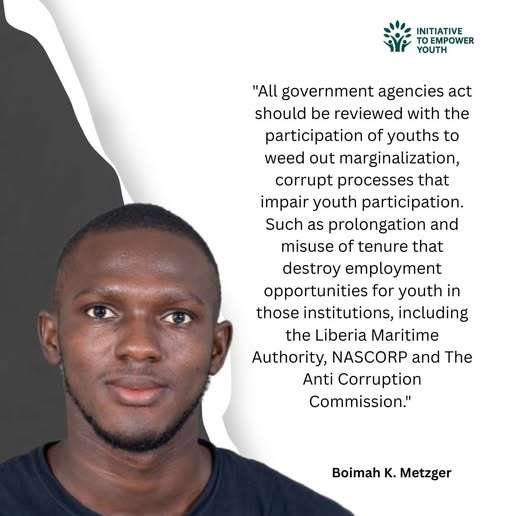
Monrovia, Liberia — A youth advocacy organization, Initiative To Empower Youth (IEY), has raised concerns over what it describes as the prolonged and misused tenure of leadership in key public institutions, warning that such practices undermine accountability, innovation, and opportunities for young professionals.
In a statement issued through its Executive Director, Boimah K. Metzger, the group said the continued recycling of leadership among the same individuals for decades has created barriers for capable young Liberians who are ready to contribute to national development.
“One of the most damaging issues we face is the prolongation and misuse of tenure in key institutions,” Metzger said. “When individuals remain in powerful positions for decades, they block innovation, weaken accountability, and destroy employment and leadership opportunities for young professionals who are capable and ready to serve.”
IEY named the Liberia Maritime Authority (LMA), the National Social Security and Welfare Corporation (NASCORP), and the Liberia Anti-Corruption Commission (LACC) as institutions critical to Liberia’s development but often cited in public discussions as lacking leadership renewal, transparency, and meaningful youth inclusion.
According to the group, NASCORP has been under intense public scrutiny following reports from the General Auditing Commission (GAC) in late 2025, which alleged the misuse of millions of dollars in pension funds. The reports sparked public outrage and renewed calls for accountability and reform.
“Situations like this highlight how weak oversight and prolonged tenure can erode public trust,” Metzger noted.
The statement also raised concerns about governance at the Liberia Maritime Authority, one of the country’s highest revenue-generating institutions. IEY questioned whether leadership continuity without significant reform has limited succession planning and reduced opportunities for young Liberians to assume leadership roles.
Similarly, the group argued that the Liberia Anti-Corruption Commission must reflect the democratic values it is mandated to uphold. “When institutions tasked with fighting corruption are perceived as insulated from reform or youth participation, it undermines confidence in the entire accountability system,” the statement said.
IEY described these trends as “undemocratic tendencies” that run counter to principles of good governance, transparency, and inclusion. The organization emphasized that youth participation should go beyond symbolism and be embedded in law and practice through term limits, transparent appointment processes, regular performance reviews, and deliberate reforms to open leadership pathways for young people.
The group further called for a comprehensive review of all government agencies, with active youth participation, to identify and address marginalization and corrupt practices that limit youth employment and leadership opportunities.
“Liberia cannot build a democratic future while governing with outdated systems,” Metzger said. “A country that sidelines its youth is delaying its own progress. It is time to reform, renew, and make room for the next generation.”
The statement adds to ongoing national conversations about governance reform, accountability, and the role of young people in shaping Liberia’s political and institutional future.