


By G Watson Richards
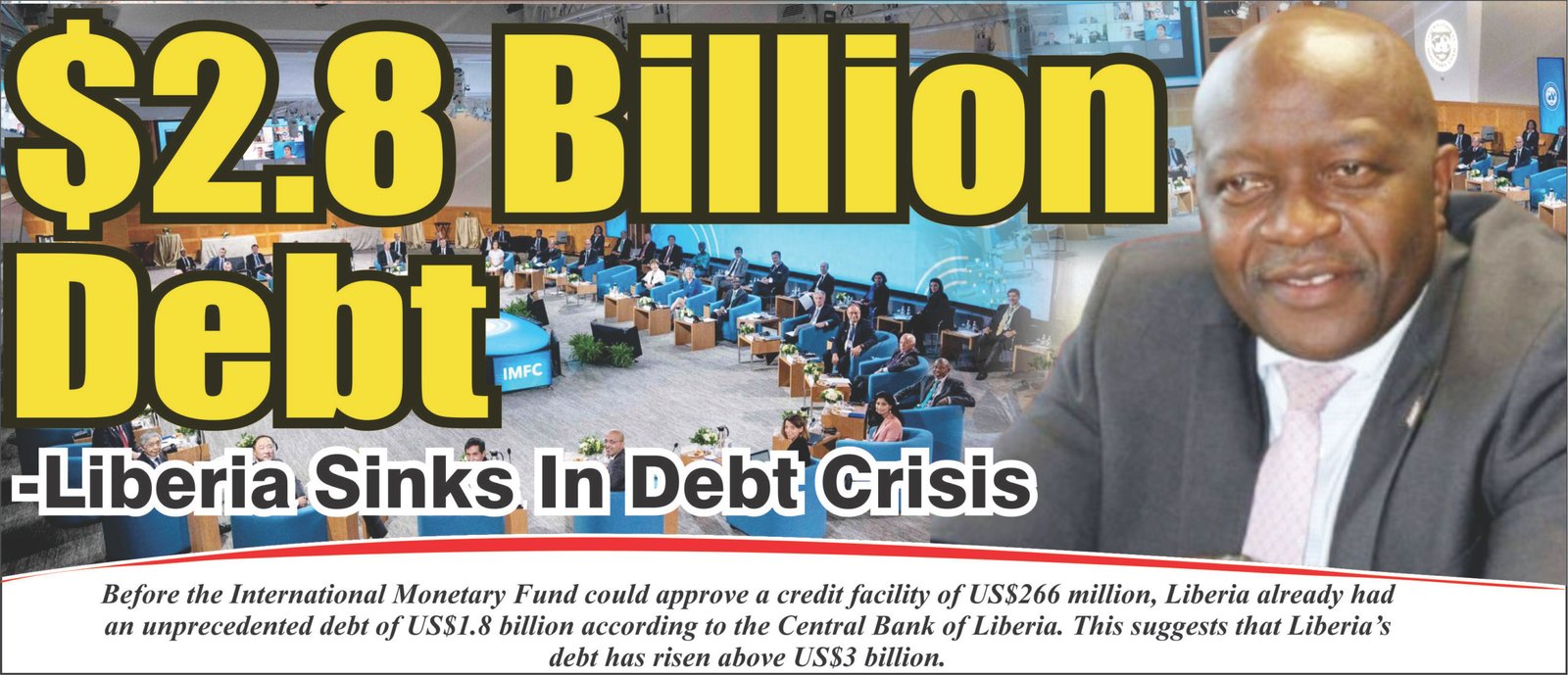
Before the International Monetary Fund could approve a credit facility of US$266 million, Liberia already had an unprecedented debt of US$1.8 billion according to the Central Bank of Liberia. This suggests that Liberia’s debt has risen above US$3 billion.
The CBL’s September 2025 report shows that total public debt edged up to US$2.687 billion, or 52.4 percent of Gross Domestic Product (GDP). Though the increase was slight, just 0.1 percent, it adds to concerns about the country’s long-term fiscal position.
External borrowing continues to make up the larger share of the debt stock. Of the total, US$1.624 billion (31.7 percent of GDP) is owed to external creditors, while domestic debt stands at US$1.063 billion (20.8 percent of GDP). The bank warns that even small increases in external debt can strain government revenues and put added pressure on foreign exchange reserves, especially at a time when global financial conditions remain tight.
The report also reflects mixed developments across the real economy. Mining remains the strongest performer, with iron ore production rising by 4.4 percent in August 2025 to 1.61 million metric tons. The increase is linked to strong demand on the international market, better prices, and expanded production capacity. Compared to the same period last year, output has grown significantly.
Gold production, however, fell by 14.1 percent during the month, mainly due to a slowdown in artisanal mining. Despite that drop, output is still higher than it was a year ago. Diamond production slipped slightly, affected by weaker global prices and tighter enforcement against illegal mining, though annual figures suggest a gradual recovery.
In agriculture, rubber output declined sharply by 35.4 percent, largely because of reduced production by smallholder farmers. Still, compared to last year, there has been some improvement. The manufacturing sector showed only modest gains, with cement production rising by 10.3 percent from July to August, but remaining far below levels recorded in 2024, an indication of ongoing challenges in construction and industrial activity.
Overall, the CBL paints a picture of an economy that is growing, but not evenly. Gains in mining are being offset by setbacks in agriculture and manufacturing, while the steady rise in debt continues to raise concern.
Amid these developments, the International Monetary Fund (IMF) has approved a new 21-month financing package for Liberia under its Resilience and Sustainability Facility, valued at about US$266 million.
At the same time, the Fund completed the third review of the country’s Extended Credit Facility program, clearing the way for an immediate disbursement of US$26.49 million.
The IMF says Liberia’s economy has remained relatively strong, with growth reaching 5.1 percent in 2025, driven largely by mining. That growth is expected to hold in the coming years if planned reforms are carried out. Still, the Fund points to risks, including high global oil prices and a drop in external support.
The new program is intended to help stabilize the economy, strengthen resilience to climate shocks, and support ongoing reforms. It places emphasis on increasing domestic revenue, improving infrastructure, strengthening the financial sector, and addressing governance issues.
Even so, the combination of rising debt and continued reliance on external financing leaves little room for complacency. Economists say Liberia will need to boost local revenue and expand production beyond the mining sector if it is to keep its debt under control.
As the government pushes ahead with its ARREST development agenda, both the CBL and IMF stress that careful borrowing, better management of public projects, and consistent reforms will be key to keeping the economy on a stable path.