


By G. Watson Richards
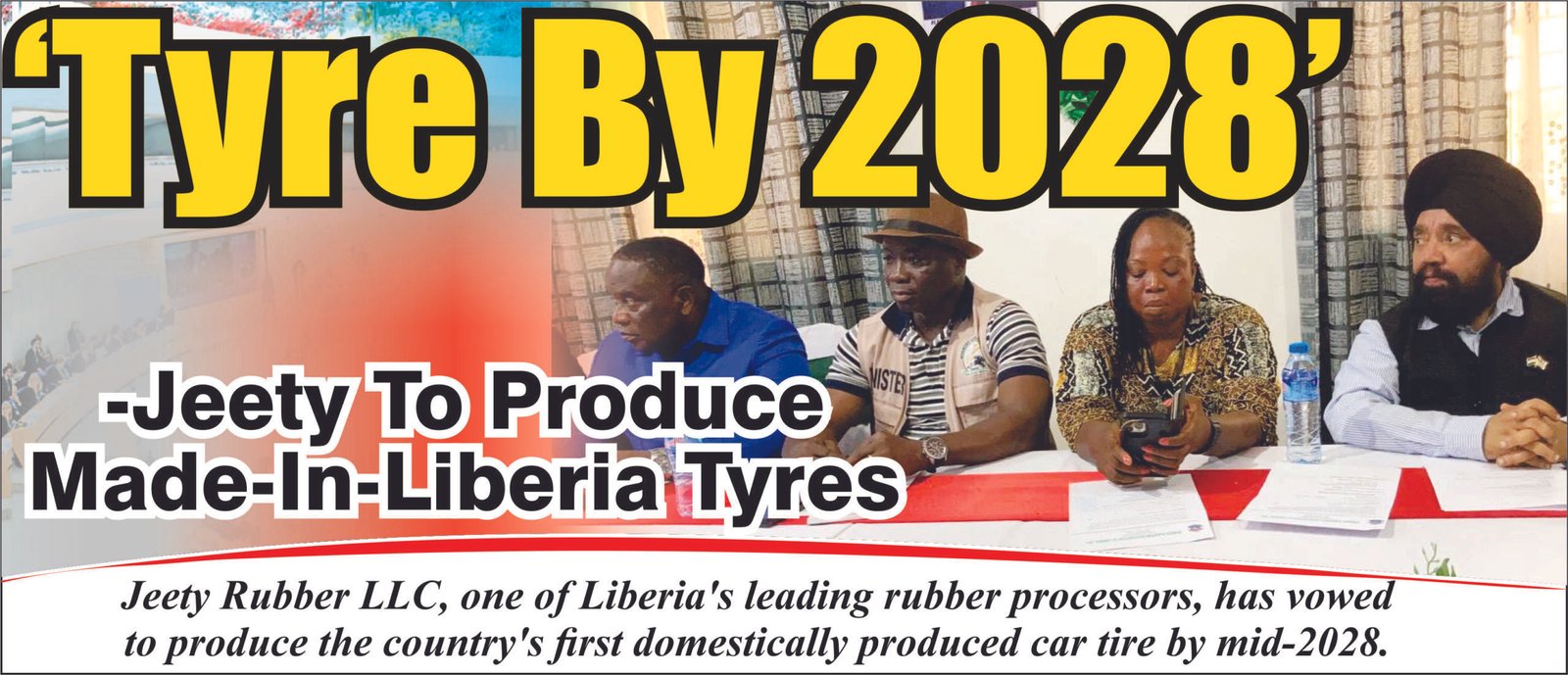
Jeety Rubber LLC, one of Liberia’s leading rubber processors, has vowed to produce the country’s first domestically produced car tire by mid-2028.
The company, owned by business tycoon Upjit Singh Sachdeva (alias Jeety), issued the challenge as it nears completion of its ongoing US$18 million second-phase expansion, which is expected to significantly boost processing capacity.
“By 2028, either June or July, Liberians can expect the first made-in-Liberia tire,” Mr. Jeety said during remarks at a recognition ceremony attended by the Minister of Agriculture on March 25. “But if I do not have the raw material, I will not be able to run the factory or carry out the expansion needed to produce tires.”
“We have completed feasibility studies to manufacture truck tires, passenger vehicle tires, motorcycle tires, and tricycle tires,” he added.
The plant upgrade, currently about 60 percent complete, will introduce a new processing line capable of handling eight tons of rubber per hour-nearly doubling the company’s existing five-ton-per-hour capacity.
Once operational by June or July 2026, the facility will require approximately 550 tonnes of wet rubber daily, up from its current demand of 200 to 250 tonnes.
Mr. Jeety warned that failure to secure sufficient raw materials could derail the company’s tire manufacturing ambitions before they begin.
“If I do not have the raw material, I will not be able to run the factory and expand to make tires,” he said. “I will not invest an additional US$35 to US$40 million if there is not enough rubber.”
Central to his appeal is a call for the government to ban or restrict the export of unprocessed rubber, locally known as “cuplumps.”
According to Jeety, exporting raw rubber deprives Liberia of manufacturing jobs and economic value, effectively shifting employment opportunities to competing countries.
“When you export unprocessed rubber, you are exporting jobs. You are giving jobs to people in Malaysia,” he said. “If you want to create jobs for the youth, you need to stop the export of raw materials.”
He also urged the government to strengthen pricing mechanisms to ensure rubber farmers earn better incomes, arguing that improved farm-gate prices would boost rural development and increase supply.
“If farmers receive better prices, they can develop, feed their families, and send their children to better schools. I am Indian by passport, Liberian by heart. I want to do something unique-to produce the first tire in this country,” he noted.
Despite acknowledging the challenges ahead, Jeety expressed confidence in achieving the milestone.
He was recently honored by the Rubber Planters Association of Liberia (RPAL) and the Rubber Development Fund Incorporated (RDFI) for Jeety Rubber’s support to the country’s rubber sector.
In presenting the award, the associations described Jeety Rubber as a reliable partner to the Liberian rubber industry, commending the company for its continued support to smallholder farmers, particularly at a time when other buyers had suspended purchases in protest of the government’s introduction of a regulated farm-gate price.