


By G. Watson Richards
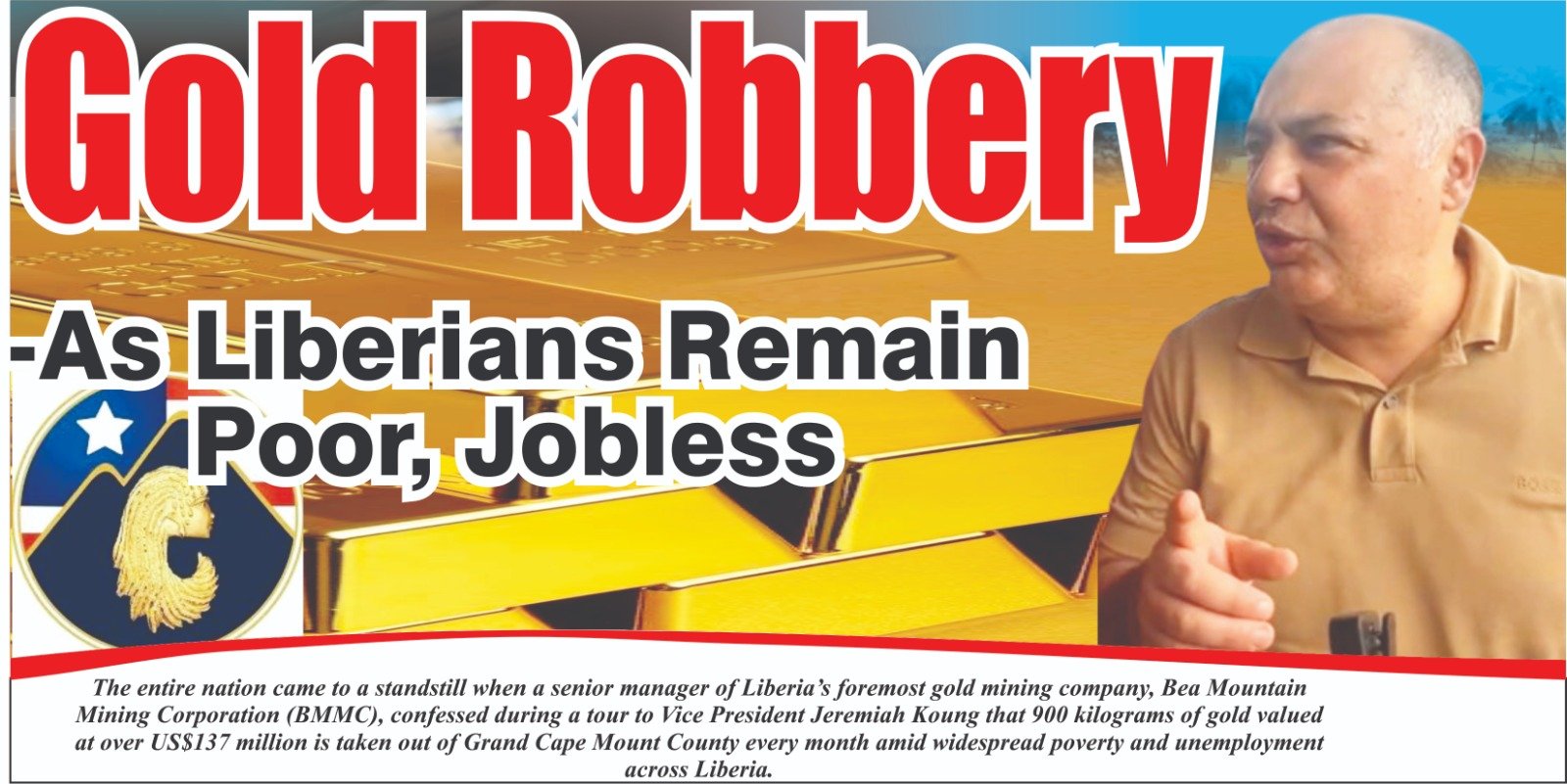
The entire nation came to a standstill when a senior manager of Liberia’s foremost gold mining company, Bea Mountain Mining Corporation (BMMC), confessed to Vice President Jeremiah Kpan Koung that 900 kilograms of gold valued at over US$137 million is taken out of Grand Cape Mount County every month amid widespread poverty and unemployment across Liberia.
The revelation, made during an official visit to BMMC’s operations in Grand Cape Mount County, has intensified national scrutiny over Liberia’s extractive sector, as citizens, officials, and advocacy groups question how such vast wealth continues to leave the country while mining communities remain underdeveloped.
During the tour, Vice President Koung repeatedly asked company officials about monthly gold production before a senior manager responded on live broadcast, stating, “We get 900 kilos of gold from here every month.”
The disclosure, confirmed by the company itself, translates to an estimated US$137 million monthly and more than US$1.6 billion annually based on prevailing global gold prices.
Despite this scale of extraction, residents of Kinjor, Darblo Clan, and surrounding communities say their living conditions have not improved. Many still lack access to clean water, healthcare, electricity, and proper roads, while unemployment remains widespread among young people. Locals describe a widening gap between the wealth generated from the land and the realities on the ground.
Concerns over transparency have also deepened following claims that no Liberians are assigned to the gold storage facilities where BMMC keeps extracted gold prior to export.
Some senior officials of this government including Lawmakers and Civil society actors have further questioned why gold produced in Liberia is reportedly weighed abroad rather than domestically, rising issues about oversight and accountability within the value chain.
Anderson Miamen, the Executive Director of the Center for Transparency and Accountability (CENTAL), a leading Civil Society Organization in Liberia alleged that Liberian leaders have been gifting the country resources to foreigners for little or nothing, while the ordinary citizens received peanuts.
“For little or nothing, our leaders have been gifting these foreign companies our naturel resources. All the people get in return are peanuts, pollution of their waters and livelihood sources, award of their jobs to foreigners, and compromised monitoring by oversight bodies.
I have not seen a country whose leaders collude with foreign and even local businesses to defraud their own people, at the scale seen in Liberia,” he added.
Nimba County Senator Nya D. Twayen has raised concerns about how Liberia’s gold is handled before export, revealing that it is weighed abroad instead of in the country where it is mined.
Twayen questioned why gold produced by major mining companies is not measured locally prior to shipment.
He pointed specifically to the operations of Bea Mountain Mining Corporation, one of the country’s leading gold producers.
The senator said the practice raises serious questions about transparency and whether Liberia is getting the full value of its resources.
According to him, weighing gold outside the country creates room for doubt about accuracy and weakens government oversight.
He maintained that carrying out the process within Liberia would improve accountability and give authorities better control over the sector.
“As the lead campaigner on concession compliance at the Senate, I said it before, why can’t we weigh the gold from Bea Mountain in Liberia rather than in London? The answer I got was nonsense, and I don’t wish to bore you with me telling,” he added.
The Vice President of the National Oil Company of Liberia (NOCAL), Boakai Jaleiba noted that Bea Mountain’s Amended Agreement is illegal, while accusing the Legislators of being in bed with BMMC.
“To start, the Bea Mountain amended agreement is flat out illegal. The Senate rammed it through on August 30, 2023. Then, on the 31st, it was shoved to the House of Representatives. The House had already shut its session on September 4th. And yet, signatures were mysteriously scraped together between the 5th and 6th of September. Let that sink in. The entire Bea Mountain agreement is a legal carcass,” he asserted.
Continuing, he noted: “As an opinion leader in my county, I’m not just going to whine from the sidelines. I’m joining forces with every likeminded fighter we’ve got. Together, we will legally challenge the agreement, first. Then, we go for the economics. And to those legislators currently curled up in bed with Bea Mountain, your time is coming. Once this deal is declared legally dead, and it will be, we will come for you. Individually. Collectively. And we will have a discussion you won’t forget.”
Environmental and human rights concerns have added to the growing tensions. Residents in affected areas report repeated pollution incidents linked to mining operations, with one local leader warning of the consequences. “If we don’t move, we will die,” said village Chief Mustapha Pabai, citing contamination of water sources relied upon for drinking and fishing.
Independent assessments and civil society groups, including the Resource Equity Alliance of Liberia (REAL), argue that the situation reflects systemic governance failures.
REAL maintained that flawed concession agreements have enabled foreign companies and elites to benefit disproportionately, while ordinary Liberians remain excluded from the country’s mineral wealth.
Citizens of Grand Cape Mount County have repeatedly called for the renegotiation of BMMC’s Mineral Development Agreement, citing concerns over labor practices, lack of training opportunities, weak community development contributions, and environmental degradation. “The people of Cape Mount County deserve a fair and equitable share of the benefits from their natural resources,” said spokesperson Thompson Mahatma Kiatamba. “BMMC’s disregard for local communities and exploitation of our people must end.”
Citizens Reactions
Public frustration continues to grow, with citizens expressing anger over what they describe as entrenched corruption and inequality.
“This is not a curse, its pure wickedness and greed,” said Ben Suomie, reflecting a wider sentiment that Liberia’s resource wealth is not benefiting its people. Others have called for protests, stronger government action, and the nationalization of resources.
Citizens Reactions on social media
“We are busy with CDC and UP business while other people keep taking our minerals,” Franklin Howard noted.
Roland Phie Harris Jr., noted: “Didn’t you guys see it in the agreement upon signing it or ya’ll were just after ya’ll pockets as usual?”
Syl Dixon could not also hold back his sentiments: “Foreign Powers have long been extracting our mineral resources, and the reality is we as Liberians know very well who those are involved. Stop those politicians who purchase trucks and rent them to foreign companies and nationalize our resources,” he lamented.
As pressure mounts from citizens, local leaders, and policymakers, the situation in Grand Cape Mount County has become a focal point in the national debate over resource governance.
At the heart of the issue remains a persistent question: how can billions of dollars in gold are extracted annually while the communities at the source continue to live in poverty without basic social services?