


By G. Watson Richards
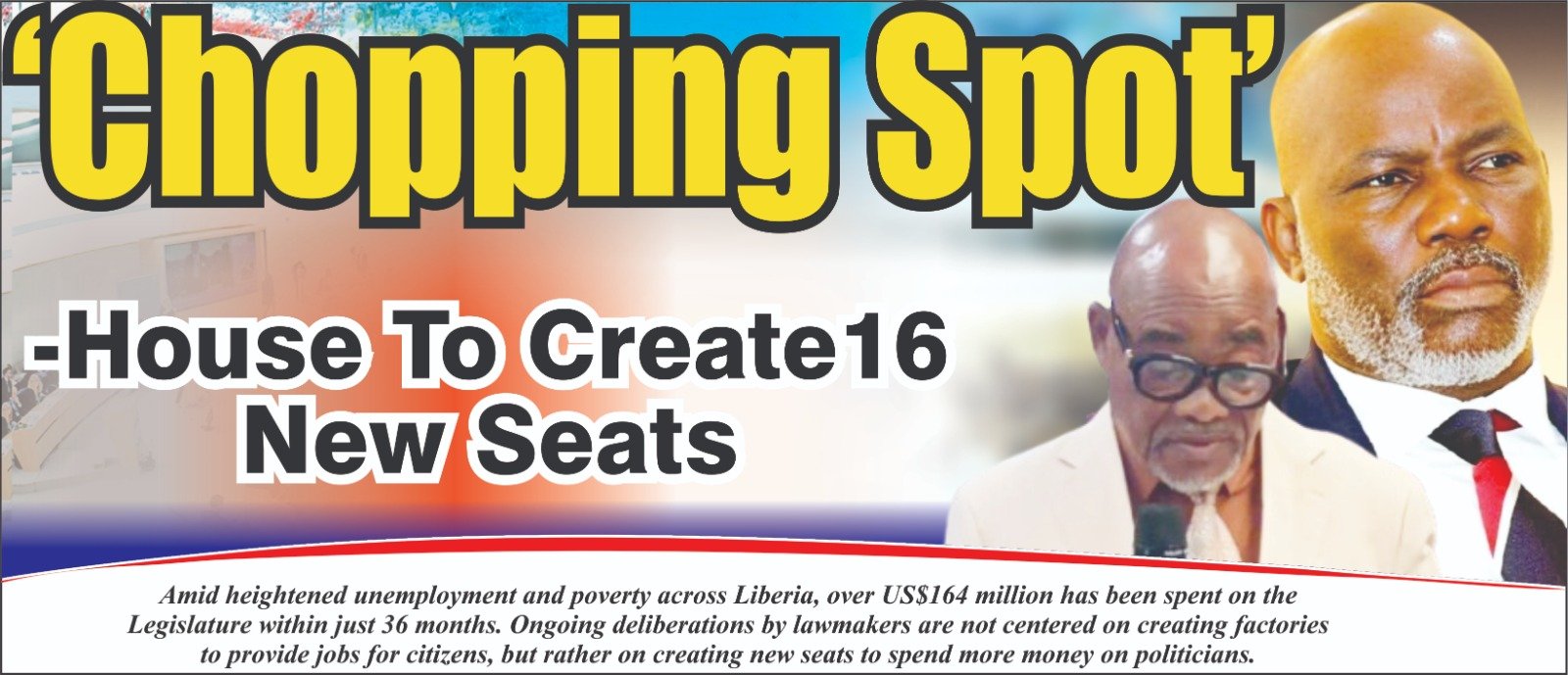
Amid heightened unemployment and poverty across Liberia, over US$164 million has been spent on the Legislature within just 36 months. Ongoing deliberations by lawmakers are not centered on creating factories to provide jobs for citizens, but rather on creating new seats to spend more money on politicians.
A special committee report has recommended to plenary the creation of 16 additional elected seats based on a revised population threshold. If approved, as currently anticipated-Liberia’s House of Representatives would increase from 73 to 89 members.
Proposed Seat Distribution by County
The additional seats are distributed as follows:
Montserrado — 17 to 20 (3 new seats)
Nimba — 9 to 11 (2 new seats)
Bong — 7 to 9 (2 new seats)
Lofa — 5 to 7 (2 new seats)
Margibi — 5 to 6 (1 new seat)
Grand Bassa — 5 to 6 (1 new seat)
Grand Gedeh — 3 to 4 (1 new seat)
Grand Cape Mount — 3 to 4 (1 new seat)
Maryland — 3 to 4 (1 new seat)
Sinoe — 3 to 4 (1 new seat)
Bomi — 3 to 4 (1 new seat)
River Gee — 3 to 3 (no new seat)
Gbarpolu — 3 to 3 (no new seat)
Grand Kru — 2 to 2 (no new seat)
River Cess — 2 to 2 (no new seat)
Legislative Spending Under Scrutiny
This new proposal from the special committee has intensified public concerns over government spending priorities, as the 55th National Legislature reportedly consumed over US$159 million in budgetary allocations between fiscal years 2024 and 2026.
In contrast, only about US$5.2 million was allocated to fourteen major referral hospitals serving a national population of approximately 3.33 million.
A review of budget records shows growing allocations for legislative leadership offices, including the Pro Tempore, Speaker, Deputy Speaker, and both chambers of the Legislature-while essential public services remain underfunded.
Breakdown of Legislative Expenditure (FY2024–FY2026)
FY2024: US$63,652,102
FY2025: US$44,344,708
FY2026: US$51,710,390
Total: US$159,707,200
Public Health Funding Constraints
During the same period, the fourteen referral hospitals collectively received just US$5.2 million, despite serving as key facilities for emergency care, maternal health, surgery, diagnostics, and infectious disease response.
Health workers across several counties continue to report persistent challenges, including:
Shortages of essential medicine
Malfunctioning diagnostic equipment
Irregular salary payments
Insufficient fuel for generators
Overcrowded wards
Hospital administrators maintain that they are still expected to deliver services comparable to better-resourced institutions in the capital, despite chronic shortages.
Budget Imbalance Concerns
Analysis of the national budget indicates that the combined allocations for referral hospitals represent only a fraction of what top legislative offices consume over the same period. Civil society groups argue that this reflects a widening imbalance in national priorities.
“Legislators cannot continue to justify these levels of spending while rural hospitals are dying,” one governance advocate stated. “This is not just waste-it is a direct threat to public welfare.”
Growing Public Frustration
As economic hardship deepens and basic services deteriorate, public dissatisfaction is increasing. Radio discussions, community engagements, and protests have amplified calls for a shift in national spending toward health, education, and agriculture.
Despite this pressure, there has been no clear indication that lawmakers intend to reduce their own budgetary allocations.
For many citizens, the figures present a stark contrast: expanding legislative costs on one side, and struggling healthcare systems on the other.
This is a developing story. More details to follow.