


By G. Watson Richards
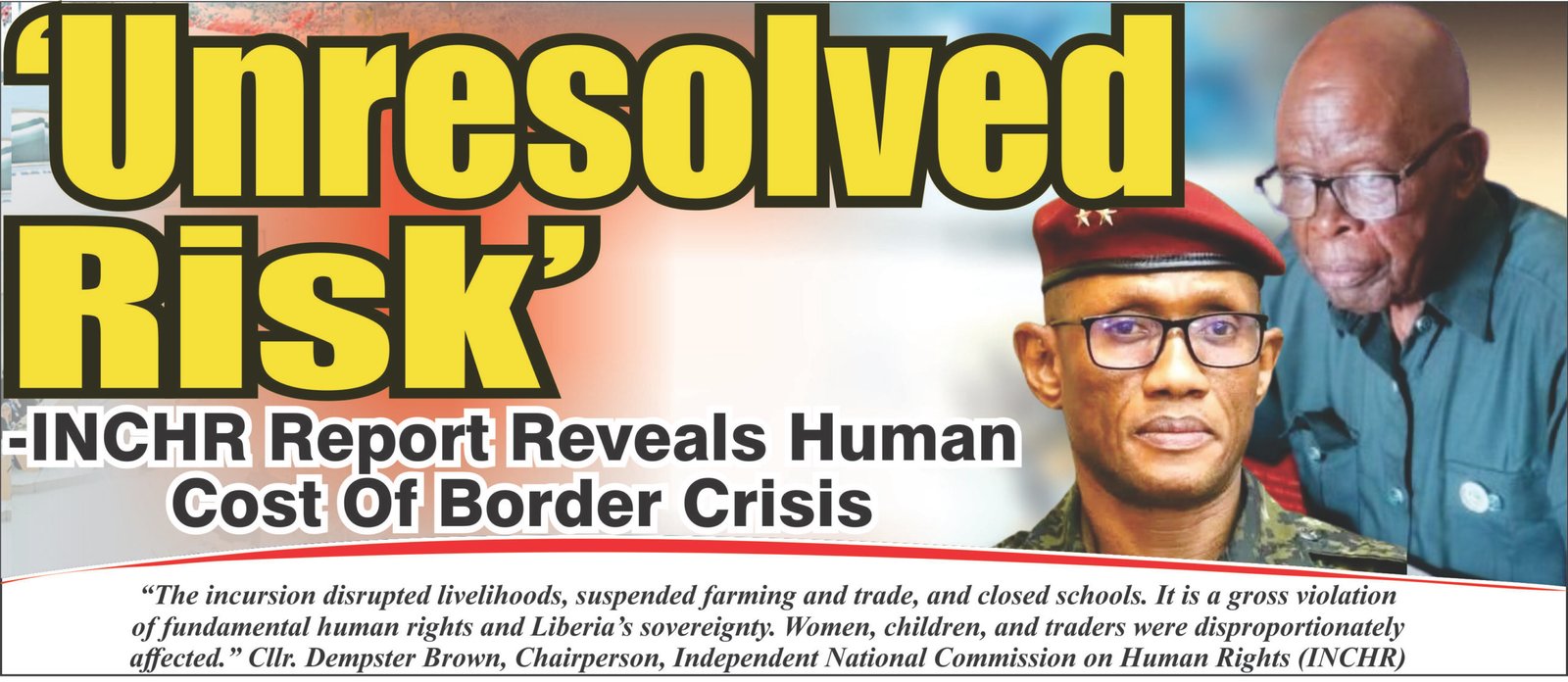
“The incursion disrupted livelihoods, suspended farming and trade, and closed schools. It is a gross violation of fundamental human rights and Liberia’s sovereignty. Women, children, and traders were disproportionately affected.” Cllr. Dempster Brown, Chairperson, Independent National Commission on Human Rights (INCHR)
In a statement addressing rising tensions along the Liberia-Guinea frontier, the commission said: “Guinea’s intentions regarding the reported incursion into Liberian territory remain unclear,” a remark that reflects caution while keeping space open for diplomatic engagement between the two countries.
The INHRC urged both governments to avoid inflammatory rhetoric and instead prioritize coordinated security and humanitarian measures to protect civilians living in border communities.
It also recommended strengthened surveillance along key crossing points and improved logistical support for security forces operating in remote areas. Among the practical measures proposed were the installations of solar-powered lighting systems to enhance night-time visibility and deter unauthorized movement across poorly monitored stretches of the border.
Regional diplomacy and unresolved tensions
Although the immediate situation appears to have stabilized compared to earlier moments of heightened tension, observers warn that the underlying issues remain unresolved. Border disputes across the Mano River region have historically been linked to unclear demarcation lines, competing local land claims, and limited enforcement capacity in remote areas.
The INHRC emphasized that the current situation should be viewed within a broader regional framework, noting that Liberia, Guinea, and Sierra Leone have engaged in ongoing discussions aimed at improving border delimitation and conflict prevention through diplomatic channels.
According to Cllr. Brown, such dialogue mechanisms are critical to preventing isolated incidents from escalating into recurring diplomatic crises. Weak border management structures, they caution, risk turning local disputes into national political flashpoints.
The commission’s remarks also highlighted the human impact of border instability, pointing to disruptions in schooling, displacement of families, and growing insecurity in affected communities. It warned that without consistent protection of livelihoods, territorial control risks becoming purely symbolic.
“This situation underscores the intersection between human rights protection and state policy,” the INHRC noted in its broader assessment, stressing that border governance must ensure both security and continuity of daily life for residents.
The commission added that findings from its field assessments have been submitted to relevant regional and international bodies for further review, signaling that the issue has moved beyond local administrative handling.
Call for coordinated response
The INHRC concluded that sustainable stability will require coordinated action between security agencies, diplomatic actors, and humanitarian institutions. It warned that fragmented responses could allow tensions to resurface.
As diplomatic consultations continue, the commission’s appeal underscores a broader challenge in West Africa: balancing territorial sovereignty with the lived realities of communities whose livelihoods depend on porous and often contested borders.