
By Archie Boan
Liberia’s decentralization program is struggling under a severe lack of funding, according to a new report released by NAYMOTE Partners for Democratic Development.
The report, titled “Decentralization from Promise to Practice in Contemporary Liberia: Assessing the Functionality of County Development Agendas and County Councils in Bong, Margibi, and Grand Bassa Counties,” was launched Monday at the Governance Commission Conference Hall in Monrovia.
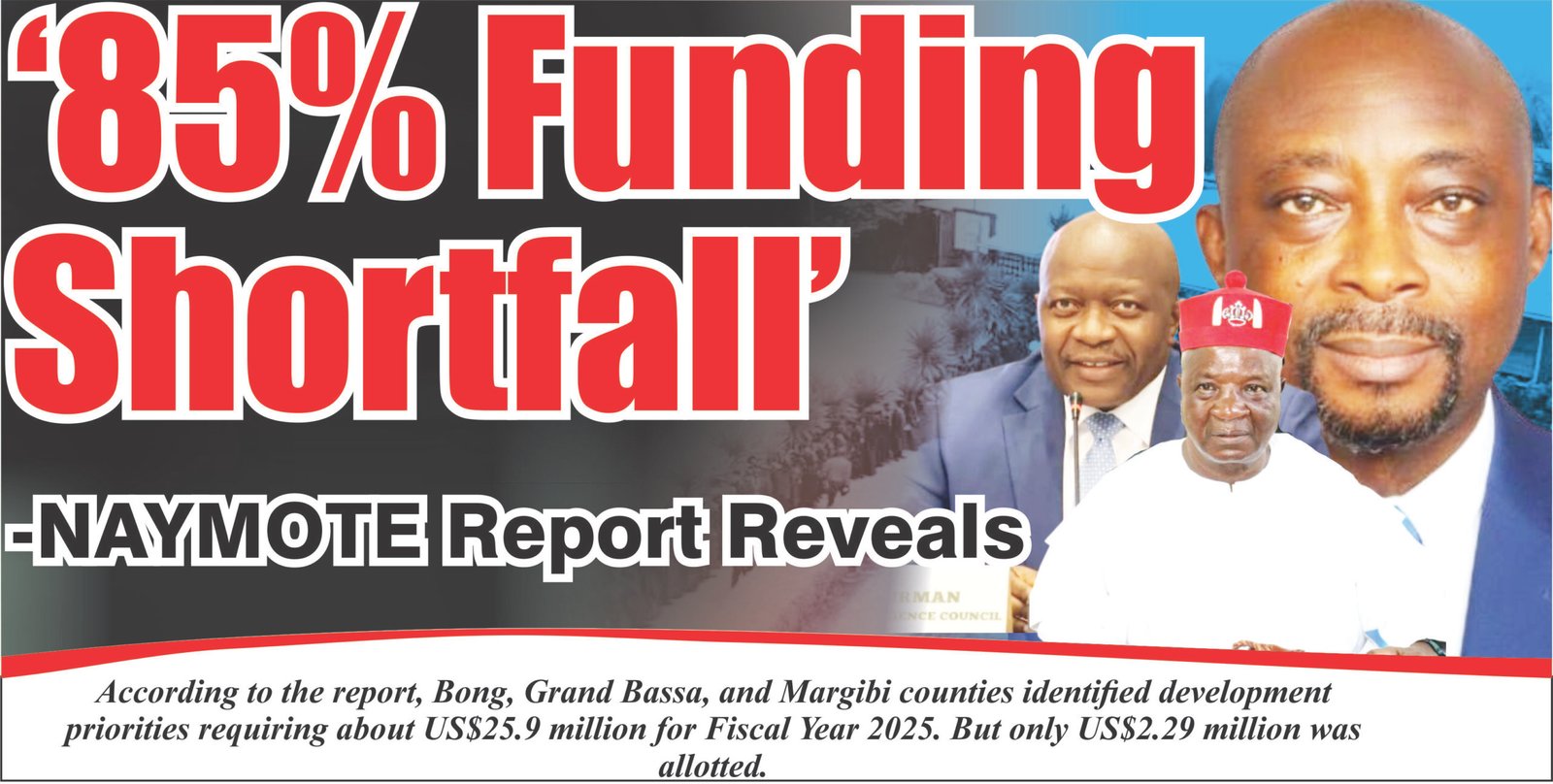
According to the report, Bong, Grand Bassa, and Margibi counties identified development priorities requiring about US$25.9 million for Fiscal Year 2025.
However, government allocations through the County Development Fund (CDF), Social Development Fund (SDF), and County Service Centers (CSC) totaled only US$2.29 million, leaving a substantial funding shortfall.
NAYMOTE’s assessment found that despite government commitments to support county-level development, available resources remain far below what is needed to implement projects identified by local communities.
Speaking at the launch, Acting Governance Commission Chairman Alaric K. Tokpah described decentralization as one of Liberia’s most important governance reforms.
He said the process remains critical to improving service delivery, strengthening democracy, and increasing citizens’ participation in local decision-making.
Tokpah noted that the passage of the Local Government Act of 2018 was intended to shift decision-making authority closer to local communities after decades of centralized governance.
The report acknowledges progress, including the establishment of County Service Centers and other local governance structures. However, it points to several challenges that continue to affect implementation.
According to the NAYMOTE report, key obstacles include inadequate funding, weak accountability systems, procurement delays, political interference, and uncertainty over the roles and responsibilities of local governance institutions.
Researchers found that while more than 80 percent of county projects align with County Development Agenda priorities, many have stalled because funding is unavailable.
The report also found gaps in public understanding of local governance structures. Although most respondents were aware of County Development Steering Committees, many said they did not fully understand their responsibilities.
NAYMOTE Executive Director Eddie D. Jarwolo said the findings reveal a widening gap between national commitments and implementation at the local level.
He warned that unless reforms are introduced, decentralization risks falling short of its intended purpose of bringing development and decision-making closer to citizens.
The report projects that if current funding trends continue, the financing deficit across the three counties could reach nearly US$179.4 million by 2029.
To address the situation, NAYMOTE recommends a needs-based funding model, improved procurement transparency, stronger local revenue systems, enhanced county-level capacity, and clearer mandates for local governance institutions.
The report also calls for greater citizen participation and stronger accountability measures to ensure communities play a meaningful role in determining local development priorities.